The Alchemy of Chiaroscuro: Defining the Dutch Golden Age
To step into a gallery of the seventeenth century is to witness a revolution written in light and shadow. During the Dutch Golden Age, the canvas became a stage where the interplay of chiaroscuro—the dramatic contrast between dark and light—transcended mere technique to become a profound language of emotion and divinity. Unlike the grand, often idealized allegories of the Italian Renaissance, the Dutch masters sought a more visceral truth. They utilized light not just to illuminate subjects, but to sculpt them out of the surrounding gloom, creating a sense of three-dimensional presence that feels almost tangible to the modern viewer.
This era was defined by an unparalleled mastery of tonal range. Painters learned to manipulate the way light hits a surface, understanding how it glints off a silver goblet or softens upon the folds of a silk sleeve. This alchemy allowed artists to direct the viewer's eye with surgical precision, guiding us through complex compositions toward the emotional heart of the work. It was a period where shadow was never merely an absence of light, but a rich, velvety substance that provided depth, mystery, and a sense of the infinite.
Capturing the Intimate: Genre Painting and Psychological Depth
Beyond the grand landscapes and portraits, the true soul of the Dutch Golden Age resided in its genre paintings—scenes of everyday life captured with startling intimacy. In works such as Gerard ter Borch’s Le Duo, we find a quiet, domestic world where a singer and lutenist are rendered with meticulous realism. Here, the light does not roar; it whispers. It settles gently upon the instruments and the faces of the musicians, revealing a psychological depth that invites the observer to eavesdrop on a private moment of beauty.
These paintings functioned as mirrors to the Dutch soul, celebrating the dignity of the mundane. Whether depicting a letter being read by candlelight or a quiet moment of reflection in a sun-drenched parlor, the artists utilized light to imbue ordinary objects with extraordinary significance. The subtle gradations of shadow allowed for a nuanced portrayal of human emotion—a fleeting glance, a furrowed brow, or a momentary smile—making these works timeless explorations of the human condition. Through this lens, the domestic sphere was elevated to the level of high art, proving that the most profound truths are often found in the simplest of settings.
Maritime Majesty: Light, Atmosphere, and the Sea
As a nation defined by its relationship with the water, the Dutch masters also turned their gaze toward the horizon, mastering the depiction of the sea and the atmospheric complexities of the maritime world. The works of artists like Abraham Storck exemplify this fascination, particularly in scenes such as Dutch Whalers near Spitsbergen. In these compositions, light is no longer a localized spotlight but an expansive, atmospheric force that permeates the very air.
The challenge for the marine painter was to capture the translucent quality of ocean spray, the heavy weight of storm clouds, and the way sunlight breaks through a turbulent sky to illuminate a distant vessel. This required a sophisticated understanding of color temperature and atmospheric perspective—the ability to use receding tones of blue and grey to create an immense sense of distance. These maritime masterpieces do more than document naval history; they evoke the sheer scale of the natural world, capturing the tension between the fragile human endeavor and the indomitable power of the sea.
The Master’s Touch: Techniques of Realism and Texture
The breathtaking realism of this era was not merely a product of vision, but of rigorous technical discipline. The Dutch masters were masters of texture, employing various layers of oil paint to mimic the tactile world. They understood that to represent the sheen of satin, the roughness of burlap, or the cold hardness of pewter, one had to manipulate the physical properties of the medium itself. This often involved impasto—the thick application of paint—to catch actual light on the canvas surface, creating a literal relief that mimics the subject's texture.
The use of glazes—thin, transparent layers of oil—allowed artists to build up deep, luminous colors that seem to glow from within. This layering process is what gives Dutch masterpieces their characteristic "inner light." By carefully controlling the drying time and the translucency of each layer, they could achieve a tonal complexity that a single layer of paint could never sustain. It is this dedication to the chemistry of art—the careful selection of pigments and oils—that ensures these works retain their brilliance centuries after the final brushstroke was laid.
Legacy in Every Stroke: Preserving the Golden Age for Modern Interiors
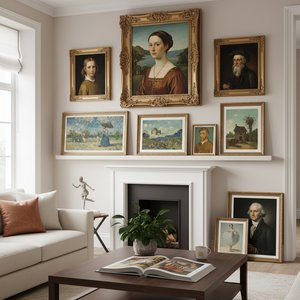
Today, the influence of the Dutch Golden Age continues to resonate within the contemporary aesthetic. The dramatic tension of chiaroscuro and the quiet elegance of genre scenes offer a sophisticated counterpoint to the minimalism of modern design. Bringing these works into a modern home is not merely an act of decoration, but an act of preservation—a way to anchor a space with historical weight and emotional resonance.
At OriginalUniqueArt.com, we honor this enduring legacy by bridging the gap between the Old Masters and the modern collector. Our mission is to make fine art accessible through authentic, hand-painted reproductions that capture the true essence of these historical triumphs. Each piece is meticulously crafted by artists trained in the academic traditions, ensuring that the visible brushstrokes, the depth of tone, and the tactile texture of the original era are preserved on 100% cotton canvas. Whether you seek a large-scale maritime scene to anchor a room or a delicate portrait to evoke intimacy, our collections allow you to inhabit the light and shadow of history.