The Alchemical Revolution: The Advent of Oil Glazing
To step into the world of Early Netherlandish painting is to witness a moment where chemistry and artistry converged to redefine the limits of human vision. Before the fifteenth century, the tempera tradition—pigments bound with egg yolk—offered a beautiful but relatively opaque and rapid-drying medium. However, a profound shift occurred in the workshops of the Low Countries, often attributed to the legendary Jan van Eyck. This was not merely a change in preference, but an alchemical revolution. The mastery of oil as a binder allowed for a slow-drying, translucent medium that could be applied in successive, gossamer-thin layers known as glazes.
These glazes acted like tiny prisms, catching the light and refracting it through multiple depths of color. When light penetrates these transparent layers and reflects off the white gesso ground beneath, it creates a luminosity that seems to emanate from within the painting itself. This technique allowed Northern masters to achieve a depth of tone and a richness of saturation previously unimaginable. The transition from the matte finish of tempera to the jewel-like brilliance of oil changed the very texture of reality on canvas, inviting viewers to look not just at the surface, but through it.
As these layers built up, artists could manipulate light and shadow with unprecedented subtlety. This evolution in technique provided the foundation for the Northern Renaissance's most defining characteristic: a hyper-realistic depiction of the physical world that felt both tangibly present and spiritually transcendent.
Microscopic Devotion: Symbolism Hidden in Plain Sight
In the works of the Flemish Primitives, nothing is ever merely decorative. Every fold of heavy velvet, every glint of light on a brass ewer, and every stray petal on a floor serves a higher narrative purpose. This era of painting practiced what might be called microscopic devotion—a belief that the divine could be found in the smallest, most mundane details of earthly existence. To the untrained eye, a painting might appear to be a simple domestic scene or a portrait of a wealthy patron; however, for the contemporary viewer, every object was a vessel for complex theological meaning.
Consider the way a single drop of water or a crystal carafe is rendered with such precision that it commands attention. Such elements often functioned as symbols of purity or the clarity of faith. A lit candle might represent the presence of the Holy Spirit, while certain flowers could signify the sorrows of the Virgin Mary. This layering of meaning required an intimate literacy in religious iconography, turning the act of viewing art into a meditative process of decoding and discovery.
This profound attention to detail created a dual reality: a world that was simultaneously hyper-realistic and deeply symbolic. The artists did not just paint objects; they painted the spiritual significance embedded within those objects. By mastering the ability to render texture so convincingly, they forced the viewer to linger on the details, and in lingering, to encounter the sacred hidden within the secular.
Jan van Eyck and the Mastery of Light and Texture
No discussion of this era is complete without centering our gaze upon Jan van Eyck, a figure whose name remains synonymous with the pinnacle of Netherlandish achievement. His work, most notably masterpieces like The Madonna with Canon van der Emden, demonstrates an almost supernatural command over the behavior of light. Van Eyck possessed an uncanny ability to differentiate between textures—the cold hardness of polished metal, the soft warmth of human skin, and the heavy, light-absorbing weight of brocade.
In his hands, light becomes a character in its own right. He understood how light interacts with different surfaces: how it glints sharply off a gemstone, how it softens as it hits velvet, and how it creates deep, velvety shadows in the recesses of a heavy cloak. This was achieved through his meticulous application of those aforementioned oil glazes, allowing him to build up highlights that felt physically raised from the surface.
The sheer technical virtuosity required to execute such works is staggering. Each brushstroke was calculated to contribute to a cohesive atmosphere of profound stillness and intense presence. Through his mastery, Van Eyck did more than replicate the world; he elevated it, creating a visual language where the tactile reality of the material world served as a bridge to the eternal.
The Northern Renaissance Aesthetic: Realism Beyond the Surface
While the Italian Renaissance was often preoccupied with the mathematical perfection of perspective and the idealized proportions of the human form, the Northern Renaissance pursued a different kind of truth. The aesthetic of the North was rooted in an uncompromising realism—a commitment to capturing the world exactly as it appeared to the senses. This was not a shallow imitation, but a deep, observational realism that sought to honor the complexity of nature.
This approach led to a fascination with the "microcosm." Northern painters found as much beauty in the intricate veins of a leaf or the wrinkles on an elderly man's face as they did in grand architectural vistas. There was no attempt to sanitize or idealize; instead, there was a celebration of the particular. This focus on the specific and the individual gave their portraits a psychological depth that remains hauntingly modern even centuries later.
The result was an art form that felt incredibly intimate. By bringing the viewer into close proximity with the textures and details of life, these artists created a sense of shared space. The realism of the Northern Renaissance was not just about visual accuracy; it was about creating a visceral connection between the observer and the observed, making the distant past feel vibrantly, undeniably alive.
Preserving the Legacy: Bringing Netherlandish Grandeur to Modern Interiors
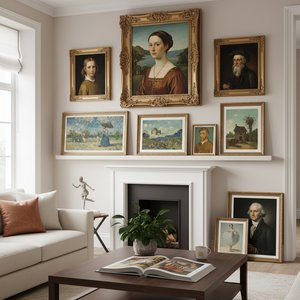
The enduring power of Early Netherlandish painting lies in its ability to command attention through sheer, quiet intensity. In a modern world often characterized by rapid movement and digital abstraction, the stillness and profound detail of these Old Masters offer a sanctuary of contemplation. The luminous depths and rich textures of this era possess a timeless quality that transcends the boundaries of history, making them remarkably compatible with contemporary sophisticated interiors.
Integrating such classical grandeur into a modern home requires an appreciation for the interplay between historical weight and modern lightness. Whether through a large-scale reproduction that serves as a focal point in a minimalist room or a meticulously detailed portrait that adds character to a study, these works bring a sense of permanence and intellectual depth to a space. The heavy textures and deep tonal ranges found in these paintings provide a necessary counterpoint to the clean lines and smooth surfaces of modern architecture.
At OriginalUniqueArt.com, we believe that such extraordinary beauty should be accessible to all who cherish it. Our mission is to preserve this human creativity by providing museum-quality, hand-painted reproductions that honor the original masters' techniques. Through our dedicated artists, we strive to recreate the very soul of the Northern Renaissance—the luminous glazes, the tactile brushstrokes, and the profound devotion to detail—ensuring that the magic of the Netherlandish masters continues to inspire and enchant generations to come.