Beyond Imitation: The Historical Evolution of Parody in Fine Art
 Paintings in Hospitals
Paintings in Hospitals is a UK charity using art to enhance wellbeing in health & community care settings since 1959. Explore our national collection featuring Bridget Riley, Antony Gormley & more! Art loans, workshops & an online shop.
Parody, often relegated to the realm of comedic mimicry, possesses a far richer and more complex history than commonly acknowledged. To dismiss it as mere imitation is to overlook its potent role as a critical lens through which artists have challenged authority, subverted expectations, and redefined aesthetic boundaries for centuries. The roots of parody extend deep into antiquity, not simply as lighthearted jest but as a sophisticated form of social commentary. Aristotle himself noted the early practitioners – Hegemon of Thasos, who subtly altered existing poems to create humorous effect, marking an initial disruption of established narratives. In ancient Greece, parodies weren’t confined to poetry; they were woven into theatrical performances and philosophical discourse, often employing satire to expose societal flaws. These “counter-songs,” as the Greek term *parodia* suggests, offered a parallel narrative, one that questioned the dominant ideology through playful distortion.
However, the evolution didn’t stop there. The Renaissance witnessed a flourishing of parody in literature and art, often employed to critique classical forms or rival artists. The 19th century saw its use as a means to dissect burgeoning social conventions, with artists subtly mocking the pretensions of high society. But it was arguably in the 20th century, with movements like Dadaism and Surrealism, that parody truly exploded into radical experimentation. Artists began not just to imitate *styles* but to deconstruct entire artistic systems, questioning the very nature of originality and representation. This shift laid the groundwork for contemporary approaches where parody isn’t simply about replicating a work but engaging in a complex dialogue with art history itself.
Appropriation vs. Parody: Defining the Nuances for Collectors
In art, appropriation is the use of pre-existing objects or images with little or no transformation applied to them. The use of appropriation has played a significant role in the history of the arts (literary, visual, musical and performing arts). In...
Understanding the subtle yet crucial distinction between appropriation and parody is paramount for any discerning collector. While both strategies involve utilizing pre-existing imagery or objects, their intent and execution differ significantly. Appropriation, in its purest form, involves taking something that already exists and recontextualizing it – often to explore themes of authorship, originality, or consumer culture. Marcel Duchamp’s readymades, for example, were groundbreaking acts of appropriation, elevating everyday objects to the status of art through sheer force of conceptual intent. However, they weren't necessarily parodies; their power lay in challenging traditional definitions of artistic creation.
Parody, conversely, *always* appropriates but does so with a specific aim: to comment on, critique, or mock its source material. It’s an imitative practice infused with irony, exaggeration, or satire. Consider the work of Francis Picabia – his Dadaist pieces weren't simply borrowing forms; they were actively dismantling them, questioning artistic conventions through playful distortion and mechanical aesthetics. Legally, this distinction is also significant. Copyright law recognizes parody as a “fair use” exception, acknowledging its transformative nature. Appropriation, without that critical element of commentary, is far more likely to face legal challenges. The key question for collectors isn’t simply *what* has been borrowed but *how* it's being used – does the new work add something novel, a fresh perspective, or a pointed critique?
Pop Surrealism & Satirical Subversion: A Contemporary Case Study
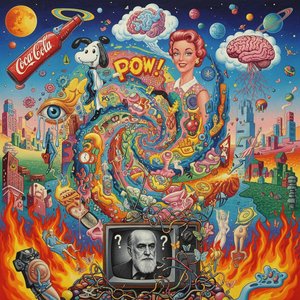 Pop Surrealism: A Collision of Culture, Dreams & the Subconscious in Post-War Art
Explore the captivating world of Pop Surrealism with OriginalUniqueArt. Discover key artists like George Condo & Robert Williams, investment potential, and the movement's cultural impact. Expert insights for collectors.
Emerging in the post-war era, Pop Surrealism represents a particularly compelling example of parody’s power within a defined artistic movement. This genre masterfully blended the accessibility and vibrant imagery of pop art with the dreamlike, often unsettling qualities of surrealism. Artists like George Condo and Robert Williams didn't simply replicate existing styles; they employed parody to subvert traditional notions of beauty, taste, and societal values. Their works frequently feature distorted figures, jarring juxtapositions, and ironic commentary on consumer culture, creating a visual language that is both captivating and deeply unsettling.
Condo’s paintings, for instance, can be seen as parodies of portraiture – exaggerating facial features, employing grotesque imagery, and challenging the idealized representations prevalent in art history. Williams similarly satirizes American iconography, questioning the promises of consumerism and exposing the underlying anxieties of contemporary life. The movement also draws heavily on the aesthetics of lowbrow art—comics, cartoons, and kitsch—further blurring the lines between high and low culture and inviting parodic interpretations. This isn’t merely shock value; it's a deliberate attempt to expose contradictions and absurdities, forcing viewers to confront uncomfortable truths about their own society.
Symbolism as Critique: Decoding Layers in Modern Parody Paintings
 The Art of Painting (detail) (8)
Discover Johannes Vermeer's 'The Art of Painting,' an allegorical masterpiece brimming with light & detail. Explore its composition, symbolism, and the artist’s unique style – a true Dutch Golden Age treasure.
Effective parody rarely operates on a purely surface level. While imitation is crucial, the most compelling works employ subtle yet powerful symbolism to enhance their critiques and engage viewers on a deeper intellectual plane. Artists frequently incorporate recurring motifs, hidden references, or altered iconography to add layers of meaning beyond the initial visual impact. Consider the use of color symbolism – employing traditionally optimistic hues in a dystopian setting to create ironic contrast, for example, or appropriating religious imagery to critique societal hypocrisy.
The power of these symbols lies in their ability to evoke associations and challenge preconceived notions. Even seemingly innocuous details can carry significant weight when viewed through the lens of parody. Johannes Vermeer’s *The Art of Painting* itself, as explored on OriginalUniqueArt, is rich with symbolism – a subtle allegory for the artistic process, employing light, perspective, and representation to convey deeper meanings about creativity and perception. Contemporary artists often build upon this tradition, utilizing symbolic language to create parodies that are both visually engaging and intellectually stimulating, rewarding careful observation and thoughtful interpretation.
The Digital Canvas: Technology’s Impact on Creation and Reception
The advent of digital tools has profoundly impacted the creation and dissemination of contemporary parody paintings. Software allows artists to seamlessly manipulate images, create collages, and experiment with different styles – dramatically facilitating the process of appropriation and reinterpretation central to this artistic practice. The ease of sharing artwork online through social media platforms also plays a crucial role in its reception, allowing for rapid circulation and immediate engagement with audiences worldwide.
Memes, for example, represent a contemporary form of visual parody that relies heavily on digital technology and viral spread. Artists can now create parodies that respond directly to current events or trending topics, fostering an immediacy previously unimaginable. However, this accessibility also raises complex questions about originality and authorship. The ease of copying and remixing images necessitates a critical examination of intellectual property rights and the role of the artist in the digital age. Furthermore, digital tools allow for entirely new forms of parody – such as glitch art or AI-generated imagery – that push the boundaries of traditional artistic expression.
Investing in Irony: Market Trends and Collector Considerations
The market for contemporary parody paintings is evolving, presenting unique opportunities for discerning collectors. While not always categorized as “blue-chip” investments, works by established artists within this niche can hold significant value. The demand for art that challenges conventions, provokes thought, and offers fresh perspectives continues to grow, particularly among those interested in Pop Surrealism or pieces with strong social commentary. However, assessing the investment potential requires careful consideration of several factors: the artist’s reputation, the originality of the work, its historical context, and its overall aesthetic quality.
Works that demonstrate technical skill, intellectual depth, and a unique artistic voice are more likely to appreciate in value over time. Collectors should also be aware of copyright issues and ensure the authenticity of the artwork. Platforms like OriginalUniqueArt, offer access to a vast library of contemporary art, making it easier for collectors to discover emerging artists and acquire high-quality reproductions at accessible price points. Ultimately, investing in parody paintings is about more than just financial gain; it’s about supporting artists who are pushing boundaries, challenging norms, and engaging in meaningful dialogues with the world around us.