Early Life & Artistic Beginnings: A Journey from Ukraine to St. Petersburg
 Wikipedia: Arkhip Kuindzhi
Arkhip Ivanovich Kuindzhi (Russian: Архип Иванович Куинджи [ɐrˈxʲip kʊˈindʐɨ]; Ukrainian: Архи́п Іва́нович Куї́нджі [ɑrˈxɪp kʊˈindʐɨ]; Greek: Αρχίπ Ιβάνοβιτς Κουίντζι; 27 January [O.S. 15 January] 1841 – 24 July [O.S. 11 July] 1910) was
The story of Arkhip Ivanovich Kuindzhi is one steeped in the romanticism he so powerfully conveyed on canvas, a narrative beginning not in grand academies but amidst the humble landscapes of Southern Ukraine. Born near Mariupol in 1842 – though the precise date remains shrouded in some mystery – his early life was marked by hardship and self-reliance. The son of a Pontic Greek shoemaker, Kuindzhi’s childhood was abruptly altered by the loss of both parents at a young age, forcing him to navigate a world of itinerant labor: church construction, grazing livestock, even assisting a corn merchant. These formative experiences, however, weren't devoid of artistic spark; a local Greek teacher fostered his nascent talent for drawing, igniting a passion that would ultimately define his life’s work.
A brief apprenticeship with Ivan Aivazovsky in Feodosia proved less instructive than inspirational. While not directly mentored by the renowned seascape painter, Kuindzhi absorbed the elemental power of light and form that characterized Aivazovsky's work – a foundational influence he would later synthesize into his own unique style. The years spent as a retoucher in a Taganrog photography studio were equally crucial, honing his observational skills and providing an understanding of tonal values and composition. This practical training, coupled with an unwavering determination, propelled him towards St. Petersburg in the 1860s, a city that would become the crucible for his artistic evolution.
The Dramatic Use of Light: Kuindzhi's Signature Style and Techniques
 Arkhip Ivanovich Kuindzhi
Arkhip Kuindzhi (1842-1910) was a Russian landscape painter renowned for his dramatic use of light and color, capturing the beauty & atmosphere of Ukraine and beyond. Explore iconic works like 'Evening in Ukraine'.
Kuindzhi didn’t merely *depict* light; he sought to capture its very essence – its transformative power, its ethereal quality, and its ability to evoke profound emotion. This obsession became the hallmark of his style, setting him apart from his contemporaries and earning him a reputation as a master illusionist. Unlike traditional landscape painters who built form through careful layering of color, Kuindzhi often began with dark underpainting, gradually building luminosity from within. He experimented extensively with pigments, employing techniques that remain partially enigmatic even today – some accounts suggest the use of metallic particles to enhance reflectivity.
His canvases aren’t simply representations of scenes; they are studies in atmospheric perspective and the interplay of light and shadow. He understood how light could alter perception, creating a sense of depth, drama, and almost otherworldly beauty. This wasn't merely technical skill; it was an intuitive grasp of how light shapes our emotional response to the natural world. The effect was often startlingly realistic, prompting viewers to search for hidden sources of illumination – a testament to his masterful manipulation of tone and color.
Iconic Works: 'Ukrainian Night,' 'Birch Grove,' and the Pursuit of Atmospheric Realism
Several paintings exemplify Kuindzhi’s unique approach. ‘Ukrainian Night,’ painted in 1876, is a prime example of his ability to imbue a seemingly simple landscape with profound emotional resonance. The deep blues and purples of the night sky, contrasted with the warm glow emanating from the village windows, create an atmosphere of quiet contemplation and mystery. ‘Birch Grove’ (1879) showcases his meticulous attention to detail and his skill in rendering the delicate interplay of light filtering through the trees. But perhaps his most celebrated work is ‘Moonlight Night on the Dnieper’ (1880), a painting that caused a sensation when it was first exhibited.
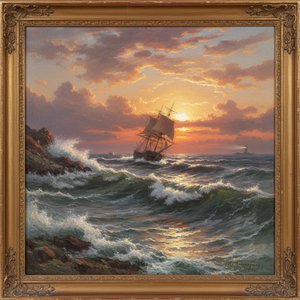
‘Moonlight Night,’ with its silvery luminescence and almost palpable stillness, defied conventional expectations. Viewers were captivated by the illusion of light emanating from the canvas itself, believing there must be a hidden source behind the work. This pursuit of atmospheric realism wasn’t simply about technical prowess; it was about capturing the soul of the landscape – its inherent beauty, its quiet power, and its ability to inspire awe. ‘Autumn Impassability of Roads’ (1872), though earlier in his career, foreshadows this mastery, depicting winter's bleakness with a hauntingly beautiful light that emphasizes the vastness and solitude of the Russian countryside.
Kuindzhi’s Influence & Legacy: Bridging Realism and Impressionism in Russian Art
Arkhip Kuindzhi occupied a unique position within the landscape of 19th-century Russian art. While associated with the Peredvizhniki movement – a group dedicated to realist depictions of social life – his work transcended simple realism, venturing into territory that foreshadowed Impressionism. He wasn’t interested in merely documenting reality; he sought to capture its fleeting moments, its emotional essence, and its subjective experience. His dramatic use of light and color paved the way for later generations of Russian painters, influencing artists who explored similar themes of atmosphere and perception.
His influence extended beyond painting itself. Kuindzhi was a highly respected teacher at the Academy of Fine Arts in St. Petersburg, where he fostered a new generation of artists, encouraging them to experiment with light and color and to embrace their own unique visions. He instilled in his students a deep appreciation for the beauty of nature and a commitment to capturing its emotional power. His legacy isn’t simply found in the paintings he created but also in the artistic spirit he cultivated.
Beyond the Canvas: The Artist as Innovator and Educator
Kuindzhi's impact wasn’t limited to his brushstrokes; he was a true innovator, constantly experimenting with materials and techniques. His dedication to understanding the science of light – how it interacts with surfaces, how colors are perceived – informed his artistic practice. He even reportedly conducted experiments with electricity to better understand its effects on illumination. This scientific curiosity, combined with his profound artistic sensibility, allowed him to create paintings that were both visually stunning and intellectually engaging.
His role as an educator was equally significant. He didn’t simply impart technical skills; he encouraged his students to develop their own unique voices, to embrace experimentation, and to find beauty in the world around them. He believed that art should be a reflection of personal experience and emotional truth. This emphasis on individuality and artistic freedom helped shape the course of Russian landscape painting for decades to come.
Collecting Kuindzhi Today: A Lasting Investment in Romantic Vision
Today, Arkhip Kuindzhi’s paintings are highly sought after by collectors worldwide, representing not only a significant investment but also a connection to a pivotal moment in art history. His works grace the walls of major museums and private collections, serving as enduring testaments to his artistic genius. The scarcity of his output – he produced relatively few paintings during his lifetime – further enhances their value.
Acquiring a Kuindzhi painting is more than simply owning a beautiful object; it’s possessing a piece of Romantic vision, a tangible connection to the landscapes and emotions that inspired one of Russia's greatest artists. OriginalUniqueArt offers high-quality reproductions of his iconic works, allowing art enthusiasts to experience the beauty and power of Kuindzhi’s paintings in their own homes. Explore our collection today and discover the enduring legacy of this master of light and atmosphere.