The Enlightenment Catalyst: Moving from Rococo Excess to Rational Restraint
 Neoclassicism Unveiled: The Timeless Elegance of Order, Reason, and Classical Antiquity
The Enlightenment Catalyst: From Rococo Excess to Rational Restraint The Revival of Antiquity: Exploring Neoclassical Art's Ideals & Enduring Legacy The Seeds of Revival: Enlightenment Ideals & Rediscovering Classical Antiquity The latter half of the...
To understand the profound seismic shift that birthed Neoclassicism, one must first envision the sensory overload of the mid-18th century. Before the era of rational restraint took hold, European artistic sensibilities were dominated by the Rococo—a style characterized by its ornate frivolity, pastel whimsy, and a certain decorative excess that prioritized pleasure over purpose. It was an age of swirling curves, asymmetrical flourishes, and a lightness of spirit that often bordered on the superficial. However, as the Age of Enlightenment began to illuminate the intellectual landscape of Europe, a new hunger emerged: a desire for clarity, logic, and moral weight. The chaotic whims of emotion were increasingly viewed through a lens of skepticism, leading artists and thinkers alike to seek a more stable foundation for expression.
This transition was not merely a change in aesthetic preference but a fundamental reconfiguration of the artist's role within society. The Enlightenment brought with it a rigorous pursuit of truth and reason, demanding that art serve a higher intellectual function. As the decorative textures of the Rococo began to fade, they were replaced by a deliberate movement toward austerity and structural integrity. This period marked the beginning of a great reset, where the focus shifted from the fleeting light of superficial drama to the enduring strength of permanent truths. It was a move away from the sensory indulgence of the aristocracy toward a more universal language of order, setting the stage for an era that would look backward to antiquity to find the path forward.
The Revival of Antiquity: Rediscovering the Greco-Roman Ideal
 pierre antoine de machy
Gavin Hamilton: The Antiquarian Painter of Rome Gavin Hamilton (1723, Lanarkshire – 4 January 1798, Rome) stands as a singular figure in the history of art, a man inextricably linked to both the burgeoning neoclassical movement and the passionate pur...
As the intellectual tides turned, the ruins of ancient Greece and Rome ceased to be mere relics of a lost age and became instead the blueprints for a new cultural renaissance. The discovery of archaeological treasures and the publication of accurate records regarding classical buildings provided the essential fuel for this revival. This was more than a nostalgic glance at the past; it was an active, scholarly pursuit of the Greco-Roman world's foundational principles. Artists became antiquarians, much like the influential Gavin Hamilton, whose life was inextricably linked to both the burgeoning Neoclassical movement and the passionate excavation of Roman ruins. Through his work, the narratives of Homer’s Iliad were brought back to life, not as mere legends, but as structured, monumental histories.
This fascination with antiquity manifested in a profound admiration for sculptural achievements and the idealized beauty found in classical forms. The works of this era sought to capture the eternal—the immutable laws of geometry and the stoic dignity of the human spirit. Whether through the meticulous pencil sketches of Vincenzo Camuccini, which captured the serene dignity of a bearded male profile, or the delicate, draped figures of Johann Gottfried Schadow, the goal was to evoke the spirit of ancient Greece and Rome. By looking to the Classical Antiquity period, artists found a way to communicate values of virtue, heroism, and permanence that transcended the political upheavals of their own time, creating a visual language that felt both ancient and revolutionary.
Architectural Order and Symmetry: The Neoclassical Built Environment
 Neoclassical architecture
Neoclassical architecture, sometimes referred to as Classical Revival architecture, is an architectural style produced by the Neoclassical movement that began in the mid-18th century in Italy, France and Germany. It became one of the most prominent a...
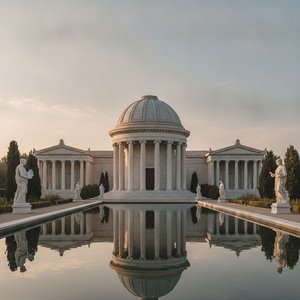
The Neoclassical movement was never confined to the canvas; it etched its principles into the very skyline of the Western world. In architecture, this era represented a Classical Revival that aimed to strip away the heavy, theatrical ornamentation of the Late Baroque and Renaissance styles. Instead, architects sought a purer, more authentic classical style adapted for modern utility. This was achieved through an emphasis on the wall rather than dramatic light and shadow, prioritizing symmetry, simple geometry, and social demand over unnecessary ornament. The result was a landscape defined by stability and monumental grace, where every column, pediment, and frieze served to reinforce a sense of structural truth.
From the grand designs of Karl Friedrich Schinkel in Berlin to the refined elegance of the Petit Trianon, Neoclassical architecture became a statement of Enlightenment ideals rendered in stone. These structures were designed to inspire awe through their proportions rather than their decorations. The movement emphasized a clear separation of parts and a cohesive whole, mirroring the era's preoccupation with logic and organized society. This architectural vocabulary was so successful that it became one of the most prominent styles in the Western world, providing a sense of civic permanence and dignity that continues to define many of our most important institutional buildings today.
Mastering the Form: Key Artists and Techniques of the Era
 Mastering the Classics: The 25 Greatest Paintings by Nicolas Poussin
Introduction To step into the world of Nicolas Poussin is to leave the chaotic whims of emotion behind and enter a realm of profound intellectual clarity. As you wander through this curated selection of his top twenty-five masterpieces, you are not m...
The technical execution of Neoclassical art required a level of precision and discipline that mirrored its philosophical goals. The primacy of disegno—the emphasis on line, structure, and clear contour—was paramount. Unlike the soft, blended edges of later movements, Neoclassical masters utilized techniques like hatching and cross-hatching to build tonal values, creating a sense of sculptural depth and anatomical accuracy. This approach allowed for a remarkable clarity of form, where every muscle, fold of drapery, and architectural element was rendered with unmistakable definition. The works of Nicolas Poussin, often regarded as an architect of French Classicism, exemplify this commitment to intellectual clarity, using meticulous compositions to transform mythological scenes into structured stages for moral contemplation.
Beyond the mastery of line, the era's artists were skilled in the subtle manipulation of texture and light to convey weight and volume. In sculpture, as seen in the works of Schadow, the smooth surfaces and carefully modeled folds of fabric created an illusion of movement within a static form. Even in painting, the use of light was controlled and purposeful, avoiding the flickering, unstable light of the Rococo in favor of a more even, illuminating glow that highlighted the subject's nobility. This technical rigor ensured that the art did not merely dazzified the eye with fleeting beauty but commanded respect through its undeniable craftsmanship and formal perfection.
Neoclassicism in Modern Spaces: Integrating Timeless Elegance into Contemporary Design
 Mougins Museum of Classic Art
A Timeless Dialogue: The Soul of Mougins Nestled within the sun-drenched, medieval heart of Provence, the Mougins Museum of Classic Art serves as a profound sanctuary where the echoes of antiquity meet the vibrant pulse of modernity. To step into thi...
While the era of Neoclassicism has passed, its aesthetic legacy remains a vital tool for the modern decorator and architect. The principles of order, balance, and symmetry offer a profound sense of tranquility and sophistication that can anchor even the most avant-garde contemporary interiors. In large-scale hospitality projects—such as hotels and corporate headquarters—incorporating Neoclassical elements provides a layer of historical depth and "timelessness" that mass-produced modernism often lacks. The use of multi-panel group paintings or large-format classical murals can transform a wide, empty wall into a focal point of cultural significance.
Integrating these classical motifs does not require a complete reconstruction of the past; rather, it is about a curated dialogue between eras. Much like the Mougins Museum of Classic Art, which orchestrates an encounter between ancient antiquities and contemporary vision, modern design can use Neoclassical reproductions to create a sense of continuity. By selecting pieces that emphasize clean lines and noble subjects, designers can introduce a sense of "monumental calm" into a space. Whether through a single, high-quality oil reproduction or a complex architectural fresco, the return to classical order offers a way to bring enduring elegance and a sense of lasting value to any modern environment.