Early Life & Artistic Foundations: From Rural Sweden to Academy Training
Anders Leonard Zorn, a name synonymous with the shimmering light of Swedish Impressionism, wasn’t born into an artistic dynasty but rather amidst the rustic beauty of Dalarna province in 1860. His origins lay on his grandparents' farm near Utmeland, a landscape that would indelibly shape his aesthetic sensibility. This early immersion in rural life – the textures of wood, the play of sunlight across fields, the honest faces of farmers and villagers – formed the bedrock of his artistic vision. Formal education began at twelve, but it was a natural aptitude, an innate talent for observation and rendering form, that truly set him apart. By fifteen, Zorn found himself in Stockholm’s Royal Swedish Academy of Arts, quickly astonishing instructors with his precocious skill. However, the rigid structure of academic training proved somewhat stifling; Zorn possessed an independent spirit, a desire to capture life *as* it was lived, rather than as prescribed by convention. This nascent rebellion would become a defining characteristic of his artistic journey.
The Rise of an Impressionist: Zorn's Technique and Capturing Fleeting Moments
 I vardinnans tradgard
Explore 'I vardinnans tradgard' by Anders Zorn – a serene 1882 oil painting capturing Swedish life & Impressionistic beauty. Discover its muted palette, textured brushstrokes & peaceful scene.
Zorn’s path to becoming a leading Impressionist wasn’t a direct one, but rather a series of explorations fueled by travel and observation. Early trips to Spain in the early 1880s proved pivotal. He abandoned meticulous detail for a looser, more spontaneous approach, captivated by the vibrant colors and intense sunlight of the Iberian Peninsula. London followed, where he exhibited at both the Royal Academy and the Royal Institute of Painters in Water-colour, gaining recognition but also refining his unique style. It was during this period that Zorn began to develop the remarkable technique for which he is celebrated: a rapid, confident brushstroke capable of capturing not just form, but the very *essence* of light itself. He wasn’t merely painting objects; he was rendering the ephemeral qualities of illumination – the way it dances on skin, reflects off water, and transforms ordinary scenes into moments of breathtaking beauty. This mastery extended beyond oil to watercolor, where his ability to achieve luminosity and depth with such economy of means was truly exceptional.
Portraits of Power & Society: Painting Royalty, Presidents, and the Elite
 Wikipedia: Anders Zorn
Anders Leonard Zorn (18 February 1860 – 22 August 1920) was a Swedish artist who attained international success as a painter, sculptor, and etching artist. His portrait subjects include King Oscar II of Sweden and three American Presidents: Grover Cl...
While Zorn’s artistic heart lay in capturing everyday life, it was his portraits that brought him international acclaim. His ability to convey not just physical likeness but also personality – a sense of inner character – made him highly sought after by prominent figures on both sides of the Atlantic. King Oscar II of Sweden became an early patron, followed by a string of commissions from American Presidents: Grover Cleveland, William H. Taft, and Theodore Roosevelt. These weren’t simply exercises in flattery; Zorn approached each subject with a keen eye for detail and a willingness to reveal their individual strengths and vulnerabilities. His portraits possess a remarkable immediacy, as if the sitter is about to turn and engage you directly. He didn't shy away from depicting wrinkles or imperfections, believing they added depth and authenticity to his work. The success of these commissions cemented Zorn’s reputation as one of the foremost portraitists of his era.
Beyond Portraiture: Genre Scenes, Nudes, and Swedish Life in Zorn’s Oeuvre
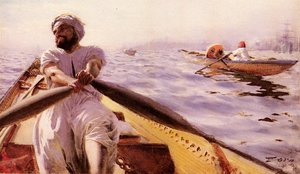 Kaikroddare
Experience Anders Zorn’s ‘Kaikroddare’! A captivating Impressionistic painting showcasing Swedish life & masterful technique. Commission a hand-painted replica today!
To define Zorn solely as a portrait painter would be to overlook the breadth and depth of his artistic output. He was equally adept at capturing genre scenes – glimpses into everyday life in Sweden – with a warmth and intimacy that resonated deeply with audiences. Scenes of peasant life, bustling markets, and intimate family moments reveal a profound empathy for his subjects. Perhaps most captivating are Zorn’s nudes, often depicted outdoors bathed in the golden light of summer. These paintings aren't merely studies of the human form; they are celebrations of vitality, sensuality, and the beauty of nature. He approached these works with a remarkable freedom and directness, capturing the fleeting moments of sunlight on skin and the natural grace of the body. His nudes stand as testaments to his mastery of light, color, and composition.
Zorn's Etchings: A Masterful Exploration of Light and Shadow
Often overshadowed by his paintings, Zorn’s etchings represent a significant – and often overlooked – aspect of his artistic genius. He approached etching with the same passion and skill that he brought to oil and watercolor, transforming this traditional medium into something truly innovative. Inspired by Rembrandt, whom he deeply admired, Zorn developed a unique technique characterized by bold cross-hatching and an extraordinary ability to capture light and shadow. His etchings are not merely reproductions of his paintings; they possess their own distinct character – a sense of immediacy and intimacy that is particularly striking. He produced nearly 300 etchings throughout his career, depicting portraits, genre scenes, and nudes with equal skill and sensitivity. These works demonstrate his versatility as an artist and his unwavering commitment to exploring the expressive possibilities of different mediums.
Legacy and Influence: The Enduring Appeal of Anders Zorn
Anders Zorn’s influence on subsequent generations of artists is undeniable. His mastery of light, his confident brushstroke, and his ability to capture the essence of his subjects continue to inspire painters today. He established a Swedish literary prize, the Bellman Prize, in 1920, further cementing his legacy as a patron of the arts. His work embodies a unique blend of Impressionistic techniques with a distinctly Scandinavian sensibility, capturing the beauty and vitality of Swedish life with unparalleled skill and sensitivity. Zorn’s paintings and etchings are now held in major museums around the world, and continue to captivate audiences with their timeless appeal. At OriginalUniqueArt.com, we are proud to offer high-quality reproductions of his most iconic works, allowing you to experience the shimmering light and enduring beauty of Anders Zorn’s art firsthand.