Early Life and Artistic Formation: Seeds of a Russian Vision
Aleksey Kondratyevich Savrasov’s story is one deeply interwoven with the burgeoning artistic consciousness of 19th-century Russia. Born in Moscow in 1830, his path to becoming the founder of lyrical landscape painting wasn't paved with privilege or formal encouragement initially. The son of a merchant, young Aleksey displayed an early and compelling aptitude for drawing, sketching scenes around his native Zamoskvorechye district with a natural talent that quickly outstripped mere hobby. These nascent artistic explorations, though self-taught, reveal the seeds of the sensitivity he would later pour onto canvas. His father’s initial resistance to what he perceived as an impractical pursuit underscores a common tension of the era – the struggle between traditional expectations and the pull of creative calling. Fortunately, intervention from Karl Rabus, a landscape tutor at the Moscow School of Painting, Sculpture, and Architecture, coupled with support from local authorities, secured his enrollment in 1844. This marked not just an entry into formal training but the beginning of a journey to articulate a uniquely Russian visual language.
The Birth of Lyrical Landscape: Savrasov's Departure from Academic Tradition
Savrasov’s decade at the Moscow School provided a solid foundation in technique, yet his true artistic revolution began after graduation. The early works demonstrate an initial adherence to Romantic tendencies prevalent at the time – dramatic skies and idealized compositions. However, a pivotal shift occurred during travels across Europe in the 1860s. While absorbing Western influences from artists like John Constable and Alexandre Calame, Savrasov didn’t simply imitate; he began distilling a distinctly Russian sensibility. He moved away from picturesque locales and grand panoramas, instead focusing on the quiet beauty of commonplace scenes – the fields surrounding Moscow, the banks of the Volga River during his summer expeditions (1870-1875). This wasn't merely a change in subject matter; it was a fundamental reorientation towards emotional resonance. He sought to capture not just *what* he saw, but *how* it felt – the melancholic stillness of a winter afternoon, the hopeful awakening of spring. This marked his departure from academic standards and the birth of what would become known as lyrical landscape painting.
Masterpieces of Mood and Atmosphere: ‘The Rooks Have Returned’ and Beyond
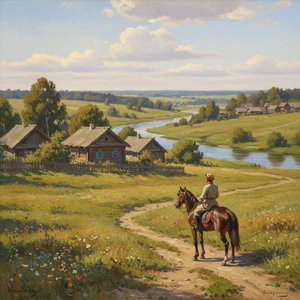
 Round dance in the village
Experience the charm of Alexei Savrasov's 'Round Dance in the Village.' This oil painting captures a lively rural scene with expressive brushstrokes and folk art influences. A tranquil glimpse into 19th-century Russian life.
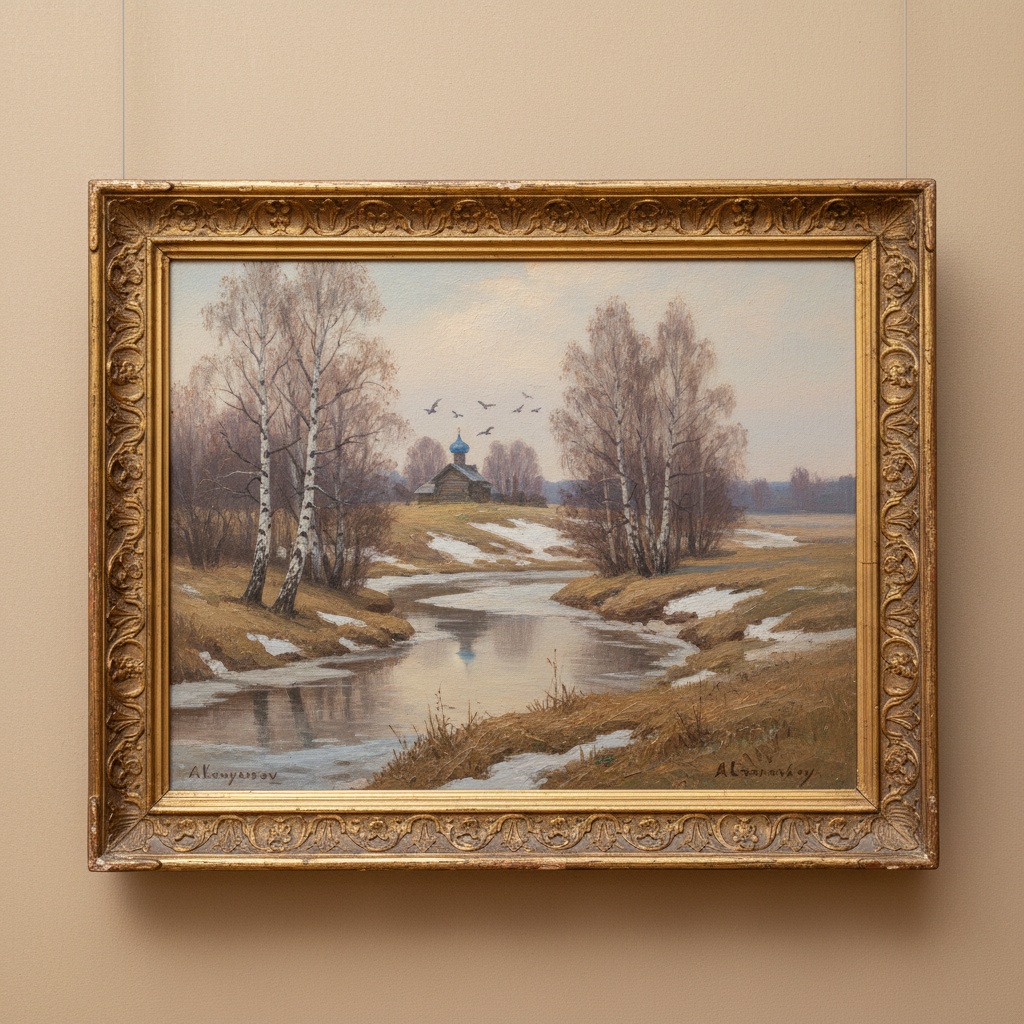
The watershed moment in Savrasov’s career – and arguably for Russian art itself – arrived with “The Rooks Have Returned” (1871). Presented at the inaugural exhibition of the Peredvizhniki (“Wanderers”), a group he helped found, the painting wasn't lauded for its technical virtuosity or dramatic composition. Instead, it resonated deeply because of its profound simplicity and emotional depth. A modest village scene – snow melting in patches, bare birch trees, a church spire rising in the distance, and rooks returning to their nests – captured something essential about the Russian soul. The canvas wasn’t an idealized vision but a truthful depiction of everyday life imbued with a subtle spiritual beauty. The delicate tones of brown, blue, and violet evoked the feeling of spring's arrival, subtly hinting at Eastertide within the Orthodox calendar. Beyond “The Rooks Have Returned,” works like “A Country Road” (1873) and “Losiny Island in Sokolniki” (1869) further solidified his reputation for capturing fleeting moments of atmospheric beauty, revealing the poetry inherent in the ordinary. His paintings weren’t about grand narratives; they were about evoking a feeling, a memory, a sense of place.
Savrasov’s Influence on the Peredvizhniki Movement and Subsequent Generations
The impact of “The Rooks Have Returned” extended far beyond its initial reception. It signaled a new aesthetic within Russian art – one that prioritized emotional truth over academic convention. Savrasov became a central figure in the Peredvizhniki, a group dedicated to bringing art directly to the people through traveling exhibitions, challenging the established norms of the Imperial Academy of Arts. The Peredvizhniki championed realistic depictions of Russian life and landscapes, often focusing on social themes and the lives of ordinary citizens. Savrasov’s emphasis on capturing the soul of the countryside resonated deeply with their ideals. His influence was particularly profound on Isaac Levitan, who became his devoted pupil and arguably surpassed him in fame. Levitan absorbed Savrasov's lyrical sensibility, further refining it to create some of the most iconic Russian landscapes ever painted. Other students like Konstantin Korovin also carried forward elements of his style, demonstrating the breadth of his impact on a generation of artists.
Technique and Style: Capturing the Soul of the Russian Countryside
Savrasov’s technical mastery lay not in flamboyant brushwork or elaborate compositions but in his ability to convey atmosphere through subtle nuances. He employed a restrained palette, favoring muted tones that evoked mood rather than spectacle. His brushstrokes were expressive yet controlled, creating textures that suggested depth and form without being overly detailed. He was particularly adept at capturing the effects of light and shadow, using them to create a sense of stillness and contemplation. Unlike some contemporaries who focused on grand vistas, Savrasov often chose intimate perspectives – a corner of a village, a quiet stretch of road, a patch of forest bathed in sunlight. This deliberate focus allowed him to imbue his paintings with a sense of personal connection and emotional resonance. He wasn’t simply painting landscapes; he was capturing the *feeling* of being within them, translating the soul of the Russian countryside onto canvas.
Legacy and Rediscovery: The Enduring Appeal of Savrasov’s Poetic Realism
Despite periods of relative obscurity following his death in 1897, Aleksey Savrasov's work has experienced a remarkable resurgence in recent decades. His paintings continue to captivate audiences with their quiet beauty and emotional depth, offering a poignant glimpse into the heart of 19th-century Russia. The enduring appeal lies in his ability to connect with universal themes – the changing seasons, the beauty of nature, the longing for home. Today, Savrasov is rightfully recognized as a pivotal figure in Russian art history, the founder of lyrical landscape painting and a master of poetic realism. His legacy lives on not only through his iconic masterpieces but also through the countless artists he inspired to find beauty in the ordinary and to capture the soul of their surroundings. At OriginalUniqueArt.com, we are proud to offer high-quality reproductions of Savrasov’s works, allowing you to experience the magic of his paintings firsthand and bring a touch of Russian serenity into your own home.