Introduction: Albert Kretschmer – Beyond Historical Record
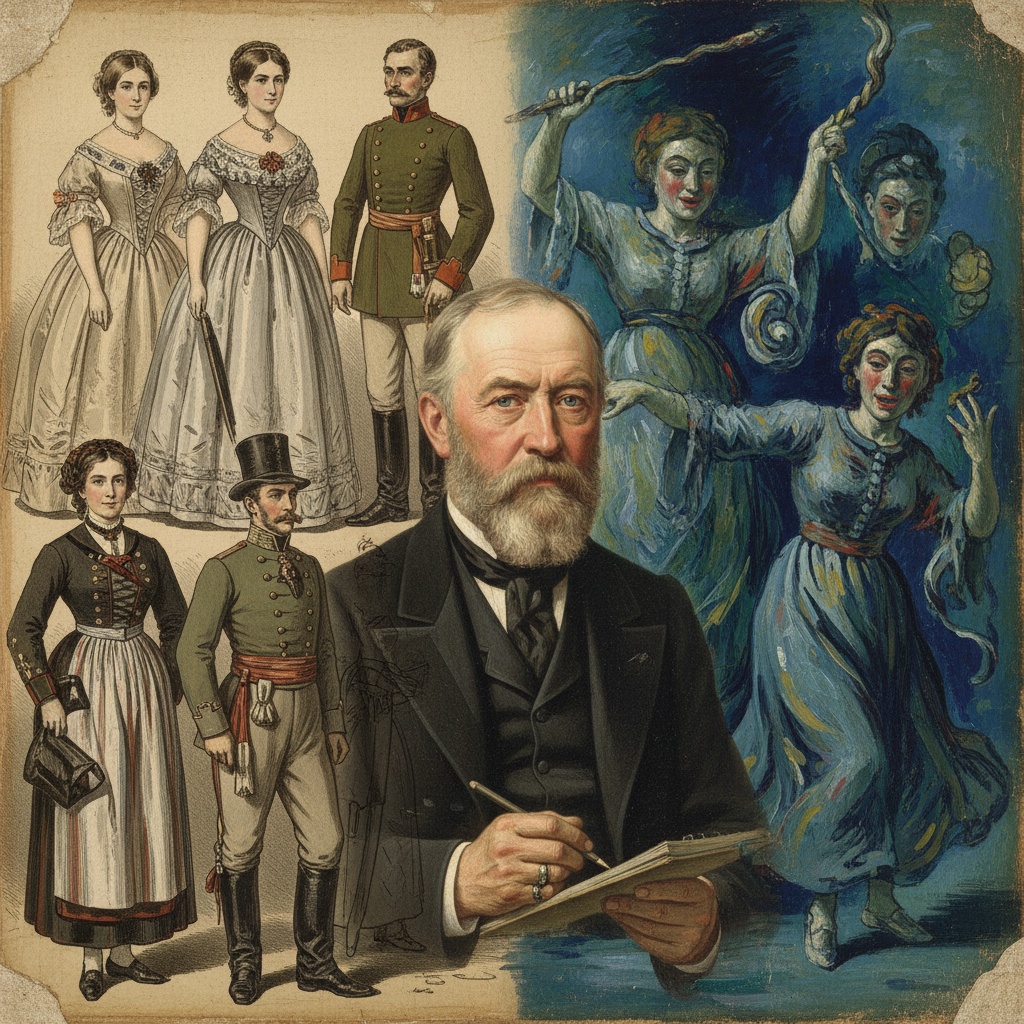
Albert Kretschmer (1825-1891) occupies a fascinating, often overlooked position within the landscape of 19th-century art. While readily categorized as a costume researcher and painter, to limit him to these descriptors is to diminish the profound sensitivity and artistic skill that infused his work. He wasn’t merely documenting garments; he was capturing worlds – social structures, cultural identities, and fleeting moments in time rendered with an almost obsessive attention to detail. Kretschmer's legacy extends beyond the purely historical, hinting at a burgeoning subjective approach to representation that foreshadowed the anxieties and expressive distortions of the Expressionist movement. His work offers a unique window into a period grappling with rapid change, national identity, and the very nature of artistic observation.
The Precision of Detail: Kretschmer’s Costume Studies & Artistic Training
Albert Kretschmer (27 February 1825 – 11 July 1891) was a German professor, painter, costumes researcher and chairman of Schauspielhaus Berlin. == Life and work == Kretschmer moved to Berlin in 1842 and studied under Professor Carl Joseph Begas at ...
Kretschmer's journey began in Berlin in 1842, where he received formal training under Carl Joseph Begas at the prestigious Prussian Academy of Arts. This academic foundation instilled within him a mastery of draftsmanship and watercolor techniques – skills that would become hallmarks of his oeuvre. However, Kretschmer’s true passion lay not in grand historical narratives or idealized portraiture, but in the meticulous study of costume. He possessed an almost scientific dedication to accuracy, painstakingly recreating fabrics, embellishments, and silhouettes with remarkable fidelity. This wasn't simply about replicating visual appearances; it was a deep engagement with material culture, understanding how clothing functioned as a signifier of status, region, and personal identity. His drawings weren’t sketches but detailed records, imbued with an artist’s eye for composition and color.
German Roots, Global Visions: Exploring Regional Attire in Kretschmer's Work
 German Costume Baden Rickesbach
Discover 'German Costume Baden Rickesbach' by Albert Kretschmer! A detailed 19th-century drypoint etching showcasing regional attire & social life. Explore this nostalgic, richly textured artwork.
While his artistic training was rooted in Berlin, Kretschmer’s interests extended far beyond the confines of Prussian society. He embarked on a comprehensive project to document the diverse costumes of Germany and beyond. Works like “German Costume Baden Rickesbach” and “German Costume Pommern Weitzacker” exemplify this dedication. These aren't simply picturesque depictions; they are ethnographic studies brought to life through artistic skill. Each figure is rendered with a quiet dignity, their attire revealing subtle clues about their social standing and regional origins. The drypoint etching technique employed in many of these works lends itself beautifully to the textures of wool, linen, and leather, creating a sense of tactile realism. He wasn’t merely illustrating clothing; he was portraying people *through* their clothing, offering glimpses into lives often overlooked by mainstream historical accounts. His illustrations of Persian costumes further demonstrate his broad scope and fascination with diverse cultures.
Kretschmer and the Precursors of Expressionism: A Subjective Lens on Reality
Expressionism is a modernist movement, initially in poetry and painting, originating in Northern Europe around the beginning of the 20th century. Its typical trait is to present the world solely from a subjective perspective, distorting it radically ...
Though not explicitly labeled an Expressionist during his lifetime, Kretschmer’s work contains seeds of the movement that would blossom in the early 20th century. Expressionism, as it emerged, sought to convey subjective emotional experience rather than objective reality – a distortion of form and color to evoke mood and feeling. While Kretschmer remained committed to detailed representation, his intense focus on specific details, coupled with a subtle but palpable sense of melancholy in many of his depictions, hints at this underlying sensibility. Consider the way he renders faces; they are often introspective, even haunted, suggesting an awareness of the social pressures and anxieties inherent within the costumes themselves. French Costumes, for example, while outwardly celebrating aristocratic fashion, also subtly reveals a sense of formality and constraint. This nuanced approach – acknowledging both beauty and underlying tension – aligns with the Expressionist desire to explore the complexities of the human condition.
Legacy and Influence: Kretschmer’s Impact on Art Historical Documentation
Kretschmer's influence lies primarily in his meticulous documentation of costume history. His publications, such as “Das große Buch der Volkstrachten” and “Die Trachten der Völker,” remain invaluable resources for scholars and artists today. He wasn’t just creating beautiful images; he was building a visual archive – a testament to the diversity and richness of human culture. His work provided a foundation for subsequent costume designers, historians, and artists seeking inspiration from past traditions. Furthermore, his dedication to detail set a high standard for art historical research, emphasizing the importance of primary sources and careful observation. His legacy is one of preservation, scholarship, and a quiet artistic sensitivity that continues to resonate with audiences today.
Collecting Kretschmer Today: Availability & Appreciation
Original works by Albert Kretschmer are increasingly sought after by collectors interested in 19th-century art, costume history, and the precursors of Expressionism. While his paintings command higher prices, lithographs and drawings offer more accessible entry points for aspiring collectors. OriginalUniqueArt.com offers high-quality reproductions of Kretschmer’s most iconic works, allowing enthusiasts to experience the beauty and detail of his artistry firsthand. Whether you are a seasoned art collector or simply appreciate the elegance of historical fashion, Kretschmer's work provides a captivating glimpse into a bygone era – a testament to the power of observation, artistic skill, and the enduring allure of cultural heritage. Explore our collection today and discover the timeless beauty of Albert Kretschmer’s masterpieces.