Early Life & Artistic Formation: From Architecture to Impressionism
 Wikipedia: Albert Lebourg
Albert Lebourg (1 February 1849, in Montfort-sur-Risle – 6 January 1928, in Rouen), birth name Albert-Marie Lebourg, also called Albert-Charles Lebourg and Charles Albert Lebourg, was a French Impressionist and Post-Impressionist landscape painter o...
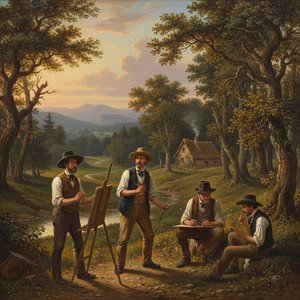
Albert Charles Lebourg’s artistic journey was not one of immediate, unwavering focus, but rather a considered evolution born from an initial pursuit of structural precision. Born in Montfort-sur-Risle in 1849, young Albert initially enrolled in the École des Beaux-Arts in Rouen with ambitions toward architecture. This early training instilled within him a keen eye for form and spatial relationships – qualities that would later subtly inform his exquisitely balanced compositions. However, the rigid constraints of architectural design soon proved insufficient to contain his burgeoning artistic sensibilities. By 1867, barely eighteen years old, Lebourg decisively abandoned his architectural studies, turning instead towards painting under the tutelage of Gustave Morin at the Académie de peinture et de dessin in Rouen. This pivotal shift marked not a rejection of structure entirely, but rather its translation into a more fluid and expressive medium. A brief period studying with Jean-Paul Laurens further refined his technical skills, yet it was his subsequent sojourn to Algiers that truly ignited his artistic voice.
The light of Algeria – intense, vibrant, and dramatically different from the muted tones of Normandy – proved transformative. While teaching drawing in Algiers between 1872 and 1877, Lebourg developed a personal palette characterized by brightness and clarity, a stark contrast to the academic traditions he had initially embraced. This period was crucial; it laid the foundation for his later mastery of capturing fleeting atmospheric effects, a hallmark of his Impressionistic style. It wasn’t merely about replicating what he saw, but about conveying the *feeling* of light – its warmth, its texture, and its ephemeral beauty.
The Rouen School & Lebourg’s Luminous Landscapes
 Albert-Charles Lebourg
Discover Albert-Charles Lebourg (1849-1928), a French Impressionist master of the Rouen School. Explore his serene landscapes & Seine river scenes, featured in major museums like Musée d'Orsay.
Upon returning to France in 1877, Lebourg found himself drawn into the orbit of the burgeoning Impressionist movement, specifically the circle known as the Rouen School. This group, while often overshadowed by its Parisian counterparts, possessed a distinct character rooted in their shared experience of the Normandy landscape and the unique qualities of light along the Seine River. Though not always considered a core member in the strictest sense, Lebourg actively participated in two Impressionist exhibitions – in 1879 and 1880 – alongside luminaries like Monet, Pissarro, and Degas. These exhibitions were pivotal moments, exposing his work to a wider audience and establishing him as a significant voice within the evolving artistic landscape.
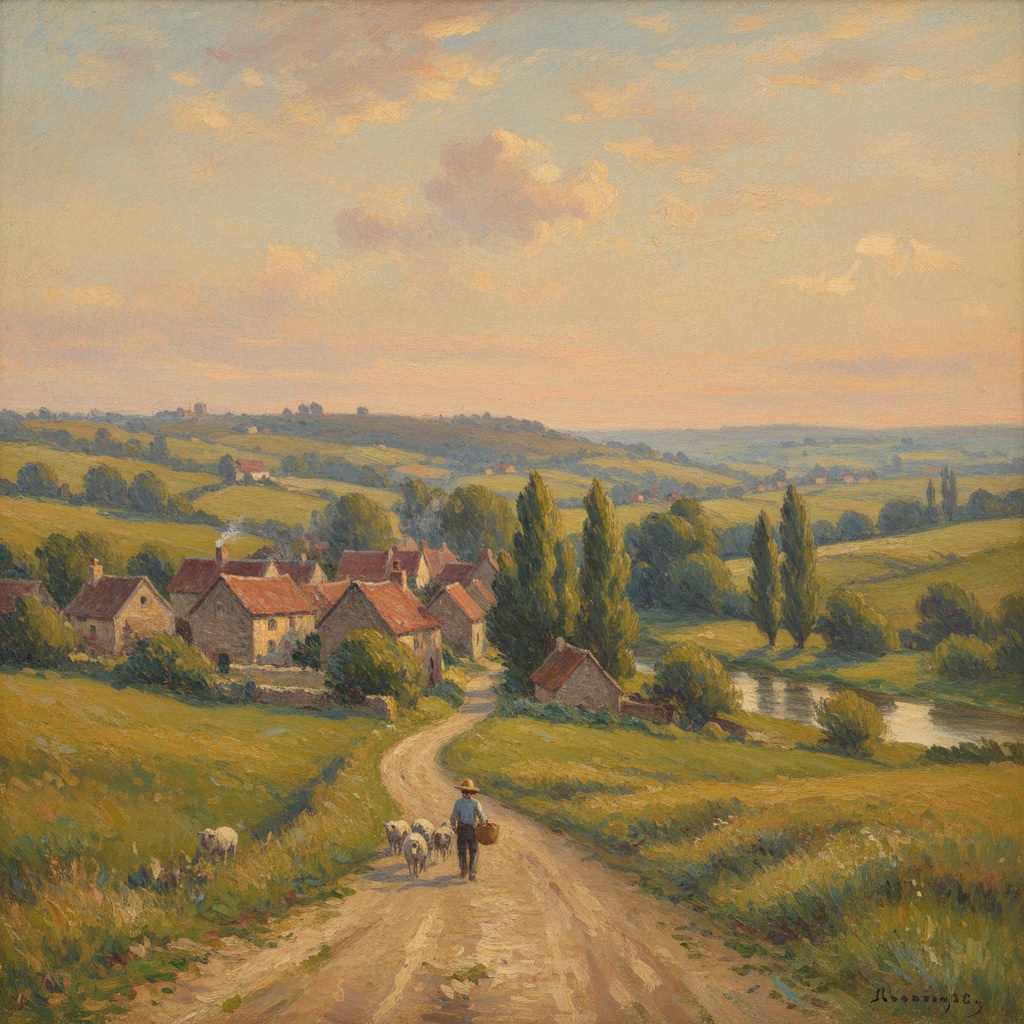
Lebourg’s contribution to the Rouen School lay in his unwavering dedication to depicting the subtle nuances of light and atmosphere. He wasn't interested in grand narratives or dramatic compositions; instead, he focused on capturing the quiet beauty of everyday scenes – riverbanks bathed in morning mist, fields shimmering under a summer sun, the gentle play of shadows across a village street. His paintings are characterized by loose brushwork, vibrant color palettes, and an almost palpable sense of tranquility. He sought to render not just *what* he saw, but *how* it felt to be present in that moment.
Capturing the Seine: A Study in Atmospheric Perspective
Aerial perspective, or atmospheric perspective, is the effect the atmosphere has on the appearance of an object as viewed from a distance. As the distance between an object and a viewer increases, the contrast between the object and its background de...
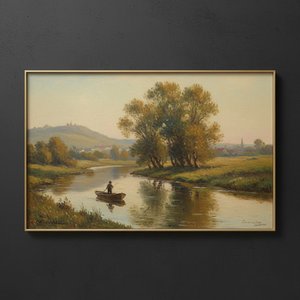
The Seine River became the central motif of Lebourg’s artistic career – a constant source of inspiration and a canvas for his exploration of atmospheric perspective. He understood, with remarkable sensitivity, how distance alters perception; how colors become muted, contrasts soften, and details dissolve into a hazy blur as objects recede into the background. This wasn't merely a technical exercise, but rather an attempt to capture the very essence of space and depth on canvas.
Consider his painting, The Seine at Bas Meudon, for example. The textured brushstrokes evoke the rippling surface of the water, while the subtle gradations of color create a convincing illusion of distance. Buildings along the riverbank appear to fade into the mist, their forms softened and indistinct. This masterful use of aerial perspective isn’t simply about creating a realistic depiction; it's about conveying the feeling of being immersed in that environment – the cool dampness of the air, the gentle murmur of the river, the sense of quiet contemplation. Similarly, The Quays of Dieppe, after the Rain, showcases his ability to capture post-rain tranquility through a delicate interplay of light and shadow on wet cobblestones.
Exhibiting with the Masters: Lebourg and the Impressionist Circle
Lebourg’s participation in the Fourth and Fifth Impressionist Exhibitions (1879 & 1880) was more than just a professional opportunity; it was an affirmation of his artistic vision. To exhibit alongside artists like Monet, Pissarro, and Degas – figures who were actively challenging conventional norms and redefining the boundaries of painting – required courage and conviction. While he maintained a degree of independence from the core Impressionist group, these exhibitions provided invaluable exposure and solidified his reputation as a skilled landscape painter.
His presence at Les XX exhibition in 1887 further broadened his artistic network, connecting him with artists like Walter Sickert and Georges-Pierre Seurat. Throughout his career, Lebourg cultivated relationships with fellow painters, exchanging ideas and techniques. He was represented by prominent galleries in Paris – Mancini Gallery (1896, 1899), Bernheim-Jeune (1903, 1910) and Paul Rosenberg (1918, 1923) – demonstrating the growing recognition of his work within the art world. These connections were not merely social; they fostered a spirit of collaboration and mutual inspiration that enriched his artistic practice.
A Legacy of Light: Lebourg's Enduring Influence
Though perhaps less celebrated than some of his Impressionist contemporaries, Albert Charles Lebourg left an indelible mark on the landscape painting tradition. His unwavering dedication to capturing the subtle nuances of light and atmosphere – particularly along the Seine River – continues to resonate with viewers today. He painted over 2,000 landscapes during his lifetime, each one a testament to his keen observation skills and his profound appreciation for the beauty of the natural world.
Lebourg’s influence can be seen in the work of subsequent generations of landscape painters who sought to capture the fleeting effects of light and weather. His paintings offer a glimpse into a bygone era – a time when artists were actively engaged with their surroundings, striving to convey not just what they saw, but how it *felt* to experience the world around them. At OriginalUniqueArt.com, we are proud to offer high-quality reproductions of Lebourg’s masterpieces, allowing you to bring his luminous landscapes into your own home and experience the tranquility and beauty that he so skillfully captured on canvas.