The Rise of Genre Painting in the Dutch Golden Age
The 17th century Netherlands, a nation newly independent and flourishing through global trade, witnessed an unprecedented blossoming of artistic talent. This period, known as the Dutch Golden Age, saw a dramatic shift away from the religious iconography that had dominated art for centuries. While history painting remained theoretically prestigious, it was genre painting – scenes of everyday life – that truly captured the spirit of the age and resonated with a burgeoning middle class eager to possess images reflecting their own world. This wasn’t merely a change in subject matter; it represented a fundamental re-evaluation of what constituted worthy artistic endeavor. The demand for depictions of domestic interiors, bustling markets, lively taverns, and tranquil landscapes fueled an explosion of creativity, giving rise to masters who would define the era. The focus moved from grand narratives to intimate moments, from divine intervention to human interaction, creating a uniquely Dutch aesthetic characterized by realism, detail, and often, subtle social commentary.
Adriaen Brouwer: A Life Immersed in Flemish & Dutch Artistic Circles
Born around 1605, likely in Oudenaarde, Flanders (modern-day Belgium), Adriaen Brouwer’s artistic journey was one of movement and collaboration. Early biographical accounts, often embellished by Arnold Houbraken, initially placed his origins in Haarlem and attributed Frans Hals as his mentor – a claim now largely discredited. What *is* certain is that Brouwer navigated the vibrant art scenes of both Flanders and the Dutch Republic, absorbing influences from diverse sources. His time in Amsterdam brought him into contact with other Flemish artists who had relocated north, while his later years in Antwerp placed him squarely within the orbit of Peter Paul Rubens and Anton van Dyck. These relationships were not merely professional; Rubens famously collected Brouwer’s work and even intervened on his behalf during a period of imprisonment – a testament to the respect he commanded from his peers. This immersion in two distinct artistic cultures shaped Brouwer's unique style, blending Flemish realism with Dutch directness.
Decoding Brouwer’s Scenes: Peasant Life as Social Critique
 Peasants in an Inn
Adriaen Brouwer’s "Peasants in an Inn" (1638) – a Dutch Golden Age masterpiece! Explore its rich impasto, dramatic lighting & social critique. Discover this iconic genre scene.
Brouwer didn’t simply depict peasant life; he *investigated* it. His taverns are not idyllic retreats but rather microcosms of human behavior – spaces filled with boisterous laughter, drunken arguments, and quiet contemplation. Paintings like “Drunken Peasant in a Tavern” (1624) aren't celebrations of revelry, but rather unflinching portrayals of excess and its consequences. The figures are often rough-hewn, their faces etched with the hardships of rural existence, yet Brouwer imbues them with a surprising degree of psychological depth. He avoids sentimental idealization, presenting his subjects with an honesty that borders on harshness. This realism wasn’t accidental; it was a deliberate choice to explore the complexities of social life and perhaps offer a subtle critique of societal norms. The smoke-filled interiors, dimly lit spaces, and crowded compositions contribute to a sense of claustrophobia and moral ambiguity. Even seemingly simple scenes of card playing or smoking reveal underlying tensions and power dynamics.
Mastering Realism: Technique and Style in Brouwer's Works
 Drunken Peasant in a Tavern
Adriaen Brouwer’s "Drunken Peasant" captures Baroque tavern life! Explore this 1624 oil painting's dynamic realism & symbolic depth at the Boijmans Van Beuningen.
Brouwer’s mastery lay in his ability to convey texture, light, and emotion with remarkable precision. His brushwork is dynamic and expressive, creating a sense of immediacy and vitality. He employed a rich impasto technique – applying thick layers of paint – particularly evident in works like “Peasants in an Inn” (1638), which gives the surfaces a tactile quality that draws the viewer into the scene. The dramatic lighting, often sourced from a single window or flickering candlelight, accentuates the figures and creates strong contrasts between light and shadow. This chiaroscuro effect not only enhances the realism but also adds to the psychological intensity of his compositions. Brouwer’s color palette is typically earthy and subdued, reflecting the rustic settings he favored, though punctuated by occasional bursts of vibrant red or blue to draw attention to key details. He was a keen observer of human anatomy and gesture, capturing subtle nuances of expression that bring his characters to life.
Brouwer’s Legacy: Influence on Subsequent Genre Painters
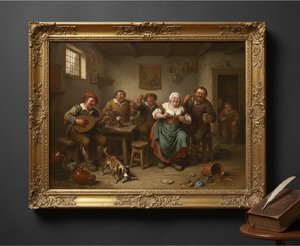
 Abraham Diepraam
Explore the genre scenes of Abraham Diepraam (1622-1670), a Dutch Golden Age painter known for his tavern interiors & peasant life depictions. Discover his influence and legacy in 17th-century Dutch art.
Despite a relatively short career – he died in Antwerp in 1638 at the young age of approximately thirty-three – Adriaen Brouwer exerted a profound influence on subsequent generations of Flemish and Dutch genre painters. His vivid depictions of peasant life, his psychological realism, and his innovative use of light and shadow inspired artists such as David Ryckaert III, who directly emulated his style, and Abraham Diepraam, whose tavern scenes owe a clear debt to Brouwer’s pioneering work. His impact extended beyond the immediate circle of Flemish painters; even Rembrandt is believed to have studied and admired Brouwer's compositions. The emphasis on everyday life, the exploration of social dynamics, and the pursuit of realism that characterized Brouwer’s art paved the way for a new era in painting – one where the ordinary became extraordinary and the lives of common people were deemed worthy of artistic representation.
Exploring Key Works: 'Drunken Peasant', 'Peasants in an Inn', & Beyond
To truly appreciate Brouwer’s genius, one must delve into his individual works. “Drunken Peasant in a Tavern” exemplifies his unflinching realism and psychological insight. The central figure, slumped over a table, embodies both vulnerability and degradation. “Peasants in an Inn,” painted later in his career, showcases his mastery of composition and light, creating a bustling scene filled with character and energy. “Smoke”, though smaller in scale, is equally compelling, capturing the intimate atmosphere of a gathering around a table. These paintings, along with others from his limited oeuvre, offer a glimpse into the world of 17th-century Dutch life – a world that Brouwer depicted not as an idealized fantasy but as a complex and often challenging reality. At OriginalUniqueArt, we are proud to offer high-quality reproductions of these masterpieces, allowing you to experience the power and beauty of Brouwer’s art firsthand. Explore our collection today and discover the enduring legacy of this remarkable painter.