The Rise of Realism: A Reaction Against Romantic Ideals
The mid-19th century witnessed a profound shift in artistic sensibilities, a turning away from the emotional fervor and idealized landscapes of Romanticism towards a more grounded, objective representation of the world. This burgeoning movement, known as Realism, sought to depict life as it truly was – unvarnished, often gritty, and devoid of sentimental embellishment. While France is frequently cited as the epicenter of this revolution, with artists like Courbet leading the charge, Germany too fostered a powerful strain of Realism, embodied most strikingly in the work of Adolph von Menzel. Menzel wasn’t merely *a* realist painter; he became its chronicler, meticulously documenting the social and political currents swirling through Prussia and beyond. To understand his significance, one must first appreciate the context from which he emerged – a period marked by rapid industrialization, burgeoning nationalism, and increasing societal stratification.
The Romantic era, with its emphasis on individual emotion and the sublime power of nature, had begun to feel increasingly detached from the realities faced by many. The rise of scientific inquiry challenged traditional beliefs, while the growing pains of urbanization exposed a darker side of progress – poverty, alienation, and social unrest. Artists like Menzel responded not with overt political statements, but with an unflinching commitment to portraying the everyday lives of ordinary people, the bustling energy of cities, and the complex machinery that was reshaping the world. This wasn’t simply about depicting what *was* seen, but how it was experienced – the textures, the light, the very atmosphere of a changing era.
Menzel's Berlin: Capturing 19th-Century Prussian Life in Detail
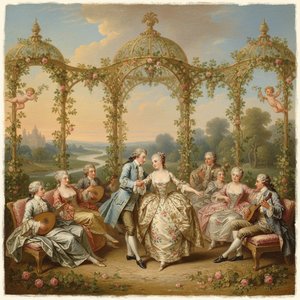
 The Flute Concert at Sanssouci (sketch)
Admire Adolph von Menzel’s ‘The Flute Concert.’ A captivating 1848 sketch showcasing aristocratic elegance & Impressionist brushwork. Explore Prussian realism & a glimpse into 19th-century social life.
Berlin, during Menzel’s formative years and throughout much of his career, served as both his muse and his subject. Unlike many artists who sought inspiration in distant lands or historical events, Menzel found richness and complexity within the fabric of his own city. He wasn't interested in grand monuments or sweeping vistas; instead, he focused on the intimate details of daily life – a theatre audience captivated by a performance (Theatre of Gymnase, 1878), two men engaged in earnest conversation (Two Discussing Voters, 1849), or a fleeting sketch capturing aristocratic leisure (The Flute Concert at Sanssouci (sketch), 1848). These weren’t merely snapshots of a particular time and place; they were carefully constructed observations, imbued with a profound sense of empathy and psychological insight.
Menzel possessed an extraordinary ability to capture the nuances of human interaction. His figures aren't idealized or romanticized; they are rendered with a remarkable degree of realism, complete with imperfections, anxieties, and subtle gestures that reveal their inner lives. He meticulously researched his subjects, often spending hours observing people in public spaces, sketching details from life, and studying contemporary fashion and architecture. This dedication to accuracy wasn’t simply about technical skill; it was driven by a desire to create an authentic representation of the world around him – a world that was rapidly changing before his eyes.
History Painting Reimagined: Menzel’s Patriotic Vision and 'Frederick the Great'
 The Enduring Legacy of 19th-Century Realism: A Reflection of Society & Artistic Innovation
Explore the captivating world of 19th-century Realism! Discover key artists, masterpieces & the social commentary behind this influential art movement. Expert insights at .
While celebrated for his depictions of contemporary life, Menzel also achieved considerable fame as a history painter. However, his approach to this genre differed significantly from traditional conventions. Rather than focusing on heroic battles or dramatic events, he sought to portray historical figures and moments with a newfound sense of intimacy and realism. His monumental series illustrating the works of Frederick the Great stands as a testament to this innovative approach.
Menzel didn’t simply recreate scenes from the past; he *interpreted* them, imbuing them with his own unique perspective. He depicted Frederick not as an infallible ruler, but as a complex and often contradictory figure – a brilliant strategist, a demanding leader, and a man haunted by personal demons. The series wasn't merely about glorifying Prussian history; it was about understanding the complexities of power, the burdens of leadership, and the human cost of ambition. This nuanced approach resonated deeply with a public eager to embrace its national identity while grappling with the challenges of modernity.
Beyond Grand Narratives: Everyday Scenes and Social Commentary
Menzel’s commitment to realism extended beyond historical subjects to encompass the everyday lives of ordinary people. He depicted workers in factories (Iron Rolling Mill, 1872-75), scenes of domestic life, and bustling marketplaces with equal attention to detail and psychological insight. These weren't simply genre paintings; they were subtle forms of social commentary, offering a glimpse into the lives of those often overlooked by traditional art.
His depictions of industrial labor, for example, weren’t romanticized or idealized. He didn’t shy away from portraying the harsh realities of factory work – the grime, the noise, and the physical toll it took on workers' bodies. Similarly, his scenes of domestic life often revealed the subtle power dynamics within families and the anxieties of a rapidly changing society. Menzel wasn’t necessarily advocating for specific political reforms; he was simply presenting an honest and unflinching portrayal of the world around him, allowing viewers to draw their own conclusions.
Technique and Innovation: Menzel’s Masterful Use of Light and Composition
Menzel's artistic skill wasn’t limited to his subject matter. He possessed a remarkable mastery of technique, particularly in his use of light and composition. His paintings are characterized by a luminous quality, achieved through careful observation of natural light and a subtle layering of colors. He often employed unconventional perspectives, viewing scenes from high or low angles, creating a sense of dynamism and immediacy.
His drawings, in particular, demonstrate his extraordinary technical skill. He experimented with various techniques – pen-and-ink, watercolor, charcoal – to create works that are both incredibly detailed and remarkably expressive. Menzel’s influence on later artists is undeniable. His innovative use of light and composition paved the way for Impressionism, while his commitment to realism inspired generations of artists to depict the world around them with greater honesty and authenticity.
Menzel's Enduring Legacy: Influence on Modern Art & a Chronicle of Change
Adolph von Menzel’s legacy extends far beyond his native Germany. He remains one of the most important figures in 19th-century art, celebrated for his detailed depictions of Prussian society, innovative techniques, and profound psychological insight. His work continues to resonate with audiences today, offering a glimpse into a world that was rapidly changing before his eyes.
His influence can be seen in the works of artists like Degas, who admired Menzel’s ability to capture fleeting moments and dynamic compositions. More broadly, Menzel's commitment to realism paved the way for modern art movements that sought to depict the world with greater honesty and authenticity. Through his paintings, drawings, and etchings, Adolph von Menzel created a lasting chronicle of change – a testament to the power of art to capture the complexities of human experience.
Explore the masterpieces of Adolph von Menzel and discover the enduring beauty of 19th-century Realism at OriginalUniqueArt.com, where hand-painted reproductions bring history to life.