Art Deco · 1928
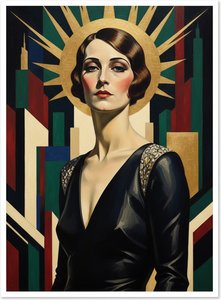
Printemps (Tamara de Lempicka, 1928)
Tamara de Lempicka (1898–1980) made Printemps. It dates from 1928. It belongs to the Art Deco movement.
- 1928

 Preview

 Hand Made Oil Painting
 Send
 Share
 Guide


 Download
 Similars
 X-Ray
 Diaporama
 Q&A

 Stats
Printemps: the essentials
- Title
- Printemps
- Artist
- Tamara de Lempicka (1898–1980)
- Artist born in
- Warsaw, Poland
- Date
- 1928
- Movement
- Art Deco
- Subject
- elegant women, floral portrait, art deco style, female beauty, romantic art, white flowers
Printemps in high resolution

Tamara de Lempicka, Printemps (1928).
Questions about Printemps
Who made "Printemps", and when?
"Printemps" was created by Tamara de Lempicka in 1928.
What is the creation date of "Printemps" by Tamara de Lempicka?
The creation of "Printemps" by Tamara de Lempicka is dated 1928.
What are the date and style of "Printemps" by Tamara de Lempicka?
"Printemps" was made in 1928, within the Art Deco movement.
How much light do the colors of "Printemps" appear to reflect?
"Printemps" by Tamara de Lempicka has a bright balance luminance. Luminance describes how much light the colors appear to reflect.
Is "Printemps" by Tamara de Lempicka a bright or a dark artwork?
In terms of perceived brightness, "Printemps" by Tamara de Lempicka is brilliant.
Can I see an X-ray view of "Printemps" by Tamara de Lempicka?
How do I download the image of "Printemps" by Tamara de Lempicka?
What subjects appear in "Printemps" by Tamara de Lempicka?
The subjects of "Printemps" are elegant women, floral portrait, art deco style, female beauty, romantic art, white flowers, stylized figures.
What underlying hue runs through "Printemps" by Tamara de Lempicka?
The dominant hue of "Printemps" by Tamara de Lempicka is golden yellow range. The hue is the underlying tone of the palette.
About the artist, Tamara de Lempicka

1898–1980, Poland
Tamara de Lempicka
The Aristocrat of the Jazz Age Born Maria Teresa Górska in Warsaw, Poland, the woman who would become known to the world as Tamara de Lempicka lived a life that mirrored the sharp, polished edges of her own canvases. Her early years were spent within the sophisticated circles of a wealthy Polish-Jewish family, a world of European spas and high society that instilled in her a lifelong devotion to elegance. This sheltered existence was upended by the tremors of the Russian Revolution, forcing her and her husband, Tadeusz Łempicki, to flee toward the promise of Paris. In the city of light, she sought to reinvent herself, adopting a name that carried a certain aristocratic weight, and began to transform from a socialite into a professional force.
About Tamara de Lempicka Notable works by Tamara de Lempicka
Also by Tamara de Lempicka
 in the Green Bugatti
 Self-Portrait in the Green Bugatti1925
 Portrait of Marjorie Ferry1932
 Adam and Eve1932
Essays around Printemps
 Tamara de Lempicka: Art Deco Iconoclasm & the Construction of Modern FemininityExplore the captivating world of Tamara de Lempicka, Art Deco icon. Discover her life, groundbreaking paintings, and lasting influence on m…
 25 Iconic Masterpieces by Valentin Laurent de Courcey: The Pinnacle of Modern Art DecoExplore 25 iconic Art Deco masterpieces by Valentin de Courcey. Discover museum-quality treasures on OriginalUniqueArt.com.
 20th century Polish painters20th-century Polish painters like Tamara de Lempicka, Sigmar Polke, and Aleksandra Ekster define an era. Find museum-quality reproductions …