Pop Art
Visa (Stuart Davis)
Stuart Davis (1892–1964) made Visa. It belongs to the Pop Art movement.

 Preview

 Hand Made Oil Painting
 Send
 Share
 Fact sheet


 Download
 Similars
 X-Ray
 Diaporama
 Q&A

 Stats
Visa, in brief
- Title
- Visa
- Artist
- Stuart Davis (1892–1964)
- Artist born in
- Philadelphia, United States
- Movement
- Pop Art
- Subject
- bold typography, geometric shapes, dynamic composition, color collage, modernist design, abstract expression
What does Visa depict?
A Dynamic Synthesis: Exploring Stuart Davis’ “Visa”
Stuart Davis's "Visa" is a captivating example of American Modernism at its most vibrant and energetic. This collage-style painting isn’t merely an aesthetic statement; it’s a visual articulation of the dynamism of early 20th-century America, infused with the rhythms of jazz and the burgeoning spirit of Pop Art decades before its formal emergence. The artwork immediately commands attention through its bold typography – the phrase “CHAMPION ELSE” emblazoned across a complex field of geometric abstraction. This isn’t a tranquil scene; it's a burst of controlled chaos, reflecting the accelerating pace and multifaceted nature of modern life.Style & Technique: Cubism Meets Jazz Age Energy
Davis masterfully blends influences in “Visa.” While the fragmented forms and overlapping planes clearly nod to Cubism, particularly the Synthetic Cubist approach, the work transcends simple imitation. The bright, contrasting colors and graphic treatment anticipate the boldness of Pop Art, demonstrating Davis’s forward-thinking vision. His technique appears to be a sophisticated combination of hand-painted elements layered with potentially printed components – creating texture and depth. This mixed-media approach allows for a unique visual density and a slightly rough surface quality that adds to its tactile appeal. The flattened perspective further emphasizes the artwork's graphic nature, prioritizing impact over illusionistic space. It’s a testament to Davis’s skill in translating musicality—specifically, the improvisational spirit of jazz—into visual form.Historical Context & Symbolic Resonance
Created during a period of significant artistic upheaval and experimentation, “Visa” reflects Davis's early engagement with avant-garde movements. His inclusion in the groundbreaking Armory Show of 1913, alongside European Modernists, was pivotal in shaping his artistic trajectory. The title itself, while seemingly simple, hints at a deeper meaning. "Visa" can be interpreted as a metaphorical stamp of approval – a validation of striving and competition, aligning with the phrase “CHAMPION ELSE.” The repeated ‘C’ shapes within the composition could symbolize cycles, continuous effort, or even musical chords, reinforcing the jazz-inspired undercurrents. Davis wasn't simply depicting objects; he was exploring concepts—the energy of urban life, the pursuit of success, and the very essence of American identity in a rapidly changing world.Emotional Impact & Interior Design Considerations
“Visa” evokes a sense of exhilaration and restless energy. It’s a piece that demands attention and sparks conversation. Its bold color palette and dynamic composition make it a striking focal point for any space. In an interior design context, “Visa” would be particularly effective in modern or contemporary settings, adding a vibrant accent to minimalist décor. The artwork's graphic quality also lends itself well to larger spaces where its impact won’t be diminished. A high-quality reproduction of "Visa" offers an opportunity to bring a piece of American Modernist history into your home or office, injecting it with the spirit of innovation and artistic freedom that defines Stuart Davis’s legacy.High-resolution images of Visa
Protected by copyright: these files are for personal reference, not a licence to republish.
Stuart Davis, Visa.
Stuart Davis (1892–1964), Visa. Image: OriginalUniqueArt.com.
Questions on Visa, answered
What subjects appear in "Visa" by Stuart Davis?
The subjects of "Visa" are bold typography, geometric shapes, dynamic composition, color collage, modernist design, abstract expression, jazz influence.
Can the image of "Visa" by Stuart Davis be freely reproduced?
The copyright answer for "Visa" by Stuart Davis: the work is still protected by copyright. This determines whether reproductions of the image may be freely made.
Who is the artist behind "Visa"?
The artist behind "Visa" is Stuart Davis. The work is catalogued under Stuart Davis's name.
What style does "Visa" belong to?
The movement associated with "Visa" by Stuart Davis is Pop Art. This classification situates the work among related artists and artworks.
Which period of Stuart Davis's career does "Visa" belong to?
Within Stuart Davis's career, "Visa" falls in the Mature Period. The phase helps compare it with the artist's other works.
What explains the copyright situation of "Visa" by Stuart Davis?
The copyright status of "Visa" - still protected by copyright - follows from the artist's death in 1964.
How does "Visa" fit into Stuart Davis's themes and style?
"Visa" belongs to Stuart Davis's Pop Art work, whose recorded themes include early pop experiments, bold color exploration, proto-pop imagery, pop art & cubism, jazz aesthetics, geometric abstraction, competition & victory, american modernity.
Is "Visa" typical of what Stuart Davis usually created?
Among Stuart Davis's recorded themes - early pop experiments, bold color exploration, proto-pop imagery, pop art & cubism, jazz aesthetics, geometric abstraction, competition & victory, american modernity - "Visa" brings its own focus on bold typography, geometric shapes, dynamic composition, color collage, modernist design, abstract expression, jazz influence.
About the artist, Stuart Davis
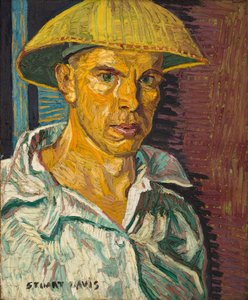
1892–1964, United States
Stuart Davis
Stuart Davis: A Pioneer of American Modernism Early Life and Training Born on December 7, 1892, in Philadelphia, Stuart Davis was immersed in an artistic environment from a young age. His father, Edward Wyatt Davis, served as the art editor for the Philadelphia Press, while his mother, Helen Stuart Davis, was a sculptor. This familial background undoubtedly fostered his early interest in visual arts. Davis received formal training at the Robert Henri School of Art in New York City from 1909 to 1912 under the guidance of Robert Henri.
Also by Stuart Davis
 Odol
 Lucky Strike1924
 T View1951
 Sixth Avenue El1931
Essays around Visa
 American artworks of the 1950s1951's Saying Grace by Norman Rockwell and Jackson Pollock's 1949 Number 1 show the shift from Paris to New York through 10 key works.
 Geometry with Purpose: Distinguishing Suprematism from ConstructivismKazimir Malevich hung his Black Square in the corner of a room in Petrograd in 1915. Why did this single gesture change the purpose of art?
 Dreams on Canvas: Understanding Automatist and Veristic SurrealismIn 1924, André Breton launched a movement in Paris to liberate the mind. One path used spontaneous gestures, while the other used photograp…