Expressionism · 1915
Rocks, Gloucester (Stuart Davis, 1915)
Stuart Davis (1892–1964) made Rocks, Gloucester. It dates from 1915. It belongs to the Expressionism movement. It is made in oil on canvas. It is kept at New Orleans Museum of Art in New Orleans, United States of America. It measures 76 × 91 cm (29.9 × 35.8 in).
- 1915
- Oil On Canvas
- 76 × 91 cm (29.9 × 35.8 in)
- New Orleans Museum of Art

 Preview

 Hand Made Oil Painting
 Send
 Share
 Fact sheet


 Download
 Similars
 X-Ray
 Diaporama
 Q&A

 Stats
Rocks, Gloucester, in brief
- Title
- Rocks, Gloucester
- Artist
- Stuart Davis (1892–1964)
- Artist born in
- Philadelphia, United States
- Date
- 1915
- Medium
- Oil On Canvas
- Dimensions
- 76 × 91 cm (29.9 × 35.8 in)
- Where to see it
- New Orleans Museum of Art, New Orleans, United States of America
- Movement
- Expressionism
- Period
- Early Modern
- Subject
- american landscape, mountain peaks”, “bold colors”, “dynamic composition”, “abstract forms”, “urban energy”
What does Rocks, Gloucester depict?
Rocks, Gloucester: A Transitional Masterpiece by Stuart Davis
Stuart Davis’s “Rocks, Gloucester,” painted in 1915, stands as a crucial bridge between the artist's early realist explorations and his eventual embrace of abstract expressionism. This vibrant landscape, measuring 76 x 91 cm, offers a compelling glimpse into the burgeoning artistic currents of early 20th-century America, particularly the shift away from traditional representation championed by figures like Robert Henri. The painting’s immediate impact lies in its bold use of color – a fiery palette dominated by reds, oranges, and yellows – which immediately evokes a sense of energy and dynamism. Davis wasn't simply depicting rocks; he was attempting to capture the frenetic pace of modern life, as he himself described, translating the “dynamics of city lights and sounds” onto canvas.
A Style in Formation: Expressionism and the American Landscape
“Rocks, Gloucester” exemplifies a transitional style, leaning heavily towards Expressionism while retaining elements of Davis’s earlier training. The visible brushwork, textured surface, and distorted forms – particularly evident in the jagged peaks of the mountains – betray an emotional intensity that anticipates his later abstract works. The artist's deliberate use of color isn't purely representational; it’s a vehicle for conveying feeling, mirroring the anxieties and excitement of a nation undergoing rapid transformation. The flattened perspective further emphasizes this emotional impact, prioritizing the viewer’s experience over strict adherence to realistic spatial relationships. This approach aligns with the broader artistic experimentation taking place at the time, fueled by influences from European modernism and the desire to forge a distinctly American aesthetic.
Technique and Materials: Oil on Canvas – A Gesture of Form
- Oil on Canvas: The painting is executed in oil on canvas, a technique that allows for rich color saturation and substantial textural variation.
- Visible Brushwork: Davis’s loose, gestural brushstrokes are immediately apparent, contributing to the painting's energetic feel and conveying a sense of immediacy.
- Layered Color: The use of layered colors creates depth and volume within the mountain forms, though the overall effect remains somewhat flattened, prioritizing emotional resonance over photographic realism.
- Undulating Foreground: The large, yellow-ochre mass in the foreground anchors the composition and adds to the sense of solidity and weight.
Symbolic Resonance: Mountains as Metaphor
Beyond its aesthetic qualities, “Rocks, Gloucester” carries symbolic weight. Mountains have long represented strength, resilience, and even the sublime – concepts deeply rooted in human experience. In Davis’s hands, they become a visual embodiment of these ideas, reflecting the challenges and aspirations of a nation grappling with modernity. The dark purple and grey sky provides a dramatic counterpoint to the warm tones below, further amplifying the sense of grandeur and perhaps hinting at an underlying tension between nature's power and humanity's place within it. The artist’s signature in the upper right corner confirms this work as a pivotal moment in Davis’s artistic evolution.
Which museum holds Rocks, Gloucester?
New Orleans Museum of Art
New Orleans, United States of America
A Window into New Orleans: The Soul of Art at the New Orleans Museum of Art Nestled within the vibrant embrace of City Park, a sprawling urban oasis larger than Central Park itself, the New Orleans Museum of Art (NOMA) stands as more than just a repository for masterpieces; it’s a profound reflection of Louisiana's unique identity and a testament to its enduring artistic spirit. Founded in 1911 by the visionary Isaac Delgado, NOMA began with a simple yet ambitious goal: to provide New Orleans with a secure haven where art could be cherished, exhibited, and celebrated by all. Today, this foundational principle resonates through the museum’s halls, offering visitors an immersive journey spanning over five millennia of artistic endeavor – from ancient Egyptian artifacts to contemporary works that pulse with the city's modern energy.


High-resolution images of Rocks, Gloucester

Protected by copyright: these files are for personal reference, not a licence to republish.
Stuart Davis, Rocks, Gloucester (1915).
Stuart Davis (1892–1964), Rocks, Gloucester, 1915, oil on canvas, New Orleans Museum of Art, United States of America. Image: OriginalUniqueArt.com.
Questions on Rocks, Gloucester, answered
Where is "Rocks, Gloucester" by Stuart Davis on display today?
You can see the original "Rocks, Gloucester" at the New Orleans Museum of Art, New Orleans, United States of America.
What is the creation date of "Rocks, Gloucester" by Stuart Davis?
"Rocks, Gloucester" dates from 1915. The date places the work within Stuart Davis's career and its era.
What technique was used for "Rocks, Gloucester" by Stuart Davis?
The medium of "Rocks, Gloucester" by Stuart Davis is oil on canvas. Reproductions aim to render the appearance of this technique.
How big is the original "Rocks, Gloucester"?
The original "Rocks, Gloucester" by Stuart Davis measures 76 x 91 cm (29.9 × 35.8 in).
What subjects appear in "Rocks, Gloucester" by Stuart Davis?
The themes present in "Rocks, Gloucester" by Stuart Davis include american landscape, mountain peaks”, “bold colors”, “dynamic composition”, “abstract forms”, “urban energy”, “1915 art”. Together they summarize the artwork's subject matter.
Is "Rocks, Gloucester" by Stuart Davis in the public domain?
"Rocks, Gloucester" by Stuart Davis is still protected by copyright. This status governs how the image of the work may be reproduced.
Who created "Rocks, Gloucester"?
The artist behind "Rocks, Gloucester" is Stuart Davis. The work is catalogued under Stuart Davis's name.
What style does "Rocks, Gloucester" belong to?
"Rocks, Gloucester" by Stuart Davis belongs to the Expressionism movement. This movement provides the stylistic context of the work.
Where does "Rocks, Gloucester" fall in Stuart Davis's career?
"Rocks, Gloucester" belongs to the Transitional Style of Stuart Davis's career. This classification relates the work to the artist's development.
About the artist, Stuart Davis
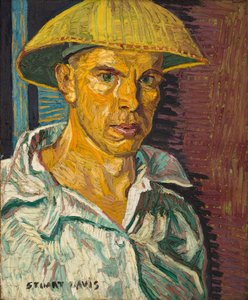
1892–1964, United States
Stuart Davis
Stuart Davis: A Pioneer of American Modernism Early Life and Training Born on December 7, 1892, in Philadelphia, Stuart Davis was immersed in an artistic environment from a young age. His father, Edward Wyatt Davis, served as the art editor for the Philadelphia Press, while his mother, Helen Stuart Davis, was a sculptor. This familial background undoubtedly fostered his early interest in visual arts. Davis received formal training at the Robert Henri School of Art in New York City from 1909 to 1912 under the guidance of Robert Henri.
Also by Stuart Davis
 Odol
 Lucky Strike1924
 T View1951
 Sixth Avenue El1931
Essays around Rocks, Gloucester
 Clyfford Still's Abstract Expressionism: A Study of Color, Form & the Existential LandscapeExplore the profound world of Clyfford Still's Abstract Expressionism with OriginalUniqueArt. Discover his unique style, existential themes…
 American abstract expressionist paintersJackson Pollock used his drip technique in 1949 to create Number 1, while Jasper Johns used impasto in 1959 for his work False Start.
 Mastering the Face of a Nation: The Top 25 Gilbert Stuart Artworks1796 marked the creation of the Athenaeum Portrait. How did Stuart use light and shadow to define the very soul of a nascent nation?