
 Preview
 Send
Send Share
Share
 Details

 Download
 Similars
 X-Ray
X-Ray Diaporama
In-laid Ceiling


 Read More
Hand Made Oil Reproduction
Hand-painted oil on canvas in your size and frame, made to order by our artists. ( Switch to Print Switch to Image)




P118B $10

P118H $10

P118W $10

P438Z $10

P508JH $12

P508YH $12

P805H $10

P805Z $10

P919BZ $10

P919G $10

P919XJ $10

P959ZH $10

P968JZ $12

W106C $8

W218G $10

W218JH $8

W218Y $10

W307PJ $10

W316G $10

W316PJ $8

W316Y $10

W398PJ $8

W4111J $10

W500HY $15

W500JH $15

W692G $12

W849H $8

W940BG $15

W953PJ $8




Pick from our preset sizes that match the artwork's original proportions.

You may enter your own dimensions to fit a specific frame or space. If your selected size does not match the original image's proportions, we will either crop the artwork or extend the painting with additional hand-painted elements. A digital mockup will be sent for your approval before production begins.
Please note that the on-screen preview does not reflect the actual cropping or extension. Only the mockup will accurately show the final composition.
While custom sizes are available, we recommend selecting a dimension from the predefined list to preserve the original proportions.
After order, OriginalUniqueArt.com team will email client for instructions and provide a mockup preview
Worldwide Delivery () in 3/4 weeks instead of standard 5 weeks. (9 August). No compromise on quality.

Free Worldwide Express Shipping

High-Quality Linen Canvas

Full Shipping Insurance

Customs Tax Refund Guarantee

True Color Matching Guarantee

60-Day Return Policy (Defects Only)

100% Money-Back Guarantee

Bulk Discount Offer
 Glass option is only available in size under 110 CM

In-laid Ceiling
Reproduction Medium
Reproduction Size
-


Total Price
$ 300
Artwork Description
The Celestial Tapestry of Santa Maria Maggiore
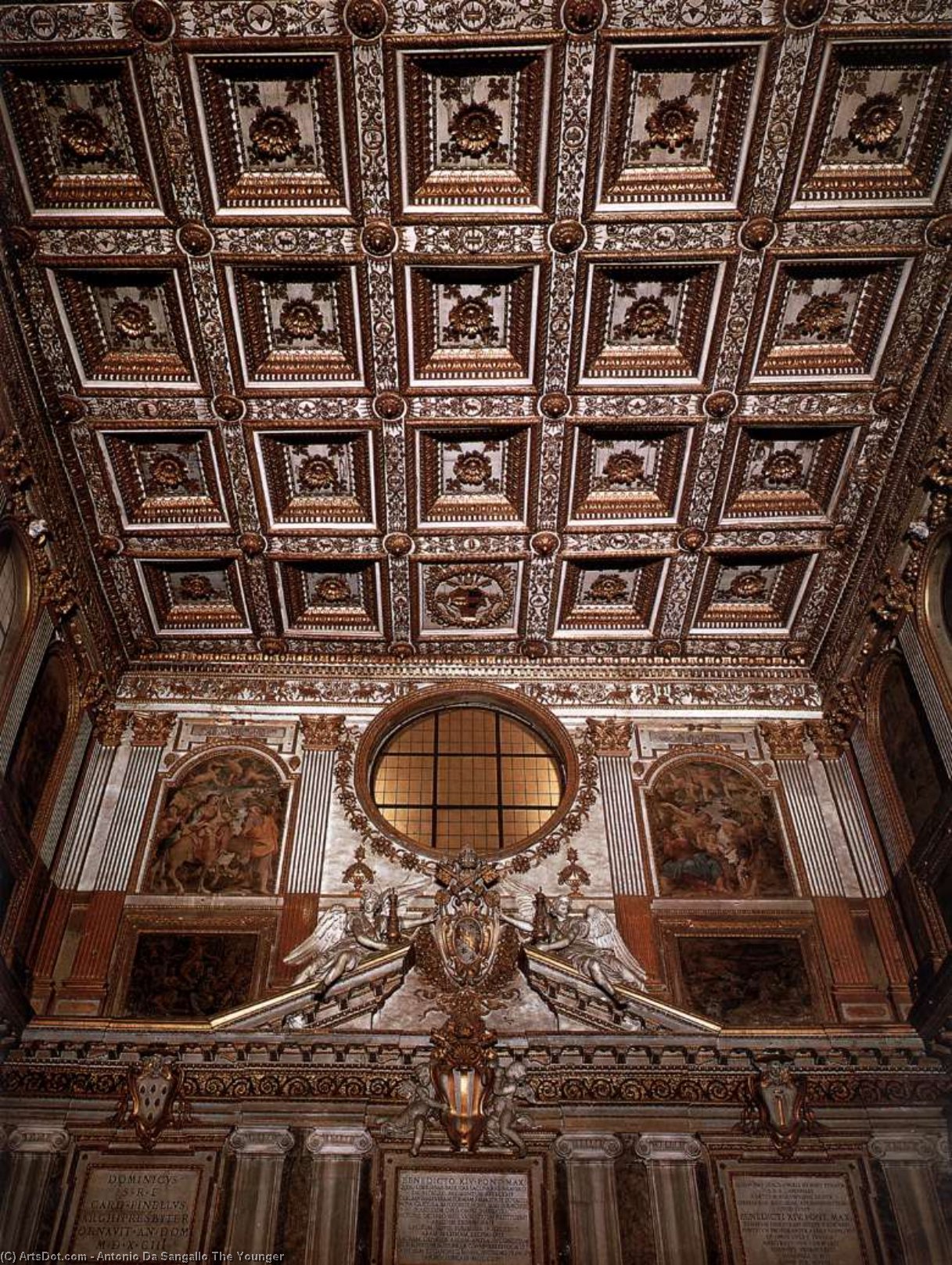
The In-laid Ceiling by Antonio da Sangallo the Younger is more than just architectural ornamentation; it’s a breathtaking encapsulation of Renaissance artistic ambition and spiritual contemplation. Situated within Rome's Basilica di Santa Maria Maggiore, commissioned during the reign of Pope Alexander VI in 1492 – a period marked by papal extravagance and intellectual ferment – this monumental fresco embodies the humanist ideals that underpinned the era’s cultural revival. Designed by Antonio da Sangallo the Elder, with Giuliano da Sangallo contributing to its initial planning stages, the ceiling represents a pinnacle of Florentine craftsmanship and artistic innovation.A Symphony of Geometric Precision
The ceiling's design is dominated by an astonishing array of square panels meticulously crafted from wood and gilded with gold leaf – a technique perfected during this time and reflecting the immense wealth commanded by papal patronage. Each panel showcases a complex geometric pattern, primarily circles and squares interwoven with floral motifs—a deliberate echo of classical proportions and symbolizing divine harmony. The symmetrical arrangement of these elements speaks to an unwavering belief in order and rationality, hallmarks of Renaissance aesthetics. Careful observation reveals subtle variations in color and texture, demonstrating the artist’s mastery of pigment blending and surface manipulation.Symbolism Rooted in Christian Tradition
Beyond its formal beauty lies a profound symbolic significance. The central circular window, framed by ornate scrollwork and topped with a sculpted figure—likely Saint Peter—serves as a focal point for divine illumination, mirroring the basilica’s dedication to Mary Immaculate. Surrounding walls are adorned with frescoes depicting biblical scenes – notably the Nativity of Jesus – reinforcing the spiritual narrative at the heart of the space. The artist's meticulous attention to detail underscores the importance of conveying religious truth through visual representation—a cornerstone of Renaissance artistic practice.A Legacy of Artistic Excellence
Antonio da Sangallo the Younger’s contribution to this masterpiece cemented his reputation as one of Florence’s foremost architects and engineers, alongside his father and brother. His work exemplifies the Renaissance commitment to reviving classical ideals while simultaneously elevating Christian iconography to new heights of expressive power. The In-laid Ceiling continues to inspire awe and admiration today, serving as a testament to human creativity and artistic vision—a timeless reminder of Rome's glorious past and its enduring influence on Western art history.- Artist: Antonio da Sangallo the Younger
- Born Year: 1484
- Death Year: 1546
- Birth City: Florence
- Birth Country: Italy
- Wikipedia: https://en.wikipedia.org/wiki/Antonio_da_Sangallo
- WGA: https://www.wga.hu/html_m/s/sangallo/antonio1/ceiling.html
- OriginalUniqueArt: https://OriginalUniqueArt.com/@@/A@D3C2GM-Discovering-the-Artworks-of-Basilica-di-Santa-Maria-Maggiore-Rome-Italy?srsltid=AfmBOop19jdRD0Azb5QNSc7J3gXVU1_B4HqGcE6Em4aCngfrIBzUZZ0
Artist Biography
Hans Baldung: A Bridge Between Darkness and Light
Born in the small Imperial Free City of Schwäbisch Gmünd around 1484 or 1485, Hans Baldung was a pivotal figure in the transition between the late Gothic traditions of Northern Europe and the burgeoning Renaissance art scene. His life, tragically cut short in September 1545 at the age of approximately sixty-one, marked him as a master craftsman deeply rooted in both the expressive power of the past and the innovative spirit of his time. While often overshadowed by his influential student, Albrecht Dürer, Baldung carved out a unique artistic identity, characterized by a potent blend of meticulous detail, dramatic color, and a distinctly unsettling psychological depth.
Baldung’s early life remains somewhat shrouded in mystery. He was the son of a jurist and a doctor, receiving an unusual education for an artist of his era – he attended university himself, though not to pursue a degree. This intellectual background likely contributed to his later explorations of allegory and symbolism. His apprenticeship with Albrecht Dürer in Nuremberg from 1503 to 1507 proved transformative. Here, he absorbed the master’s technical skills and observational acuity, but crucially, Baldung began to develop a style that diverged significantly from Dürer's idealized realism. While Dürer sought clarity and order, Baldung embraced a more subjective and emotionally charged approach.
The Dual Nature of a Master
Baldung’s artistic legacy is defined by its inherent duality. He was simultaneously a devout follower of Dürer and a champion of the darker, more expressive currents of late Gothic art. This tension manifests in his diverse body of work – from meticulously rendered portraits and intricate woodcuts to hauntingly beautiful altarpieces and stained glass windows. His nickname, “Hans Baldung Grien,” derived from the German word for green, reflects his penchant for rich, saturated colors, often employed with a dramatic intensity that bordered on the macabre.
His work is characterized by a fascination with death, decay, and the grotesque – themes frequently explored in late medieval art. This interest isn’t simply morbid; it represents a profound engagement with the complexities of human existence, acknowledging both beauty and suffering. Consider his depictions of demons and devils, not as purely malevolent figures, but as embodiments of temptation and moral struggle. Baldung's ability to convey such psychological nuance was remarkably advanced for his time.
A Flourishing Career
Baldung’s career spanned several decades, during which he produced a vast and varied oeuvre. He worked as a painter, printmaker, draftsman, and even a stained glass artist, demonstrating remarkable versatility. His woodcuts, in particular, are considered masterpieces of the German Renaissance, showcasing his technical skill and expressive power. These prints often depict scenes from mythology, biblical stories, and allegorical narratives, imbued with a sense of drama and emotional intensity.
His altarpieces, such as those found in the St. Sebaldus Church in Munich, are notable for their vibrant colors, dynamic compositions, and unsettling imagery. These works reflect Baldung’s unique artistic vision – a synthesis of Gothic expressiveness and Renaissance innovation. He also created numerous portraits, often characterized by a psychological realism that anticipated later developments in portraiture.
Legacy and Influence
Despite his undeniable talent and prolific output, Hans Baldung's place in art history has been somewhat overshadowed for centuries. Initially, he was largely viewed as a mere student of Dürer, lacking the independent genius of his master. However, in recent decades, scholars have increasingly recognized Baldung’s originality and significance. His work is now appreciated for its complex psychological depth, its masterful use of color, and its crucial role in bridging the gap between late Gothic art and the Renaissance.
Baldung's influence can be seen in the works of subsequent generations of German artists, including his son, Hans Holbein the Younger. His legacy endures as a testament to the power of artistic duality – the ability to embrace both darkness and light, tradition and innovation, to create art that is both deeply rooted in the past and profoundly relevant to the present.

antonio da sangallo the younger
1484 - 1546 , Italy
Quick Facts
- Artistic Movement Or Style: German Renaissance, Mannerism
- Artists Or Movements Influenced By This Artist: ['Sandro Botticelli']
- Artists Who Influenced This Artist: ['Albrecht Dürer']
- Date Of Birth: 1484 or 1485
- Date Of Death: September 1545
- Full Name: Hans Baldung
- Nationality: German
- Notable Artworks:
- Primavera
- The Birth of Venus
- The Adoration of the Magi
- Place Of Birth: Schwäbisch Gmünd, Germany
Related Articles
Leonardo da Vinci's Masterpieces: Explore 25 Iconic Artworks for Your Home | OriginalUniqueArt
Journey through Leonardo da Vinci's genius with our curated selection of 25 iconic artworks. Explore the stories behind Mona Lisa, The Last Supper & more Renaissance masterpieces. Find museum-quality art reproductions for your home at OriginalUniqueArt.com.

Drama and Light: A Definitive Guide to the Italian Baroque Masterpieces and the Revolution of Chiaroscuro
Explore the dramatic world of Italian Baroque art. Discover how masters like Caravaggio used chiaroscuro and tenebrism to revolutionize painting through light, shadow, and profound realism. A definitive guide for history lovers and art collectors.

Pietro da Cortona: Baroque Grandeur & the Synthesis of Roman Painting
Explore the life & masterpieces of Pietro da Cortona, a defining figure of the Italian Baroque. Discover his stunning frescoes at Palazzo Barberini and lasting influence on Roman art history. Learn more with OriginalUniqueArt.

Baroque Drama: Bringing Opulence & Emotion into Contemporary Interiors
Explore the opulent world of Baroque interior design! Discover key elements, modern applications & how to bring dramatic elegance into your home with 's authentic reproductions.

The Modern Ceiling Fresco: Reimagining Renaissance Grandeur for Contemporary Spaces
Discover the resurgence of ceiling frescoes! Explore historical traditions & modern interpretations for luxury spaces. 's expert artists create custom, hand-painted masterpieces.



