Art Nouveau · 1899
Clovers (Raphael Kirchner, 1899)
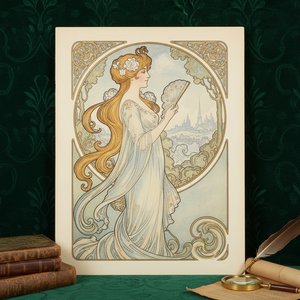
Raphael Kirchner (1875–1917) made Clovers. It dates from 1899. It belongs to the Art Nouveau movement.
- 1899

 Preview

 Hand Made Oil Painting
 Send
 Share
 Fact sheet


 Download
 Similars
 X-Ray
 Diaporama
 Q&A

 Stats
Clovers, in brief
- Title
- Clovers
- Artist
- Raphael Kirchner (1875–1917)
- Artist born in
- Vienna, Austria
- Date
- 1899
- Movement
- Art Nouveau
- Subject
- flowers, women, designs and sketches
High-resolution images of Clovers
Raphael Kirchner, Clovers (1899). Public domain.
Questions on Clovers, answered
In what year was "Clovers" by Raphael Kirchner created?
The creation of "Clovers" by Raphael Kirchner is dated 1899.
What does "Clovers" by Raphael Kirchner depict?
The themes present in "Clovers" by Raphael Kirchner include flowers, women, designs and sketches. Together they summarize the artwork's subject matter.
Is "Clovers" by Raphael Kirchner in the public domain?
"Clovers" by Raphael Kirchner is in the public domain - its copyright has expired. This status governs how the image of the work may be reproduced.
Who created "Clovers"?
"Clovers" was created by Raphael Kirchner. The information on this page describes Raphael Kirchner's original work.
Which artistic current is "Clovers" by Raphael Kirchner part of?
"Clovers" by Raphael Kirchner belongs to the Art Nouveau movement. This movement provides the stylistic context of the work.
How old was Raphael Kirchner when creating "Clovers" in 1899?
Raphael Kirchner made "Clovers" at the age of 24. The artist was born in 1875 and the work is dated 1899.
Why is the copyright status of "Clovers" what it is?
The copyright status of "Clovers" - in the public domain - its copyright has expired - follows from the artist's death in 1917.
About the artist, Raphael Kirchner

1875–1917, Austria
Raphael Kirchner
A Viennese Visionary: The Life and Art of Raphael Kirchner Raphael Kirchner, born in Vienna in 1875, emerged as a significant figure during the twilight years of the Art Nouveau movement, leaving behind a captivating legacy of elegant illustrations and evocative portraits. His life, though tragically cut short in 1917, spanned a period of immense artistic change, witnessing the shift from the ornate flourishes of Vienna Secession to the burgeoning world of early pin-up art. Kirchner’s journey began with formal training at the Academy of Fine Arts Vienna, providing him with a solid foundation in traditional techniques that he would later infuse with his unique sensibility. However, it was his move to Paris around 1900 that truly ignited his artistic development.
Also by Raphael Kirchner
 Temptation
 Greek Virgins1900
 Fables1903
 Girls and Eggs1901
Essays around Clovers
 Raphael Kirchner: A Poetic Vision of Belle Époque Society Through Art Nouveau LithographyExplore the captivating world of Raphael Kirchner, a master of Art Nouveau illustration during the Belle Époque. Discover his iconic 'Kirch…
 25 Masterpieces by Ernst Ludwig Kirchner: The Soul of German ExpressionismImmerse yourself in the raw emotion of German Expressionism. Explore 25 iconic masterpieces by Ernst Ludwig Kirchner, from bold street scen…
 Mastering the Classics: The Top 25 Iconic Works by Marc DuvallierExperience the magic of Marc Duvallier’s top 25 artworks. Explore his breathtaking reimagining of classical masterpieces through modern ill…