Preview
 Send
Send Share
Share
 Details
 Guide
Guide

 Download
 Similars
 X-Ray
X-Ray Diaporama
 Stats
StatsPartition


 Read More
The artwork displayed on this page is protected by copyright law, which means we cannot legally create or sell an identical reproduction. This protection is enforced under international agreements such as the Berne Convention and by national laws, including those outlined by the U.S. Copyright Law - Title 17.
As a respectful and legal alternative, we offer custom, hand-painted artworks inspired by the original. Our skilled and professional artists carefully study the original's style, mood, and artistic essence to create a new, unique piece that evokes the same feeling - while remaining an original creation in its own right.
This method fully complies with copyright regulations because it does not involve copying or duplicating the protected artwork. Instead, it is a creative reinterpretation - a new painting that is influenced by the original but not identical to it.
Hand Made Oil Reproduction
Hand-painted oil on canvas in your size and frame, made to order by our artists. ( Switch to Print Switch to Digital Image)




P118B $10

P118H $10

P118W $10

P438Z $10

P508JH $12

P508YH $12

P805H $10

P805Z $10

P919BZ $10

P919G $10

P919XJ $10

P959ZH $10

P968JZ $12

W106C $8

W218G $10

W218JH $8

W218Y $10

W307PJ $10

W316G $10

W316PJ $8

W316Y $10

W398PJ $8

W4111J $10

W500HY $15

W500JH $15

W692G $12

W849H $8

W940BG $15

W953PJ $8




Pick from our preset sizes that match the artwork's original proportions.

Type the width and the height you need, to fit your frame or your wall. This is hand-painted, so for a size with a different shape the artist can paint a bit more around the picture, or cut a bit — you choose. We send you a digital mockup to approve before the painting starts. The picture shown on this page does not show the real result — only the mockup does.
After order, OriginalUniqueArt.com team will email client for instructions and provide a mockup preview
Worldwide Delivery () in 3/4 weeks instead of standard 5 weeks. (18 October). No compromise on quality.

Free Worldwide Express Shipping

High-Quality Linen Canvas

Full Shipping Insurance

Customs Tax Refund Guarantee

True Color Matching Guarantee

100-Day Return Policy (Defects Only)

100% Money-Back Guarantee

Bulk Discount Offer
 Glass option is only available in size under 110 CM

Partition
Reproduction Medium
Reproduction Size
-


Total Price
$ 300
The Serene Geometry of Color Field Abstraction
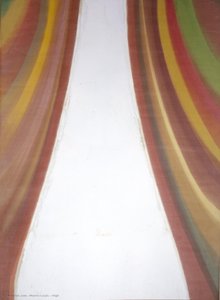
To stand before Morris Louis's Partition is to encounter a moment of profound visual stillness. This work does not shout for attention; rather, it invites the viewer into a hushed contemplation, guiding the eye across an expanse built entirely from color and line. The composition is a masterful study in horizontality, dominated by parallel bands that stretch across the canvas like stratified layers of memory or calm water at dawn. Louis eschews any single focal point, instead orchestrating a visual rhythm that encourages the gaze to drift uninterruptedly from one hue to the next. It is an experience less about looking and more about breathing with the painting.
A Dialogue Between Color and Flow
The palette itself speaks of muted elegance—a sophisticated gathering of yellows, soft blues, gentle reds, and purples set against a creamy, luminous ground. These are not the aggressive, vibrant tones of high drama; instead, they possess an earthy subtlety that lends the piece an immediate sense of tranquility. Louis’s technique is central to its magic. He pioneered methods involving the pouring and flowing of diluted paint, allowing the acrylic medium to interact with gravity and surface tension. This process results in edges that are remarkably soft, almost breathing at the boundaries between colors, giving the entire structure a fluid, organic quality despite the underlying geometric order. The texture appears impossibly smooth, as if the pigment itself has been poured from liquid light.
Historical Echoes of Abstract Expressionism
Positioned within the lineage of Color Field painting and Abstract Expressionism, Partition anchors itself in a pivotal moment of 20th-century art. Louis’s career was marked by relentless experimentation, culminating in his groundbreaking work with Magna paint. This piece embodies that spirit—a move away from narrative representation toward the pure emotional resonance achievable through color relationships. While the title suggests division or separation, the actual effect is one of integration; the bands do not fight against each other but rather coexist in a harmonious, measured dialogue. It speaks to an era grappling with profound change, finding solace and structure within abstraction.
Integrating Art into Living Space
For the collector or designer, Partition offers more than mere decoration; it offers an atmospheric anchor for any room. Its inherent calm makes it a perfect counterpoint to cluttered modern life. Imagine this piece lending its spacious, breathable quality to a formal living area or a serene study. The subtle interplay of muted tones ensures that the artwork will complement—rather than compete with—your existing décor. It is a sophisticated whisper of color that elevates any space by introducing an element of considered, meditative beauty.
Questions & Answers
Where does "Partition" sit within Morris Louis's body of work?
"Partition" shares with Morris Louis's other works its Color Field Painting style and the recorded themes: color field expressionism, veil painting technique, abstract minimalism, american art legacy, louis influence.
How is the palette of "Partition" by Morris Louis described?
The colors of "Partition" form a neutrals palette. This classification describes the dominant color families.
Where is "Partition" by Morris Louis on display today?
"Partition" by Morris Louis is on display at the Tate Modern, London, United Kingdom. The museum listing refers to the original work, not to reproductions.
Artist Biography
Early Life and Education
- Born: Morris Louis Bernstein, November 28, 1912, Baltimore, Maryland
- Parents: Louis Bernstein (furniture salesman) and Cecelia Luckman Bernstein.
- Education: Attended public schools in Baltimore; Maryland Institute of Fine and Applied Arts (now MICA), 1929-1932. Did not complete a degree.
- Early influences included Eugene Speicher and Paul Cézanne.
- Showed an early interest in art, encouraged by his family despite limited opportunities in Baltimore.
Development as an Artist & Key Influences
- 1930s: Worked various odd jobs to support himself while painting (vegetable peeling, laundry work, Gallup Poll research).
- 1934-1936: Participated in the Public Works of Art Project mural project under Sam Swerdloff.
- 1936-1937: Moved to New York City; experimented with techniques at the Siqueiros Workshop.
- Magna Paint Discovery (1948): A pivotal moment – Louis pioneered the use of Magna paint, a newly developed oil-based acrylic paint created for him by Leonard Bocour and Sam Golden. This allowed for greater fluidity and transparency in his work.
- Influence of Helen Frankenthaler: In 1953, Louis and Kenneth Noland visited Frankenthaler's studio and were deeply impressed by her stain paintings (particularly "Mountains and Sea"). This inspired their experimentation with pouring and staining techniques.
The Veil Paintings & Color Field Innovations
- Mature Veil Paintings (1954): Characterized by overlapping, superimposed layers of transparent color poured onto and stained into sized or unsized canvas.
- Technique: Extremely diluted paint was applied to an unprimed, unstretched canvas, allowing it to flow over the inclined surface, creating translucent color veils. This eliminated brushstrokes and emphasized flatness.
- Color Field Painting: Louis became a central figure in Color Field painting, simplifying pictorial space and emphasizing flat planes of intense color. He was part of the Washington Color School movement.
- Series & Styles: Beyond the Veil paintings, he explored series like florals, columns (1960), unfurleds (1960-61) – featuring rivulets of opaque color – and stripe paintings (1961-62).
Major Achievements & Historical Significance
- Pioneering Color Field Painting: Louis is recognized as a key innovator in Color Field painting, alongside artists like Kenneth Noland and Helen Frankenthaler.
- Influence on Abstract Expressionism: His work expanded the boundaries of Abstract Expressionism by focusing on color and flatness rather than gesture or composition.
- Washington Color School: A significant contributor to this influential movement, which emphasized a reductive approach to painting.
- Destruction of Works: Notably, Louis destroyed many of his paintings between 1955 and 1957, reflecting a critical self-assessment of his work.
- Legacy: His emphasis on color, flatness, and the materiality of paint continues to influence contemporary artists.
Later Years & Death
- Louis continued painting prolifically until his death.
- Death: Died September 7, 1962, in Washington, D.C., at the age of 49.
- Memorial Exhibition (1963): A significant exhibition was held at the Solomon R. Guggenheim Museum shortly after his death.
- Retrospective Exhibitions: Major retrospectives followed at the Museum of Fine Arts, Boston (1967), and the National Gallery of Art, Washington, D.C. (1976).

Morris Louis
1912 - 1962 , United States of America
Quick Facts
- Full Name: Morris Louis
- Nationality: American
- Date Of Birth: 1912
- Date Of Death: 1962
- Place Of Birth: Baltimore, United States of America
- Notable Artworks:
- High
- Number 1-36
- Where
- Number 1-68
- Gamma Tau
- Third Element
- Delta Theta
- Artistic Movement Or Style: Color Field painting
- Artists Who Influenced This Artist:
- Helen Frankenthaler
- Jackson Pollock
- Cézanne
- Artists Or Movements Influenced By This Artist:
- Kenneth Noland
- Washington Color School
Related Articles

Abstract Expressionism's 10 Defining Masterpieces |
Explore 10 defining Abstract Expressionism masterpieces by Pollock, Rothko & de Kooning. Discover the stories behind these iconic paintings and find museum-quality art reproductions to elevate your home decor on .
Acrylic on Canvas: A Modern Masterpiece – Technique, History & Contemporary Expression
Explore the world of acrylic on canvas! Discover its history, techniques & contemporary applications with expert insights from OriginalUniqueArt. Find inspiration and elevate your art collection today.
Color Field Painting: The Emotional Power of Pure Abstraction and Chromatic Depth
Explore the profound emotional depth of Color Field painting. Discover the history of mid-century abstraction, from Rothko to Newman, and learn how pure color transforms the viewer's experience through our expert art history guide.

Kandinsky's Masterpieces: 25 Paintings That Define Abstract Art | OriginalUniqueArt
Journey through Wassily Kandinsky's 25 most iconic abstract paintings. Explore his revolutionary use of color, form & spiritual expressionism. Find museum-quality Kandinsky reproductions and elevate your home decor with OriginalUniqueArt.com. Discover all masterpieces on OriginalUniqueArt.com!
Acrylic on Paper: A Modern Canvas for Contemporary Expression
Explore the versatility of acrylic painting on paper! Discover expert techniques, artist insights & archival practices for creating stunning contemporary art. Learn more at OriginalUniqueArt.