Master Meyrick (John Hoppner)
John Hoppner (1758–1810) made Master Meyrick. It is kept at Cincinnati Art Museum in Cincinnati, United States.

 Preview

 Hand Made Oil Painting
 Send
 Share
 Fact sheet


 Download
 Similars
 X-Ray
 Diaporama
 Q&A

 Stats
Master Meyrick, in brief
- Title
- Master Meyrick
- Artist
- John Hoppner (1758–1810)
- Artist born in
- Whitechapel, United Kingdom
- Where to see it
- Cincinnati Art Museum, Cincinnati, United States
Which museum holds Master Meyrick?
Cincinnati Art Museum
Cincinnati, United States
A Sanctuary of Visionary Splendor Nestled within the verdant, tranquil embrace of Eden Park, the Cincinnati Art Museum stands as a profound testament to enduring artistic passion and civic devotion. As the first purpose-built art museum west of the Alleghenies, it was born from an ambitious spirit that sought to cultivate beauty and intellectual curiosity within a burgeoning American city. The museum’s architectural grandeur, anchored by James W.


High-resolution images of Master Meyrick
John Hoppner, Master Meyrick, Cincinnati Art Museum. Public domain.
Questions on Master Meyrick, answered
Where is "Master Meyrick" by John Hoppner on display today?
You can see the original "Master Meyrick" at the Cincinnati Art Museum, Cincinnati, United States.
Is "Master Meyrick" free of copyright?
Regarding copyright, "Master Meyrick" is in the public domain - its copyright has expired.
Who is the artist behind "Master Meyrick"?
The artist behind "Master Meyrick" is John Hoppner. The work is catalogued under John Hoppner's name.
What explains the copyright situation of "Master Meyrick" by John Hoppner?
"Master Meyrick" by John Hoppner is in the public domain - its copyright has expired. Copyright duration runs from the artist's death, which occurred in 1810.
Did "Master Meyrick" stay in its artist's homeland?
No - the artwork is kept abroad. "Master Meyrick" is held in United States, while John Hoppner was born in United Kingdom.
About the artist, John Hoppner

1758–1810, United Kingdom
John Hoppner
Early Life, Family and Training John Hoppner was born in Whitechapel, London, in 1758 to German parents. His mother held a position as one of the German attendants at the royal palace, a connection that placed the family in close proximity to the court from the start. This early environment shaped his trajectory, though his initial path was musical rather than visual. As a young boy, he served as a chorister at the royal chapel, a role that required discipline but ultimately failed to hold his interest against his inclination toward art.
Also by John Hoppner
 Francis Rawdon-Hastings (1754-1826), 2nd Earl of Moira and 1st Marquess of Hastings1793
 Edward, Duke of Kent (1767-1820)1797
 Mrs. Richard Bache (Sarah Franklin, 1743–1808)1793
 Major Thomas Pechell (1753–1826)1799
Essays around Master Meyrick
 Mastering Realism: The Top 25 Iconic Artworks by Hans Holbein the YoungerStep into the Northern Renaissance with our curated guide to the top 25 Hans Holbein the Younger masterpieces. Explore breathtaking realism…
 Mastering Solitude: The Top 25 Iconic Artworks by Edward HopperStep into the quiet world of American Realism with our curated guide to the top 25 Edward Hopper artworks. Explore the light, shadow, and s…
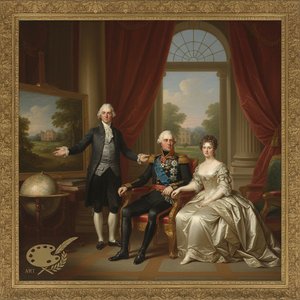 John Hoppner: Portraiture, Patronage & British Identity in the Late Georgian EraExplore the life & work of John Hoppner, a leading Georgian portraitist. Discover his vibrant style, influential patrons, and lasting impac…