Neoclassical
Voltaire (Jean-Antoine Houdon)
Jean-Antoine Houdon (1741–1828) made Voltaire. It belongs to the Neoclassical movement. It is kept at Metropolitan Museum of Art in new york, United States of America.

 Preview

 Hand Made Oil Painting
 Send
 Share
 Fact sheet


 Download
 Similars
 X-Ray
 Diaporama
 Q&A

 Stats
Voltaire, in brief
- Title
- Voltaire
- Artist
- Jean-Antoine Houdon (1741–1828)
- Artist born in
- Versailles, France
- Where to see it
- Metropolitan Museum of Art, new york, United States of America
- Movement
- Neoclassical
- Subject
- philosopher, sculpture, portraiture, enlightenment, marble bust, classical art
Which museum holds Voltaire?
Metropolitan Museum of Art
new york, United States of America
Origins and History of the Metropolitan Museum of Art The Metropolitan Museum of Art began with a vision shared by a group of businessmen, financiers, and leading artists and thinkers. Following its incorporation in 1870, the institution sought a permanent home to house its growing acquisitions. Before settling into its current location, the museum briefly resided in the Douglas Mansion estate on West 14th Street.


High-resolution images of Voltaire

Jean-Antoine Houdon, Voltaire, Metropolitan Museum of Art. Public domain.
Questions on Voltaire, answered
Which museum holds the original "Voltaire"?
The original "Voltaire" by Jean-Antoine Houdon is held at the Metropolitan Museum of Art, new york, United States of America. A reproduction allows the work to be displayed at home.
What is "Voltaire" about?
The subjects of "Voltaire" are philosopher, sculpture, portraiture, enlightenment, marble bust, classical art, jean antoine houdon.
Can the image of "Voltaire" by Jean-Antoine Houdon be freely reproduced?
The copyright answer for "Voltaire" by Jean-Antoine Houdon: the work is in the public domain - its copyright has expired. This determines whether reproductions of the image may be freely made.
Who is the artist behind "Voltaire"?
"Voltaire" is attributed to Jean-Antoine Houdon.
What style does "Voltaire" belong to?
"Voltaire" by Jean-Antoine Houdon belongs to the Neoclassical movement. This movement provides the stylistic context of the work.
Which period of Jean-Antoine Houdon's career does "Voltaire" belong to?
"Voltaire" represents the Mature Period of Jean-Antoine Houdon.
Why is the copyright status of "Voltaire" what it is?
"Voltaire" by Jean-Antoine Houdon is in the public domain - its copyright has expired. Copyright terms are measured from the artist's death, and Jean-Antoine Houdon died in 1828.
Did "Voltaire" stay in its artist's homeland?
No - the artwork is kept abroad. Jean-Antoine Houdon was born in France, and the original "Voltaire" is held in a museum in United States of America.
Where does "Voltaire" sit within Jean-Antoine Houdon's body of work?
"Voltaire" shares with Jean-Antoine Houdon's other works its Neoclassical style and the recorded themes: philosophical reflection, classical idealism, enlightenment values, sculptural mastery, intellectual portraiture.
About the artist, Jean-Antoine Houdon

1741–1828, France
Jean-Antoine Houdon
A Sculptor of the Enlightenment Jean-Antoine Houdon, born in Versailles in 1741, stands as a pivotal figure bridging the Rococo and Neoclassical eras—a sculptor whose work embodies the intellectual fervor and evolving aesthetic sensibilities of the eighteenth century. His life unfolded amidst dramatic shifts in French society, from the waning opulence of the monarchy through the revolutionary upheaval and Napoleonic ascendance. Yet, Houdon remained remarkably consistent in his artistic vision: to capture not merely a likeness, but the very essence of his subjects—their intellect, character, and inner lives—in enduring marble and bronze. This dedication stemmed from an early aptitude for sculpture, nurtured by formal training at the Académie Royale de Peinture et de Sculpture beginning in 1752 under esteemed sculptors like René-Michel Slodtz, Jean-Baptiste Lemoyne, and Jean-Baptiste Pigalle.
About Jean-Antoine Houdon Notable works by Jean-Antoine Houdon
Also by Jean-Antoine Houdon
 George Washington1786
 Bust of Mirabeau1800
 St Bruno1766
 Seated Voltaire

Essays around Voltaire
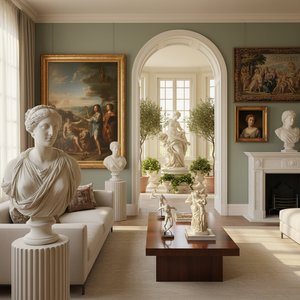 Neo-Classicism's Greatest Hits: 10 Masterpieces for Your Home |Journey through Neo-Classicism's finest! Explore 10 iconic masterpieces by David, Ingres & Canova. Discover art history, techniques & timel…
 The Revival of Antiquity: Exploring Ideals of Beauty & Power in Neoclassical PortraitureExplore the captivating world of Neoclassical portraiture! Discover the power & ideals behind masterpieces by David, Girodet & more. Expert…
 25 Must-See Artworks at the Museum of Fine Arts, Boston: A Curated GuideExplore 25 legendary works from the MFA Boston, from Sargent to European classics. Find museum-quality art at OriginalUniqueArt.com. Explor…