Oil Edition
 Everything about Salvage







































 For artworks or reproductions larger than 105 cm (approximately 41 inches) on any side, the frame will be shipped as a kit, disassembled. This method ensures safe delivery and prevents damage during transport.


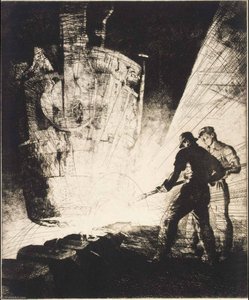
The Salvage by James E. Allen is a captivating etching that showcases the artist's ability to convey drama and tension through his work. Created in 1938, this piece is a testament to Allen's skill as a printmaker and his fascination with the human experience. The etching measures 23 x 30 cm and is currently housed at the Smithsonian American Art Museum in the United States.
The Smithsonian American Art Museum is also a great resource for learning more about American art and artists like James E. Allen.
By examining the Salvage and other works by Allen, we can gain a deeper understanding of his style and technique, as well as the historical context in which he created his art.
The Artist's Inspiration
James E. Allen was an American illustrator, printmaker, and painter who drew inspiration from the world around him. His works often featured industrial scenes, showcasing the daily lives of workers and the struggles they faced. The Salvage is no exception, depicting a shipwreck scene with a sense of urgency and desperation. As seen in other works like Nubbli Lighthouse by Emil Ganso, Allen's use of etching techniques creates a sense of depth and texture, drawing the viewer into the scene.Technique and Style
The Salvage is an excellent example of Allen's mastery of etching. The use of bold lines and contrasting tones creates a sense of drama, while the attention to detail adds depth and complexity to the piece. As noted in the biography of James E. Allen on OriginalUniqueArt.com, his works often featured industrial scenes, showcasing the daily lives of workers and the struggles they faced. Key Features:- The use of etching techniques to create a sense of depth and texture
- The depiction of a shipwreck scene with a sense of urgency and desperation
- The attention to detail, adding complexity to the piece
The Smithsonian American Art Museum is also a great resource for learning more about American art and artists like James E. Allen.
By examining the Salvage and other works by Allen, we can gain a deeper understanding of his style and technique, as well as the historical context in which he created his art.
Questions & Answers
Is this Salvage painted by hand or printed?
Painted by hand: a trained painter copies Salvage in oil on linen canvas.
What size should I choose for Salvage?
The original measures 23 x 30 cm. Sizes run from 27.3 x 36.6 cm ($200) to 182.0 x 243.7 cm ($1640); the table on this page lists the main steps and their prices.
How long does delivery take?
Delivery takes 4 to 5 weeks, with free worldwide express shipping; an urgent production option is offered on this page. You can return it within 100 days for a full refund, with no condition.
More about this painting
 Preview

 Send
 Share
 Details
 Fact sheet


 Download
 Similars
 X-Ray
 Diaporama
 Q&A

 Stats