Oil Edition
 Everything about Red Rocks







































 For artworks or reproductions larger than 105 cm (approximately 41 inches) on any side, the frame will be shipped as a kit, disassembled. This method ensures safe delivery and prevents damage during transport.


Identification of the Artwork and Artist
The scene unfolds in Red Rocks, a work that captures a specific moment of natural stillness. This painting, created in 1894, carries the hand of the French artist Armand Guillaumin. The canvas holds a vision of the coastline, where the earth meets the sea in a quiet, steady rhythm. It is a piece that reflects the artist's unique way of seeing the world through color and light.
Born in Paris, France, Armand Guillaumin spent his life translating the essence of the landscape onto the canvas. His perspective remains present in every stroke, offering a glimpse into the way he interpreted the environment. He lived through a transformative era of art, eventually passing away in 1927. Through this work, his specific vision of the coast remains fixed in time, inviting a quiet observation of the elements.
Visual Composition and Natural Subject
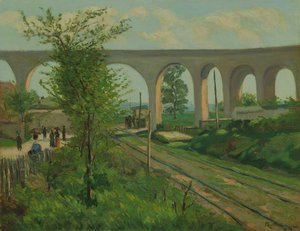
The coastline unfolds where the ocean meets the land, creating a meeting point of salt and stone. Red rocks define the edge of the world here, their deep hues contrasting against the water. Along the shore, the beach area stretches out, dotted with a few scattered rocks that rest quietly in the sand. The scene captures a moment of stillness where the elements converge.
In the foreground, several trees anchor the view, their forms reaching toward the sky. Two pine trees command attention amidst the greenery. One of these pines holds its position near the center of the composition, while the other stands toward the right side of the image. These trees, along with the others, frame the view of the coast and the rugged terrain.
Artistic Style and Technique
The brushwork carries a certain certainty, applied with a loose and assured hand that rejects the need for photographic precision. Instead of chasing every minute detail of the coastline, the artist focuses on the immediate sensation of a moment. Each stroke seems to capture the fleeting energy of the light as it hits the red rocks and the surrounding trees. There is a sense that the scene is breathing, caught in a single, unrepeatable instant of natural grace.
This approach prioritizes the atmosphere over rigid outlines. The way the paint meets the canvas suggests a direct, spontaneous connection to the landscape. Rather than documenting the shore with clinical accuracy, the technique emphasizes the essence of the environment. The result is a composition that conveys a deep sense of tranquility and serenity, inviting a quiet contemplation of the meeting point between the ocean and the land.
Related Works by Armand Guillaumin
The artist's exploration of the natural world continues through various landscapes and personal reflections. In 1872, Place Valhubert, Paris captures a specific urban atmosphere, while The Seine at Charenton follows in 1878, focusing on the river's presence. These earlier works show a focus on the immediate sensation of light and color within the French landscape. By 1893, the vision shifts toward the coast in Saint Palais, Pointe de la Perriere, and a Self-Portrait emerges in 1895, offering a glimpse into the man behind the brushstrokes.
As the years progress, the palette evolves. Seaside at Agay, painted in 1900, brings the viewer to the water's edge once more. Later, the artist turns toward the rugged terrain of the Creuse region, seen in Crozant Landscape, which dates to about 1922. Each piece reflects a movement away from strict naturalism toward a more subjective, expressive interpretation of the environment.
Questions & Answers
Is this Red Rocks painted by hand or printed?
Painted by hand: a trained painter copies Red Rocks in oil on linen canvas.
What size should I choose for Red Rocks?
Sizes run from 28.7 x 34.8 cm ($200) to 199.8 x 241.9 cm ($1772); the table on this page lists the main steps and their prices.
How long does delivery take?
Delivery takes 4 to 5 weeks, with free worldwide express shipping; an urgent production option is offered on this page. You can return it within 100 days for a full refund, with no condition.
What medium did Armand Guillaumin use for Red Rocks?
Oil On Canvas.
More about this painting
 Preview

 Send
 Share
 Details
 Fact sheet


 Download
 Similars
 X-Ray
 Diaporama
 Q&A

 Stats