Baroque · 1611
Still Life with Nuts, Candy and Flowers (Clara Peeters, 1611)
Clara Peeters (1587–1657) made Still Life with Nuts, Candy and Flowers. It dates from 1611. It belongs to the Baroque movement. It is made in oil on panel. It is kept at Museo del Prado in Madrid, Spain. It measures 52 × 73 cm (20.5 × 28.7 in).
- 1611
- Oil On Panel
- 52 × 73 cm (20.5 × 28.7 in)
- Museo del Prado, Madrid

 Preview

 Hand Made Oil Painting
 Send
 Share
 Fact sheet


 Download
 Similars
 X-Ray
 Diaporama
 Q&A

 Stats
Still Life with Nuts, Candy and Flowers, in brief
- Title
- Still Life with Nuts, Candy and Flowers
- Artist
- Clara Peeters (1587–1657)
- Artist born in
- Antwerp, Belgium
- Date
- 1611
- Medium
- Oil On Panel
- Dimensions
- 52 × 73 cm (20.5 × 28.7 in)
- Where to see it
- Museo del Prado, Madrid, Spain
- Movement
- Baroque
- Period
- Early Modern
- Subject
- food, flowers, fruit, bowl, candlelight, luxury
What does Still Life with Nuts, Candy and Flowers depict?
A Sensory Feast: The Opulence of Clara Peeters
In the quiet intimacy of a seventeenth-century tabletop, Clara Peeters invites us into a world where the mundane is elevated to the magnificent. Still Life with Nuts, Candy and Flowers is not merely a depiction of food; it is a masterclass in sensory storytelling. As one gazes upon this 1611 masterpiece, the eye is immediately drawn to the lush, tactile abundance of the arrangement. Polished bowls overflow with an assortment of nuts, while delicate candies and vibrant fruits—apples and oranges—rest alongside elegant glassware. There is a profound sense of weight and texture here; one can almost feel the rough shell of a walnut against the smooth, cool surface of a silver platter or the delicate, ephemeral softness of a flower petal. Peeters captures a moment of suspended animation, where the sweetness of life is presented in all its colorful, decadent glory.
The painting serves as a breathtaking window into the Baroque era, a period defined by its dramatic flair and intense realism. Moving away from the rigid, geometric constraints of earlier Mannerist traditions, Peeters embraces an asymmetrical composition that feels organic and alive. This deliberate lack of strict symmetry creates a dynamic energy, guiding the viewer’s gaze in a wandering, exploratory path across the table. The interplay of light and shadow—the hallmark of the Baroque style—is utilized with surgical precision. Light dances across the sheen of polished metal and the translucent skin of fruit, while deep, velvety shadows provide a sense of depth and mystery, grounding the vibrant colors in a space that feels both tangible and atmospheric.
Technique and the Art of Observation
To behold this work is to witness the extraordinary technical prowess of a true pioneer. Executed with oil on panel, Peeters employed sophisticated glazing techniques to build layers of luminous color, allowing light to penetrate the paint and reflect from within, much like the natural glow of ripe fruit. Her ability to render different materials—the glint of a wine glass, the matte surface of a nut, the organic texture of a potted plant—demonstrates an obsessive devotion to verisimilitude. Every brushstroke is subservient to the goal of absolute realism, making this piece a triumph of observational skill. For the collector or interior designer, such a work offers more than just decoration; it provides a focal point of profound complexity that rewards prolonged contemplation.
Beyond its physical beauty, the painting whispers of deeper, more contemplative themes. In the tradition of the Dutch ontbijtjes (breakfast pieces), such arrangements often functioned as subtle meditations on the fleeting nature of pleasure and the passage of time. The abundance of the feast stands in a delicate balance with the inherent fragility of the flowers and the perishable nature of the food. This tension between abundance and decay creates an emotional resonance that transcends the centuries, offering a poignant reminder to cherish the sensory richness of the present moment. It is this marriage of exquisite craftsmanship and soulful depth that makes Peeters’ vision an enduring inspiration for those seeking to bring a sense of history, elegance, and narrative weight into a contemporary space.
Which museum holds Still Life with Nuts, Candy and Flowers?
Museo del Prado
Madrid, Spain
The History of Museo del Prado The origins of the Museo del Prado are tied to the Royal Collection of Spain, tracing back to the 18th century. What began as a vision for a Natural History Cabinet under Ferdinand VII eventually shifted toward a dedicated sanctuary for painting and sculpture. This transition transformed a scientific endeavor into a repository for the Spanish Crown's most significant treasures.


High-resolution images of Still Life with Nuts, Candy and Flowers

Clara Peeters, Still Life with Nuts, Candy and Flowers (1611).
Clara Peeters (1587–1657), Still Life with Nuts, Candy and Flowers, 1611, oil on panel, Museo del Prado, Madrid, Spain. Public domain. Image: OriginalUniqueArt.com.
Questions on Still Life with Nuts, Candy and Flowers, answered
Which museum holds the original "Still Life with Nuts, Candy and Flowers"?
"Still Life with Nuts, Candy and Flowers" by Clara Peeters is on display at the Museo del Prado, Madrid, Spain. The museum listing refers to the original work, not to reproductions.
When was "Still Life with Nuts, Candy and Flowers" made?
"Still Life with Nuts, Candy and Flowers" by Clara Peeters was created in 1611.
What medium is "Still Life with Nuts, Candy and Flowers" by Clara Peeters executed in?
The medium of "Still Life with Nuts, Candy and Flowers" by Clara Peeters is oil on panel. Reproductions aim to render the appearance of this technique.
What size is "Still Life with Nuts, Candy and Flowers" by Clara Peeters in real life?
"Still Life with Nuts, Candy and Flowers" measures 52 x 73 cm (20.5 × 28.7 in) in its original form. Original dimensions are a useful reference when choosing a reproduction size.
What does "Still Life with Nuts, Candy and Flowers" by Clara Peeters depict?
The themes present in "Still Life with Nuts, Candy and Flowers" by Clara Peeters include food, flowers, fruit, bowl, candlelight, luxury, texture, composition. Together they summarize the artwork's subject matter.
Is "Still Life with Nuts, Candy and Flowers" free of copyright?
The copyright answer for "Still Life with Nuts, Candy and Flowers" by Clara Peeters: the work is in the public domain - its copyright has expired. This determines whether reproductions of the image may be freely made.
Which artist is "Still Life with Nuts, Candy and Flowers" attributed to?
The artist behind "Still Life with Nuts, Candy and Flowers" is Clara Peeters. The work is catalogued under Clara Peeters's name.
What style does "Still Life with Nuts, Candy and Flowers" belong to?
The movement associated with "Still Life with Nuts, Candy and Flowers" by Clara Peeters is Baroque. This classification situates the work among related artists and artworks.
Which period of Clara Peeters's career does "Still Life with Nuts, Candy and Flowers" belong to?
Within Clara Peeters's career, "Still Life with Nuts, Candy and Flowers" falls in the Mature Period. The phase helps compare it with the artist's other works.
About the artist, Clara Peeters

1587–1657, Belgium
Clara Peeters
Clara Peeters: Pioneer of Dutch Still Life Clara Peeters (1594-after 1657) stands as a singular figure in seventeenth-century Flemish art—one of the earliest recognized female painters operating within the burgeoning Dutch Golden Age. Despite societal constraints that severely limited women’s access to artistic training and guild membership, Peeters carved out a remarkable career, leaving behind an oeuvre characterized by meticulous detail, innovative compositional strategies, and a fascination with capturing the textures and nuances of everyday life—particularly food. Her legacy continues to inspire scholars and artists alike as they grapple with questions surrounding her identity, training, and the elusive nature of her artistic output. Early Life & Family Training & Artistic Style Notable Works & Oeuvre Size Influence & Legacy Ongoing Debate: Attribution & Authenticity Early Life & Family Born in Antwerp around 1587—the exact date remains debated by historians—Clara Peeters descended from a family steeped in artistic tradition.
Also by Clara Peeters
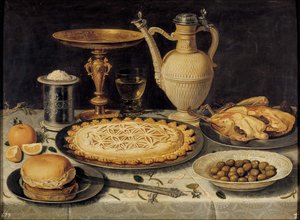 Table with Orange, Olives and Pie1611
 Still Life with Cheeses, Artichoke, and Cherries1625
 Madonna And Child Within A Floral Wreath1621
 Still-Life with Flowers and Goblets1612

Essays around Still Life with Nuts, Candy and Flowers
 Luminous Vessels: The Transcendent Art of the Bottle in Impressionist Still LifeExplore how Impressionist masters captured light through glass and bottles. Discover the magic of light and texture today.
 18th century Dutch paintersJan van Huysum completed Flowers and Fruit in 1723. Compare his botanical precision with the maritime works of Willem van de Velde the Youn…
 Master of Abundance: The Top 25 Essential Artworks by Frans SnydersBorn in 1579, Snyders trained under Pieter Brueghel the Younger. Count the twenty-five works that define his Baroque mastery of texture and…