Ölversion kaufen
 Alles über SALES COUNTER







































 Bei Kunstwerken oder Reproduktionen, die an einer Seite größer als 105 cm (ca. 41 Zoll) sind, wird der Rahmen zerlegt als Bausatz geliefert. Diese Methode gewährleistet eine sichere Zustellung und verhindert Schäden während des Transports.


A Glimpse into Mid-Century Commerce
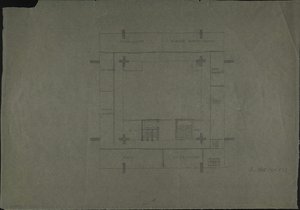
In the delicate lines of "SALES COUNTER," created in 1957 by the visionary German artist Franz Ehrlich, we are transported to a moment frozen in time. This captivating drawing serves as more than just a depiction of a commercial space; it is a window into the social fabric of the mid-2'0s. The composition captures a meticulously arranged sales counter, divided into distinct sections that guide the viewer's eye through a landscape of 1950s utility and design. Within this scene, the presence of chairs scattered near the counter and a central dining table suggests a space where commerce and community intersect. The inclusion of two figures—one standing poised on the left and another positioned toward the right—adds a layer of human narrative, transforming a structural study into a living, breathing vignette of daily life.
The artwork breathes with the unmistakable influence of the Bauhaus, an institution that shaped Ehrlich’s very soul. One can sense the architectural precision in the way the counter is rendered, reflecting his training in Dessau. The style is characterized by a clean, graphic clarity that emphasizes form and function, yet it avoids the coldness often associated with industrial design. Instead, there is a rhythmic quality to the placement of objects—the mounted television, the arrangement of seating, and the spatial relationship between the people and the furniture—that creates a sense of balanced harmony. For the collector or interior designer, this piece offers a sophisticated interplay of geometry and atmosphere, making it an ideal focal point for spaces that celebrate modernism and structural elegance.
Beyond its aesthetic appeal, "SALES COUNTER" carries a profound historical weight. Having survived the turbulence of the Nazi regime and the complexities of his political affiliations, Ehrlich’s work often reflects a resilient spirit of reconstruction and order. This drawing, produced in 1957, embodies a period of post-war stabilization, where the design of everyday objects became a way to rebuild a sense of normalcy and progress. The emotional impact of the piece lies in this quiet tension between the rigid lines of architecture and the soft, transient presence of human interaction. It invites the viewer to contemplate the beauty found in the mundane and the enduring strength of organized design.
For those seeking to adorn a contemporary interior with a sense of history and intellectual depth, a high-quality reproduction of this masterpiece offers an unparalleled opportunity. Whether placed in a minimalist gallery setting or a warm, classic study, "SALES COUNTER" brings with it the prestige of the Bauhaus legacy and the evocative charm of a bygone era. It is a piece that does not merely decorate a wall; it starts a conversation about the intersection of art, life, and the enduring power of the graphic line.
Fragen & Antworten
Ist das Kunstwerk SALES COUNTER handgemalt oder ein Druck?
Handgemalt: Ein ausgebildeter Maler repliziert SALES COUNTER in Öl auf Leinenleinwand.
Welche Größe sollte ich für SALES COUNTER wählen?
Das Original hat die Maße 51 x 66 cm. Die Größen reichen von 27.9 x 35.8 cm (€179) bis 194.3 x 248.7 cm (€1587); die Tabelle auf dieser Seite listet die wichtigsten Formate und deren Preise auf.
Wie lange dauert die Lieferung?
Die Lieferung dauert 4 bis 5 Wochen mit kostenlosem weltweiten Expressversand; auf dieser Seite wird eine Option für eine eilige Produktion angeboten. Sie können das Kunstwerk innerhalb von 100 Tagen ohne Einschränkungen an uns zurückgeben und erhalten eine vollständige Rückerstattung.
Wo befindet sich das Original von SALES COUNTER?
Das Original befindet sich in der Sammlung des Bauhaus Dessau Foundation, Dessau-Roßlau.
Ist das Original von SALES COUNTER eine Zeichnung oder ein Gemälde?
Eine Zeichnung: Franz Ehrlich fertigte sie in Drawing an.
 Vorschau anzeigen

 Versenden
 Teilen
 Details anzeigen
 Datenblatt


 Herunterladen
 Ähnliche Objekte
 Röntgenaufnahme
 Diashow
 Fragen & Antworten

 Statistiken