Modern Sculpture · 1937
Two Forms (Barbara Hepworth, 1937)
Barbara Hepworth (1903–1975) made Two Forms. It dates from 1937. It belongs to the Modern Sculpture movement. It is made in sculpture. It is kept at The Hepworth Wakefield in Wakefield, United Kingdom.
- 1937
- Sculpture
- The Hepworth Wakefield

 Hand Made Oil Painting
 Send
 Share
 Fact sheet


 Download
 Similars
 Diaporama
 Q&A

 Stats
Two Forms, in brief
- Title
- Two Forms
- Artist
- Barbara Hepworth (1903–1975)
- Artist born in
- Wakefield, United Kingdom
- Date
- 1937
- Medium
- Sculpture
- Where to see it
- The Hepworth Wakefield, Wakefield, United Kingdom
- Movement
- Modern Sculpture
- Period
- Modern
- Subject
- sculpture, concrete, abstraction, form, british art, hepworth
What does Two Forms depict?
The Essence of Form and Void
In this 1937 work, we encounter a profound exploration of simplicity. The sculpture presents two interlocking forms that ascend vertically, separated by a shallow concave curve. There is a quietude here, a deliberate move away from the representational imagery that dominated previous eras. Instead of depicting a recognizable subject, the work seeks to distill the very essence of shape. It is a study in geometric abstraction, where the relationship between the solid mass and the empty space becomes the primary subject. The verticality of the composition suggests a subtle upward movement, a quiet tension held within the stillness of the material.
Materiality and the Organic Curve
The choice of concrete allows for a specific kind of tactile presence. This material captures subtle tonal variations, giving the surface a weight and solidity that feels grounded. While the shapes are geometric, they are not cold or purely intellectual; there is an organic principle at work in the way the forms curve. This curvature mirrors the natural contours found in rock formations, suggesting a dialogue between the man-made and the geological. The interplay of light and shadow across the concave center creates a sense of depth, making the void feel as tangible as the solid material itself.
- Material: Concrete
- Year: 1937
- Style: Modern Sculpture
- Movement: Abstraction-Création
A Dialogue of Space
To understand this piece, one must consider the radical simplification of expression it represents. It emerged from a period of intense intellectual activity, where artists sought to bridge the gap between surrealist exploration and pure abstraction. The work avoids the anxieties of its time by focusing on visual harmony and precise geometric relationships. By introducing these specific voids, the sculpture transforms the empty space into a structural element. The air within the form becomes a part of the composition, creating a tension between presence and absence that defines the modernist aesthetic. It is a quiet, restrained achievement that communicates through the language of pure form.
Which museum holds Two Forms?
The Hepworth Wakefield
Wakefield, United Kingdom
The Hepworth Wakefield: A Sanctuary of Sculpture and Light Located on the south side of the River Calder in Wakefield, West Yorkshire, The Hepworth Wakefield is more than just a gallery; it’s an architectural statement and a testament to Barbara Hepworth's legacy—a celebration of British modernist art that continues to inspire visitors today. Opened in 2011 by David Chipperfield Architects, this building embodies the spirit of its namesake: simplicity, elegance, and a profound connection with the surrounding landscape. Architectural Marvel: Designed by David Chipperfield, the gallery’s ten trapezoidal blocks are clad in pigmented concrete—a groundbreaking material choice that reflects Wakefield's industrial heritage while embracing a strikingly modern aesthetic.


High-resolution images of Two Forms

Protected by copyright: these files are for personal reference, not a licence to republish.
Barbara Hepworth, Two Forms (1937), The Hepworth Wakefield.
Questions on Two Forms, answered
Where can I see the original "Two Forms" by Barbara Hepworth?
The original "Two Forms" by Barbara Hepworth is held at The Hepworth Wakefield, Wakefield, United Kingdom. A reproduction allows the work to be displayed at home.
When was "Two Forms" made?
The creation of "Two Forms" by Barbara Hepworth is dated 1937.
What technique was used for "Two Forms" by Barbara Hepworth?
The medium of "Two Forms" by Barbara Hepworth is sculpture. Reproductions aim to render the appearance of this technique.
What subjects appear in "Two Forms" by Barbara Hepworth?
The themes present in "Two Forms" by Barbara Hepworth include sculpture, concrete, abstraction, form, british art, hepworth, modernism. Together they summarize the artwork's subject matter.
Is "Two Forms" free of copyright?
"Two Forms" by Barbara Hepworth is still protected by copyright. This status governs how the image of the work may be reproduced.
Which artist is "Two Forms" attributed to?
"Two Forms" was created by Barbara Hepworth. The information on this page describes Barbara Hepworth's original work.
What art movement does "Two Forms" by Barbara Hepworth belong to?
"Two Forms" is a work of Modern Sculpture. The movement indicates the artistic tradition the work is part of.
Which period of Barbara Hepworth's career does "Two Forms" belong to?
Within Barbara Hepworth's career, "Two Forms" falls in the Mature Period. The phase helps compare it with the artist's other works.
At what age did Barbara Hepworth make "Two Forms"?
When "Two Forms" was created in 1937, Barbara Hepworth - born in 1903 - was 34 years old.
About the artist, Barbara Hepworth

1903–1975, United Kingdom
Barbara Hepworth
Early Life, Family and Training Barbara Hepworth was born on 10 January 1903 in Wakefield, West Riding of Yorkshire, England. She was the eldest child of Gertrude and Herbert Hepworth. Her father worked as a civil engineer for the West Riding County Council, a background that provided a practical, structural foundation to her upbringing. This early environment in Yorkshire shaped the spatial awareness that would later define her approach to three-dimensional form.
Also by Barbara Hepworth
 Barbara Hepworth with the plaster of Figure for Landscape and a bronze cast of Figure (Archaean), November 1964.1964
 Spring (Arts Council Collection)1966
 Hollow Form with White Interior1963
 Prototype for Mrs A.R.T. Richards (Quita)1924
Essays around Two Forms
 The Living Contour: A Collector’s Guide to Organic Form and Biomorphic DesignMaster the nuances of organic form and biomorphic design through expert analysis. Explore the rhythm of life in art today.
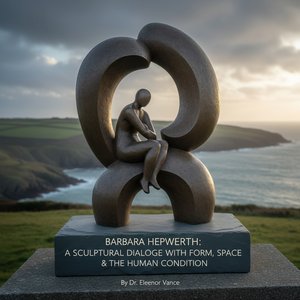 Barbara Hepworth: A Sculptural Dialogue with Form, Space & the Human ConditionExplore the profound world of Barbara Hepworth's sculpture. Discover her artistic evolution, iconic forms, and lasting influence on modern …
 Geometry with Purpose: Distinguishing Suprematism from ConstructivismMaster the differences between Suprematism and Constructivism with our expert guide. Discover the soul of the Russian avant-garde now.