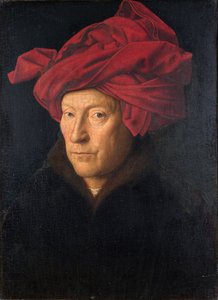
Man in a Blue Turban
Oil On Panel
Early Netherlandish painting
1433
Renaissance
17.0 x 23.0 cm
The National Museum of Art of Romania
Hand Made Oil Reproduction
Hand-painted oil on canvas in your size and frame, made to order by our artists. ( Switch to Print
Switch to Digital Image)
P118B $10
P118H $10
P118W $10
P438Z $10
P508JH $12
P508YH $12
P805H $10
P805Z $10
P919BZ $10
P919G $10
P919XJ $10
P959ZH $10
P968JZ $12
W106C $8
W218G $10
W218JH $8
W218Y $10
W307PJ $10
W316G $10
W316PJ $8
W316Y $10
W398PJ $8
W4111J $10
W500HY $15
W500JH $15
W692G $12
W849H $8
W940BG $15
W953PJ $8
Pick from our preset sizes that match the artwork's original proportions.
Type the width and the height you need, to fit your frame or your wall. This is hand-painted, so for a size with a different shape the artist can paint a bit more around the picture, or cut a bit — you choose. We send you a digital mockup to approve before the painting starts. The picture shown on this page does not show the real result — only the mockup does.
After order, OriginalUniqueArt.com team will email client for instructions and provide a mockup preview
Worldwide Delivery () in 3/4 weeks instead of standard 5 weeks. (27 October). No compromise on quality.
Free Worldwide Express Shipping
High-Quality Linen Canvas
Full Shipping Insurance
Customs Tax Refund Guarantee
True Color Matching Guarantee
100-Day Return Policy (Defects Only)
100% Money-Back Guarantee
Bulk Discount Offer
Man in a Blue Turban
Reproduction Medium
Reproduction Size
-
Total Price
$ 300
A Glimpse into Renaissance Dignity
Painted in 1433 by Jan van Eyck, this captivating portrait offers an intimate encounter with a man of quiet contemplation and refined status. More than just a likeness, it’s a window into the burgeoning artistic sensibilities of the Early Netherlandish period, showcasing Van Eyck's mastery of detail and psychological insight.

Masterful Technique & Artistic Innovation
Van Eyck’s groundbreaking use of oil paint is vividly apparent in this work. The medium allows for an unprecedented level of realism – from the subtle textures of skin and fabric to the delicate rendering of facial features. Note the meticulous detail in the man's beard, the folds of his dark clothing, and most strikingly, the luminous quality of the vibrant blue turban. This wasn’t merely representation; it was a revolution in artistic technique, enabling unparalleled depth and luminosity.
Symbolism & Historical Context
The sitter’s identity remains debated, adding to the painting's mystique. The distinctive blue headdress (or chaperon) is particularly intriguing. Blue held significant symbolic weight during this period, often associated with nobility, piety, and even the Virgin Mary. It suggests a man of importance, perhaps connected to religious orders or holding a position within the Burgundian court – where Van Eyck served as a highly esteemed painter. The inscription above his head, though partially obscured, hints at further layers of meaning, likely referencing faith or personal devotion.
Composition & Emotional Resonance
The composition is remarkably direct and engaging. The man’s frontal pose and unwavering gaze create an immediate connection with the viewer. This isn't a distant, idealized portrait; it feels like a genuine encounter. Van Eyck skillfully balances formality with intimacy, conveying a sense of solemnity tempered by quiet dignity. The dark background serves to focus attention entirely on the sitter, emphasizing his presence and inner life.
A Timeless Addition for Discerning Collectors
This artwork transcends its historical context, offering enduring aesthetic appeal. Its restrained color palette, masterful technique, and compelling subject matter make it a captivating focal point for any collection. For interior designers, this reproduction brings an air of sophisticated elegance to living spaces, studies, or libraries. It’s a piece that invites contemplation and sparks conversation – a testament to the power of Renaissance artistry.
Investing in Art History
Owning a high-quality reproduction allows you to experience the beauty and significance of this masterpiece firsthand. OriginalUniqueArt.com offers meticulously hand-painted reproductions, capturing the nuances of Van Eyck’s original work with exceptional fidelity. Bring a piece of art history into your home or office and enjoy the enduring legacy of Jan van Eyck.
Questions & Answers
Where does "Man in a Blue Turban" stand among Jan van Eyck's recurring subjects?
Jan van Eyck's recurring themes include flemish primitives influence, burgundian court patronage, showcases oil paint mastery; "Man in a Blue Turban" focuses on portrait, renaissance, realism, man, turban, detail, introspection, 15th century.
Where is "Man in a Blue Turban" suggested to be displayed, considering its palette?
With its earthy palette, "Man in a Blue Turban" by Jan van Eyck is recommended for a living room. The colors are part of the reason for this suggestion.
Can I see "Man in a Blue Turban" by Jan van Eyck under different lights?
"Man in a Blue Turban" can be examined layer by layer on the artwork's X-Ray page, a viewer inspired by a conservator's light bench with eleven optical readings of the image.
Artist Biography
The Alchemist of Light
To look at a Jan van Eyck painting is to witness the moment Western art stopped pretending and started observing. We often hear the myth that he invented oil paint, but the truth is more grounded and far more impressive: he mastered it. By applying thin, translucent glazes of pigment over one another, he achieved a depth of color and a precision of texture that tempera simply could not sustain. He did not just paint surfaces; he captured how light interacts with them. When you see the gleam of a single candle or the heavy weight of a velvet robe in his work, you are seeing the result of a technical revolution that changed the visual language of Europe.

His career was built on more than just brushwork. Van Eyck operated within the high-stakes environment of the Burgundian court, serving Philip the Good. This position required him to be much more than a craftsman; he functioned as a diplomat, traveling to places like Portugal and Spain on official missions. This access to power provided the financial stability necessary for his technical experiments. He was a man of intellect and discretion, qualities that allowed him to move between the worlds of high politics and fine art with ease.
The Precision of the Northern Eye
The work of Van Eyck is defined by an almost obsessive attention to the minute details of the physical world. In his portraits, he does not merely record a face; he records the texture of skin, the individual strands of hair, and the specific way light hits a turban. This level of realism was driven by a shift in focus toward the individual and the tangible. His ability to render atmospheric perspective—the way distant landscapes soften into a blue haze—showed a sophisticated understanding of how the human eye perceives depth.
His most significant technical achievements can be seen in several key works:
- The Ghent Altarpiece: A massive twelve-panel polyptych that demonstrates his ability to manage complex religious symbolism alongside realistic figures.
- The Arnolfini Portrait: A 1434 work where every object, from the dog representing fidelity to the discarded shoes on holy ground, carries specific weight. The mirror in the background reflects a whole other layer of reality.
- Portrait of a Man (Self Portrait?): A 1433 oil painting that features his personal motto, "Als ich kan" (As well as I can), etched directly onto the frame.
A Lasting Technical Standard
The influence of Jan van Eyck is not found in a vague sense of inspiration, but in the concrete standards he set for the medium. He moved the needle from the matte, flat surfaces of the medieval era toward a luminous, three-dimensional reality. His signature, "JOHANNES DE EYCK," and his frequent use of his motto served as a direct challenge to his contemporaries. He was not interested in the anonymity common to many medieval painters; he wanted his technical prowess to be recognized and attributed.
Even after his death in Bruges in 1441, the methods he perfected continued to dictate how artists approached light and texture for generations. His work remains a benchmark because it represents the successful marriage of scientific observation and artistic skill. He transformed pigments into something that feels alive, leaving behind a body of work that remains as sharp and clear today as it was in the fifteenth century.
Jan van Eyck
1390 - 1441 , Netherlands
Quick Facts
- Artistic Movement Or Style: Early Netherlandish painting
- Artists Or Movements Influenced By This Artist:
- Early Netherlandish painting
- Generations of painters
- Full Name: Jan van Eyck
- Nationality: Flemish
- Notable Artworks:
- Ghent Altarpiece
- Arnolfini Portrait
- Dresden Triptych
- Man in a Blue Turban
- Place Of Birth: Maastricht, Netherlands
- Date Of Birth: 1390
- Date Of Death: 1441

Glass option is only available in size under 110 CM