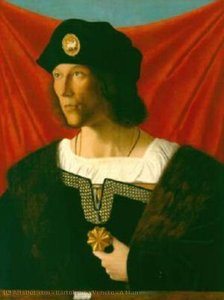
A Venetian Hand: The Life and Art of Bartolomeo Veneto
Bartolomeo Veneto, a name that whispers of Renaissance elegance and subtle psychological depth, remains an intriguing figure in the panorama of 16th-century Italian painting. Active between approximately 1502 and 1531, his career unfolded across Venice, the mainland territories of the Veneto region, and the vibrant artistic hub of Lombardy. Unlike many of his contemporaries whose lives are richly documented, Bartolomeo’s story is pieced together from the scant evidence of signatures on his works, dates inscribed upon them, and a careful analysis of stylistic evolution. This relative obscurity only adds to the mystique surrounding an artist celebrated for portraits that capture not merely likeness but also a profound sense of individual character.Early Training and Venetian Roots
Bartolomeo’s artistic journey began in Venice, where he entered the workshop of Gentile Bellini, a prominent master known for his detailed realism and narrative skill. This formative period undoubtedly instilled in Bartolomeo a meticulous approach to technique and an appreciation for refined observation. His earliest surviving paintings – small devotional pictures dating from around 1502 – reveal this early influence. These works, though modest in scale, demonstrate a delicate hand and a commitment to traditional Venetian artistic values. Significantly, the signature on his *Virgin and Child* of 1502 offers a fascinating glimpse into his identity: “Bartolomeo half-Venetian and half-Cremonese.” This intriguing inscription suggests a mixed heritage, perhaps indicating familial ties to Cremona, and importantly, points to an early exposure to diverse artistic traditions. The reference to the Cremonese school, founded by Giulio Campi, hints at a broader stylistic awareness beyond the confines of Venice itself.The Rise of Portraiture and Courtly Commissions
As the 16th century progressed, Bartolomeo astutely recognized a growing demand for portraiture within Venetian society. He skillfully adapted his subject matter to cater to this evolving taste, transitioning from smaller devotional works to more ambitious portraits that celebrated the status and individuality of his sitters. Between 1505 and 1507, records indicate he served as “Bartolomeo da Venetia” at the Este court in Ferrara, a center of refined culture and artistic patronage. There, he undertook diverse tasks – gilding frames, creating festive decorations, and painting religious compositions – broadening his skills and exposure to different artistic demands. This period likely fostered the decorative emphasis that would become characteristic of his style.Leonardo’s Influence and Milanese Success
Around 1520, Bartolomeo relocated to Milan, a city still resonating with the legacy of Leonardo da Vinci. It was here that his artistic voice truly matured, absorbing the lessons of the master who had profoundly transformed portraiture in Italy. The influence of Leonardo is palpable in Bartolomeo’s later works – a subtle sfumato softening forms, an increased psychological complexity in his sitters, and a heightened attention to atmospheric effects. He quickly gained prominence in Milan, securing numerous commissions from wealthy patrons eager for portraits that conveyed both social standing and inner life. Paintings like *Portrait of Ludovico Martinengo* (1530) exemplify this mature style, showcasing a masterful command of volume, depth, and nuanced expression.A Legacy of Elegance and Intimacy
Despite achieving considerable success during his lifetime, Bartolomeo Veneto’s oeuvre remains relatively small – approximately forty paintings are generally attributed to him, with only nine bearing his signature. He appears to have received few public commissions, focusing instead on private portraiture for a discerning clientele. His portraits, often half-length depictions of elegantly dressed young men and women, stand out for their meticulous detail, rich color palettes, and the psychological insight they offer into the sitters’ personalities. While he never achieved the widespread fame of contemporaries like Titian or Raphael, Bartolomeo Veneto carved a unique niche for himself as a painter of refined elegance and intimate character – a Venetian hand capable of capturing not just appearances but also the subtle nuances of the human spirit. His work continues to captivate viewers with its quiet beauty and enduring psychological depth, offering a compelling glimpse into the world of Renaissance Italy.问答详情
Bartolomeo Veneto 的创作时期属于哪个历史阶段?
Bartolomeo Veneto 的创作活跃于 Renaissance 时期,这一时期确立了艺术家在艺术史上的地位。
是否有关于 Bartolomeo Veneto 的生平年表?
Bartolomeo Veneto 的 艺术历程 是一个随滚动条变化的艺术时间轴,按创作时期进行章节划分,并按时间顺序呈现艺术家的作品。
Bartolomeo Veneto 属于哪些艺术流派?
全部流派 页面按艺术流派对 Bartolomeo Veneto 的作品进行了分类。
我可以在虚拟博物馆中参观Bartolomeo Veneto的作品吗?
Bartolomeo Veneto 的 3D 艺术展厅 可以在虚拟三维展厅中欣赏到艺术家的作品。