

 效果预览
效果预览
 切换至版画销售渠道
 分享
分享 分享
分享
 详情
详情

 下载
下载
 相似作品
相似作品 X射线
X射线 幻灯片播放
幻灯片播放 统计数据
统计数据Coney Island
 1940
1940 26.0 x 35.0 cm
 展开详情
展开详情
购买高分辨率增强版数字图像,其品质远超在线预览。
每一份文件都由我们的内部专家使用先进工具与专业的后期润色技术精心打造。我们确保每一张图像都具备卓越的清晰度、精准的色彩还原度以及细腻的细节表现。
最终文件将在 72 小时内通过电子邮件交付,并针对专业、编辑及印刷用途进行了优化。其品质与顶级设计工作室、出版社和画廊所信赖的标准完全一致。
每份数字图像订单均包含
专业数字图像交付,品质保障
选择 OriginalUniqueArt.com,您获得的不仅仅是一张图像——您收到的是经过专业级增强、精雕细琢的数字艺术作品,并享有满意保证。以下是您的订单中自动包含的所有内容:

邮件快速送达
您的高分辨率数字图像文件将在下单后 72 小时内通过电子邮件发送给您 —— 即可立即使用。

AI 增强型数字文件
您的艺术品经过专业优化,结合先进的 AI 技术与人工修饰,确保呈现极致的细节、清晰度与色彩准确度。

终身免费重发服务
不小心删除了文件或找不到了?没关系——我们将随时为您免费重发。

无需进口费用,始终如一
即刻拥有您的艺术作品,无需支付任何关税、税费或运费——数字下载始终免税。

色彩精准保证
我们通过专业工具与色彩管理技术,确保您的数字图像尽可能真实地还原原作色彩。

100天满意保证
如果您对所购数字图像不满意,我们将在100天内为您进行修改或提供100%的全额退款——无需任何理由。

100% 退款保证
不满意?在收到数字文件后的100天内,您可以申请全额退款——无需任何理由。

批量订单优惠
购买 3 张图片可享 10% 折扣 - 购买 5 张可享 15% 折扣 - 购买 10+ 张可享 20% 折扣。非常适合创意项目、画廊和机构使用。
艺术家简介
The Shadow of the City: The Life and Lens of Weegee
In the frantic, neon-lit pulse of mid-century New York, one name emerged from the darkness to document the city's most visceral moments: Weegee. Born Arthur Melville Fellig in 1899, the man behind the pseudonym was far more than a mere observer; he was a phantom of the streets, a self-made pioneer who transformed the grim realities of urban decay into a profound form of visual journalism. His journey did not begin in the hallowed halls of an art academy, but rather in the grit and hardship of Brooklyn. After serving as a soldier in World War I—an experience that likely stripped away any lingering illusions of romanticism—Fellig turned his gaze toward the burgeoning chaos of Manhattan. He was a man who understood that the true heart of the metropolis beat most loudly in its darkest alleys, its crime scenes, and its moments of sudden, unvarnished tragedy.
Weegee’s rise to prominence was characterized by an unparalleled audacity. Eschewing the traditional path of seeking employment through official channels, he famously created his own vocation. For years, he operated without credentials, haunting Manhattan Police Headquarters and waiting for the police teletype to broadcast the next unfolding drama. This relentless pursuit allowed him to arrive at scenes of accidents, fires, and crimes often mere minutes after they occurred, capturing a raw immediacy that no other photographer could replicate. His work was not an attempt to beautify the struggle of the Great Depression or the tension of the post-war era; instead, it was a confrontation. Through his lens, the viewer was forced to witness the unflinching reality of poverty, injury, and death, presented without the comfort of artistic embellishment.
Technique and the Aesthetics of Flash
The visual language of Weegee was defined by a stark, high-contrast aesthetic that has since become iconic in the history of street photography. Utilizing a Rolleiflex camera equipped with a powerful flashbulb, he mastered the art of illuminating the shadows. This technique created a dramatic, almost theatrical lighting effect, where subjects were thrust into sharp relief against an impenetrable black background. This "flash-heavy" style did more than just provide visibility in the dead of night; it heightened the psychological tension of his compositions, isolating individuals and objects within a void of urban uncertainty. There was no room for retouching or manipulation in his process; he sought a brutal honesty that relied entirely on the spontaneous interplay of light and darkness.
His compositions, while appearing spontaneous, were deeply impactful due to their ability to frame the human condition. Whether capturing a captured burglar, the chaotic energy of Coney Island, or the sudden stillness of a street accident, Weegee possessed an innate sense of timing and framing. His black and white prints carried a weight that color could never achieve, emphasizing textures of wet pavement, weathered skin, and the cold steel of police sirens. This mastery of light allowed him to turn the mundane and the macabre into something hauntingly beautiful, bridging the gap between news photography and fine art.
Legacy and Historical Significance
The historical significance of Weegee lies in his role as a chronicler of an era that was rapidly disappearing. He captured the transition of New York from the desperate years of the Depression through the transformative period of World War II, providing a visual record of social realism that remains unparalleled. Beyond his solo photographic endeavors, his influence extended into the realm of cinema, where he collaborated with legendary directors like Stanley Kubrick, bringing his gritty, documentary-style eye to the silver screen.
Today, Weegee is remembered not just as a photojournalist, but as an artist who found meaning in the margins of society. His work serves as a testament to the power of the unmediated gaze, reminding us that there is profound truth to be found in the shadows. His legacy continues to inspire generations of street photographers who seek to capture the pulse of the world exactly as it is: raw, unfiltered, and undeniably human.
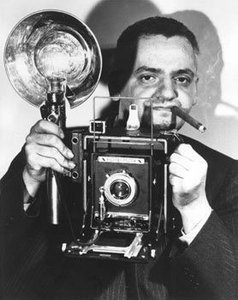
weegee (arthur fellig)
1899 - 1968
基本信息
- Artistic Movement Or Style: Street Photography
- Date Of Birth: 1899
- Full Name: Arthur Fellig
- Nationality: American
- Notable Artworks:
- Brooklyn School Children See Gambler Murdered in Street
- Street Accident
- Victory Celebration
- Place Of Birth: New York City, USA