切换至版画销售渠道
 展开全文
展开全文







































 对于任何边长超过 105 厘米(约 41 英寸)的艺术品或复制品,画框将以拆解后的组件形式发货。此方法可确保安全送达并防止运输过程中的损坏。


The Serene Bridge: Paul Cézanne’s *Pont de Maincy*
Paul Cézanne's *Pont de Maincy*, painted between 1879 and 1880, isn’t merely a depiction of a bridge; it’s a distillation of light, space, and the very essence of a fleeting moment. Preserved within the hallowed halls of the Musée d'Orsay in Paris, this unassuming landscape holds an extraordinary power—a testament to Cézanne’s revolutionary approach to painting and his profound influence on the course of modern art. The work captures a simple scene – a wooden bridge spanning the Almont River in the commune of Maincy, France – yet through Cézanne's masterful brushwork and astute observation, it transcends its humble subject matter to become an exploration of perception itself.
Cézanne’s decision to paint this particular view was rooted in his residence near Maincy during a period of intense artistic experimentation. He wasn’t simply recording the scene before him; he was actively dissecting and rebuilding it, employing a technique that would later become central to Cubism. The painting's composition is deliberately asymmetrical, with the bridge acting as a strong diagonal element bisecting the canvas. This creates an immediate sense of dynamism and movement, drawing the eye across the landscape and inviting contemplation. Notice how Cézanne doesn’t attempt to render every detail with photographic accuracy; instead, he simplifies forms, reducing them to their essential geometric shapes – cylinders, cones, and planes—a key element in his pursuit of a more fundamental understanding of visual reality.
A Post-Impressionist Masterpiece
*Pont de Maincy* firmly establishes Cézanne as a pivotal figure bridging the gap between Impressionism and Cubism. While retaining some of the Impressionists’ focus on capturing fleeting light and color, Cézanne moves beyond mere optical representation to explore the underlying structure of objects. The brushstrokes are not blended smoothly; they are distinct, visible marks that build up layers of color and texture. This technique, known as “impasto,” adds a tactile quality to the painting, inviting the viewer to almost feel the roughness of the wood and the warmth of the sun on the water.
The use of color is equally significant. Cézanne employs a palette of muted earth tones – ochres, browns, greens, and blues—to create a sense of atmospheric depth. He doesn’t rely on bright, vibrant hues; instead, he uses subtle variations in tone to suggest distance and form. The light itself seems to emanate from within the painting, bathing the scene in a warm, golden glow. The two birds perched on the bridge are not merely decorative elements; they inject a vital sense of life and movement into the otherwise tranquil landscape, acting as silent witnesses to this moment in time.
Echoes of Innovation: Influence and Legacy
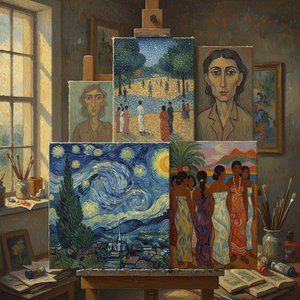
Cézanne’s *Pont de Maincy* wasn't immediately embraced by the art world. However, its innovative approach quickly gained recognition among a select group of artists, including Herman Braun-Vega, who created a striking, inverted still life titled *Papaye à la guitare (Cézanne)*. This piece, featuring a guitar and papaya, serves as a fascinating dialogue with Cézanne’s work—a visual echo of his fragmented forms and emphasis on underlying structure. The influence of *Pont de Maincy* extends far beyond Braun-Vega's painting; it can be seen in the works of Picasso, Matisse, and countless other artists who followed in Cézanne’s footsteps.
The painting has been exhibited extensively throughout history, including notable showings in London, Paris, Beijing, and New York. Its enduring appeal lies not only in its aesthetic beauty but also in its profound exploration of the nature of perception and representation. For those seeking a piece that embodies both artistic innovation and timeless elegance, a high-quality reproduction of *Pont de Maincy* offers a remarkable opportunity to connect with one of the most influential figures in modern art.
Exploring Cézanne’s World
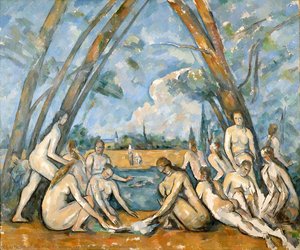
- Related Works: Consider exploring other key works by Cézanne, such as *Poplars* and *Kortspelarna paris musée d'orsay*, to gain a deeper understanding of his artistic range and evolution.
- Further Research: For more detailed information about *Pont de Maincy*, visit the Musée d’Orsay website: https://www.musee-orsay.fr/en/artworks/pont-de-maincy-797
- Additional Resources: Explore online resources such as Wikipedia: https://en.wikipedia.org/wiki/Pont_de_Maincy and the OriginalUniqueArt website for more information on Paul Cézanne and his works: /art/list/?Filter=8YDMTX-Paul-Cezanne-The-Pont-de-Maincy
常见问题与解答
"The Pont de Maincy" 是否支持增强现实 (AR) 预览?
通过兼容设备访问 塞尚 的《The Pont de Maincy》 的 AR 效果预览 页面,即可利用增强现实技术将艺术品呈现在您自己的空间中。
哪种空间能与 塞尚 的《The Pont de Maincy》 的色彩相得益彰?
考虑到其大地色系的色调,建议将“The Pont de Maincy”布置于客厅空间中。
如何描述 塞尚 的《The Pont de Maincy》 的意境?
塞尚 的《The Pont de Maincy》 的整体基调为 宁静,这种基调传达了作品的整体氛围。
 实景预览
实景预览
 分享
分享 分享
分享
 详情
详情 指南
指南

 下载作品
下载作品
 相似作品
相似作品 X射线
X射线 幻灯片播放
幻灯片播放 Q&A
Q&A 统计数据
统计数据