

 效果预览
效果预览
 购买印刷品
购买印刷品 分享
分享 分享
分享
 详情
详情

 下载
下载
 相似作品
相似作品 X射线
X射线 幻灯片播放
幻灯片播放Abstract Composition (Composition abstraite)
 1934
1934 27.0 x 35.0 cm
 展开详情
展开详情
购买高分辨率增强版数字图像,其品质远超在线预览。
每一份文件都由我们的内部专家使用先进工具与专业的后期润色技术精心打造。我们确保每一张图像都具备卓越的清晰度、精准的色彩还原度以及细腻的细节表现。
最终文件将在 72 小时内通过电子邮件交付,并针对专业、编辑及印刷用途进行了优化。其品质与顶级设计工作室、出版社和画廊所信赖的标准完全一致。
每份数字图像订单均包含
专业数字图像交付,品质保障
选择 OriginalUniqueArt.com,您获得的不仅仅是一张图像——您收到的是经过专业级增强、精雕细琢的数字艺术作品,并享有满意保证。以下是您的订单中自动包含的所有内容:

邮件快速送达
您的高分辨率数字图像文件将在下单后 72 小时内通过电子邮件发送给您 —— 即可立即使用。

AI 增强型数字文件
您的艺术品经过专业优化,结合先进的 AI 技术与人工修饰,确保呈现极致的细节、清晰度与色彩准确度。

终身免费重发服务
不小心删除了文件或找不到了?没关系——我们将随时为您免费重发。

无需进口费用,始终如一
即刻拥有您的艺术作品,无需支付任何关税、税费或运费——数字下载始终免税。

色彩精准保证
我们通过专业工具与色彩管理技术,确保您的数字图像尽可能真实地还原原作色彩。

60天满意保证
如果您对所购买的数字图像不满意,我们将在60天内为您进行修改或退还100%的款项——无需任何解释。

100% 退款保证
如果不满意?在收到数字文件后的60天内,我们为您提供全额退款——无需任何理由。

批量订单优惠
购买 3 张图片可享 10% 折扣 - 购买 5 张可享 15% 折扣 - 购买 10+ 张可享 20% 折扣。非常适合创意项目、画廊和机构使用。
艺术家简介
Early Life and Artistic Awakening
Jean Hélion, born Jean Bichier in 1904 in the rural Normandy village of Couterne, embarked on a path far removed from the world of fine art during his formative years. His childhood was initially marked by separation from his parents, spending eight years with his grandmother before rejoining them in Amiens. Though he dabbled in painting as a schoolboy—simple compositions on cardboard—poetry held his primary fascination. This early inclination towards lyrical expression would subtly inform his later visual work. A burgeoning interest in chemistry led him to enroll at the Institut Industriel du Nord in Lille, but this scientific pursuit proved short-lived; Hélion abandoned his studies in 1921 for Paris, drawn by a different kind of exploration—one focused on form and color rather than molecules and reactions. He supported himself as an architectural apprentice while continuing to write poetry, yet it was a profound encounter at the Louvre that irrevocably altered his trajectory. Immersing himself in the works of Nicolas Poussin and Philippe de Champaigne, he experienced what he termed a “great turning point,” abandoning his literary ambitions for the life of a painter. He enrolled at the Académie Adler to hone his skills, initially producing figurative paintings reminiscent of Soutine’s expressive intensity.The Embrace of Abstraction and Art Concret
The mid-1920s proved pivotal in Hélion's artistic development. A meeting with Otto Freundlich introduced him to the very concept of abstract art—a revelation that expanded his understanding of visual possibilities. The following year, he encountered Cubism through Joaquín Torres-García, a Uruguayan painter who became an important mentor. His first public exhibition in 1928 showcased still lifes bearing the hallmarks of Torres-García’s style: simplified forms and bold outlines. However, it was his involvement with Theo van Doesburg that truly propelled him towards abstraction. In 1930, Hélion co-founded Art Concret, a group dedicated to pure, non-objective art—a radical departure from representational traditions. The movement’s manifesto explicitly rejected any inspiration derived from nature or sentimentality, advocating for a universal visual language based on geometric principles. While initially aligning with this austere aesthetic, Hélion soon found himself questioning its limitations, sensing a disconnect between the rigid formalism and his own deeply felt need to connect art with reality. He became a leading figure in Abstraction-Création, further solidifying his reputation as an influential theorist and practitioner of abstract painting during the 1930s.A Transatlantic Journey and the Search for Modernity
In July 1936, Hélion embarked on a new chapter, relocating to the United States with his American wife, Jean Blair. He settled initially in New York before moving to Rockbridge Baths, Virginia, where he built a studio. This transatlantic journey marked not only a geographical shift but also a profound artistic one. While continuing to explore abstraction, Hélion increasingly felt drawn towards representation, recognizing that his work was evolving in that direction. His intellectual curiosity led him to the writings of Baudelaire, whose concept of modernity—a synthesis of the ephemeral and the eternal—deeply resonated with him. He identified Seurat and Léger as exemplars of this Baudelairian ideal, artists who successfully captured the fleeting essence of contemporary life within a timeless geometric framework. This realization triggered a radical transformation in his artistic approach, confounding expectations and setting him on a new course.The Rejection of Abstraction and Figurative Renaissance
By the late 1930s, Hélion had decisively rejected abstraction, embarking on a nearly five-decade-long exploration of figuration. This wasn’t merely a stylistic shift but a fundamental reorientation of his artistic philosophy. He sought to reconcile the geometric rigor he had embraced during the Art Concret period with the complexities and nuances of human experience. His paintings began to incorporate elements of everyday life—street scenes, interiors, portraits—rendered in a distinctive style characterized by flattened perspectives, bold colors, and a deliberate sense of artifice. During World War II, Hélion served in the French army, was captured by the Germans, and dramatically escaped. He eventually made his way to the United States again, where he lectured on his wartime experiences and published They Shall Not Have Me, a bestselling memoir that further cemented his reputation as an intellectual and artist of integrity.Legacy and Historical Significance
Jean Hélion’s artistic journey stands as a testament to the power of intellectual curiosity and the courage to challenge established norms. His early contributions to abstract art were significant, shaping the development of movements like Art Concret and influencing a generation of artists. However, his most enduring legacy lies in his bold rejection of abstraction and his subsequent exploration of figuration—a path that allowed him to synthesize geometric principles with the complexities of human experience. He was not only a gifted painter but also an eloquent critic and theorist whose writings continue to offer valuable insights into the challenges and possibilities of modern art. Hélion’s work remains a compelling example of artistic evolution, demonstrating the importance of intellectual rigor, emotional depth, and unwavering commitment to personal vision. His influence can be seen in the work of numerous contemporary artists who seek to bridge the gap between abstraction and representation, form and content, intellect and emotion.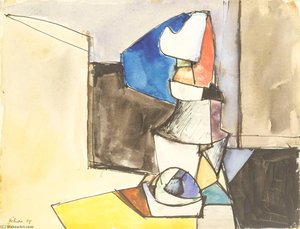
jean hélion
1904 - 1987
基本信息
- Artistic Movement Or Style: Abstract, Figurative
- Artists Who Influenced This Artist:
- Nicolas Poussin
- Philippe de Champaigne
- Joaquín Torres-García
- Date Of Birth: April 21, 1904
- Date Of Death: October 27, 1987
- Full Name: Jean Hélion
- Nationality: French
- Notable Artworks:
- Untitled
- Study for Luxembourg Scene
- Paperboard Saves Metal
- Place Of Birth: Couterne, France

