
 实景预览
实景预览
 切换至版画销售渠道
 分享
分享 分享
分享
 详情
详情 指南
指南

 下载作品
下载作品
 相似作品
相似作品 X射线
X射线 幻灯片播放
幻灯片播放 问答
问答 统计数据
统计数据Landscape Black and White


 展开全文
展开全文
获取远超网页预览效果的印刷级文件。我们销售的每一张数字图像均源自库存数据库中的高分辨率母版——宽度通常在 5,000 至 15,000 像素之间——因此您可以放心地进行大幅打印、局部裁剪或还原细腻的细节。
每一件作品在离开我们的工作室前都经过了精心的处理。数字影像专家会对照原作核对色彩,并在必要时进行校正,随后利用专业修图工具提升清晰度与细节表现——且始终忠实于艺术家的笔触与风格。最终呈现的图像宛如原作本身,而非仅仅是一张加了滤镜的扫描件。
您可以在最终定稿前进行审核:我们的专家将在 72 小时内通过电子邮件向您发送图像以供审阅。如果不满意?您可以要求改进或修正;若质量未达预期,亦可申请退款。
这也是出版商、设计工作室、画廊及印刷厂所信赖的品质。
每份数字图像订单均包含的内容
专业级数字交付,品质保障
选择 OriginalUniqueArt.com,您获得的不仅仅是一张图像——您收到的是经过专业级增强、精雕细琢的数字艺术作品,并享有满意保证。以下是您的订单中自动包含的所有内容:

邮件即时送达
您的高分辨率数字图像文件将在下单后 72 小时内通过电子邮件发送给您 —— 即可立即使用。

AI 增强型数字文件
您的艺术品经过专业优化,结合先进的 AI 技术与人工修饰,确保呈现极致的细节、清晰度与色彩准确度。

终身免费重发服务
不小心删除了文件或找不到了?没关系——我们将随时为您免费重发。

无需进口税费,始终如一
即刻拥有您的艺术作品,无需支付任何关税、税费或运费——数字下载始终免税。

色彩精准保障
我们通过专业工具与色彩管理技术,确保您的数字图像尽可能真实地还原原作色彩。

100天满意保证
如果您对所购数字图像不满意,我们将在100天内为您进行修改或提供100%的全额退款——无需任何理由。

100% 退款保证
不满意?在收到数字文件后的100天内,您可以申请全额退款——无需任何理由。

批量订购优惠
购买 3 张享 10% 折扣 - 购买 5 张享 15% 折扣 - 购买 10 张以上享 20% 折扣。非常适合创意项目、画廊及机构使用。
A Geometric Dance of Light and Shadow
In the evocative realm of mid-century abstraction, Landscape Black and White stands as a profound testament to the transformative power of shape and contrast. Created in 1967 by the visionary artist Hale Aspacio Woodruff, this piece invites the viewer into a dreamlike dimension where the boundaries between reality and geometry dissolve. At first glance, the eye is immediately arrested by a striking, luminous yellow square that anchors the left side of the composition, acting as a singular beacon of warmth amidst a sea of monochromatic depth. This bold use of color serves not merely as a focal point but as a rhythmic heartbeat within the painting, disrupting the somber tones of gray and black to create a visual tension that is both unsettling and deeply captivating.
The composition breathes through a sophisticated interplay of forms, where smaller squares in varying shades of charcoal and slate are scattered like celestial fragments across an abstract landscape. This arrangement suggests a structured chaos, a carefully orchestrated movement that guides the viewer's gaze across the canvas. Amidst this geometric dance, the subtle presence of two human figures—one positioned near the center and another toward the periphery—adds a layer of poignant narrative. These figures, though integrated into the abstract architecture of the piece, ground the work in a sense of shared existence, suggesting that even within the most fragmented or abstract environments, the human spirit remains an observant and integral participant.
Technique and the Legacy of Modernism
The technique employed in this 1967 masterpiece reflects a masterful command over balance and spatial perception. Through the deliberate application of flat planes and sharp edges, Woodruff achieves a sense of depth that defies the two-dimensional surface. The interplay between the stark black voids and the soft, misty grays creates an atmospheric quality reminiscent of a fog-swept morning, yet the rigid geometry prevents the work from becoming purely ethereal. This duality—the tension between the organic feeling of a landscape and the mathematical precision of geometric abstraction—is what gives the painting its enduring intellectual weight.
For the discerning collector or interior designer, Landscape Black and White offers an unparalleled opportunity to introduce a piece of historical significance into a contemporary setting. Its monochromatic palette provides a sophisticated foundation for modern decor, allowing it to harmonize with minimalist, industrial, or even classical interiors. As a high-quality reproduction, this artwork preserves the soul of Woodruff’s original vision, offering a window into a pivotal era of American art history. It is more than a mere decoration; it is an emotional experience that evokes contemplation, inviting anyone who dwells in its presence to find beauty in the balance of light and shadow.
常见问题与解答
Hale Aspacio Woodruff 的《Landscape Black and White》 的色彩浓郁度如何?
Hale Aspacio Woodruff 的《Landscape Black and White》 中的色彩呈现出 Monochromatic 的强度。
在哪里可以观赏到 Hale Aspacio Woodruff 的《Landscape Black and White》 的原作?
您可以在 Spelman College Museum of Fine Art, Atlanta, United States of America 欣赏到原件《Landscape Black and White》。
"Landscape Black and White" 的色彩饱和度如何?
Hale Aspacio Woodruff 的《Landscape Black and White》 的色彩饱和度为 Muted。
艺术家简介
A Legacy of Visionary Expression
Hale Aspacio Woodruff stands as a monumental figure in the tapestry of twentieth-century American art, a master whose hands moved between the delicate precision of printmaking and the sweeping grandeur of muralism. Born in Cairo, United States of America, his journey was one of profound movement and cultural synthesis. Growing up in Nashville, Tennessee, within a Black family, Woodruff’s early life was shaped by the segregated realities of the era, yet his artistic spirit sought horizons far beyond local boundaries. His education was as diverse as his palette, spanning prestigious institutions such as the Herron School of Art and Design in Indianapolis, the Art Institute of Chicago, and the Harvard Fogg Art Museum. These formative years provided him with a rigorous technical foundation, but it was his time abroad that truly ignited his creative metamorphosis.
The allure of Paris played a crucial role in his development, as a prize from the Harmon Foundation in 1926 allowed him to spend four transformative years studying in France. This period of immersion in European modernism provided a vital dialogue between classical training and avant-garde experimentation. Later, his artistic evolution was further enriched by a summer spent in Mexico, where he studied the art of mural painting under the legendary Diego Rivera. This encounter with the Mexican muralist movement deeply influenced his approach to public art, instilling in him a belief that art should serve as a powerful, communicative force within the social fabric.
The Soul of the Canvas
Woodruff’s body of work is characterized by an extraordinary ability to weave together history, myth, and identity. He was particularly renowned for his ability to capture the rhythmic pulse of heritage, most notably in his Art of the Negro series. In masterpieces such as Native Forms, Panel One, he invites viewers into a world where ancestral echoes breathe through bold, energetic brushstrokes and a saturated palette. His compositions often act as spiritual gateways, where the boundaries between the physical and the unseen dissolve into a dance of symbolic communication. Through the use of stylized figures and cultural motifs, he constructed narratives that celebrated resilience and the profound complexity of human existence.
As his career progressed, Woodruff’s style demonstrated a remarkable versatility, moving from the narrative depth of his murals to the evocative realms of abstraction. In works like Landscape Black and White, one observes a geometric dance of light and shadow, where the tension between monochromatic depth and sudden, luminous color creates a dreamlike dimension. Whether he was exploring the celestial dialogues of Sentinel Gate or the vibrant gatherings in his panel paintings, his work remained anchored by a commitment to high artistic development and a telling quality that reflected the human condition. His legacy is not merely found in the pigments on canvas, but in his enduring role as an educator and founder, having established the art department at Atlanta University, ensuring that the flame of creativity would continue to burn brightly for generations to come.
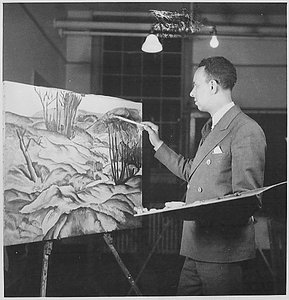
Hale Aspacio Woodruff
1900 - 1980