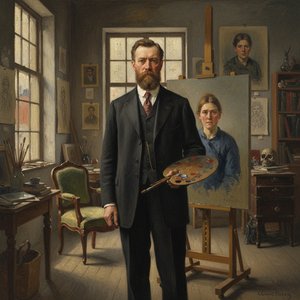
The Wandering Brush of Christian Meyer Ross
Born in the quiet coastal town of Flekkefjord and raised amidst the vibrant cultural landscape of Bergen, Christian Meyer Ross (1843–1904) was a painter whose life journey mirrored the expansive travels of his artistic soul. His early years were marked by a profound intellectual awakening; as a student at the Latin School in Bergen, he was deeply moved by the powerful oratory of Bjørnstjerne Bjørnson, an experience that planted the seeds of a lifelong connection to the great figures of Norwegian literature and art. This formative period instilled in him a reverence for history and narrative, qualities that would later define his approach to the canvas.
Ross’s artistic education was as much a pilgrimage through Europe as it was a formal study of technique. After honing his skills in Christiania, he ventured to Copenhagen, where his social and professional circles expanded to include the luminaries of the era. His travels eventually led him to the prestigious art colonies of Munich and Paris, cities that served as crucibles for his developing style. In Munich, he stood alongside contemporaries like Eilif Peterssen and offered support to the celebrated Harriet Backer, participating in a vibrant exchange of ideas that bridged the gap between Scandinavian traditions and the broader European movements. This period of wandering was not merely a search for new landscapes, but a deep immersion into the evolving aesthetics of the late nineteenth century.
A Legacy of Elegance and Historical Reverence
The work of Christian Meyer Ross is characterized by a sophisticated appreciation for the past, often drawing profound inspiration from the Rococo and Empire periods. He was far more than a mere observer of history; he was a cultivated man whose keen interest in historical aesthetics allowed him to breathe life into themes of bygone eras. His ability to marry technical precision with an evocative sense of nostalgia made his portraiture and period-inspired works particularly sought after. One of his most enduring legacies remains his large-scale portrait of Bjørnstjerne Bjørnson, a piece that captures not just the likeness of the man, but the shared spirit of a generation of Norwegian intellectuals.
In 1879, Ross found a permanent sanctuary in Rome, a city that would serve as his home until his death in 1904. The eternal beauty of the Italian landscape and the weight of its classical heritage provided the perfect backdrop for his mature period. His art became a bridge between the rugged northern sensibilities of his youth and the sun-drenched, classical elegance of the Mediterranean. Through his meticulous attention to detail and his ability to evoke the grandeur of historical epochs, Ross secured his place as a significant figure in the narrative of Norwegian art, leaving behind a body of work that celebrates the enduring beauty of history and the human spirit.
Питання та відповіді
Скільки творів Christian Meyer Ross представлено в каталозі?
Ви можете переглянути 6 творів мистецтва творів Christian Meyer Ross на сторінці Усі роботи митця.
Чи можу я переглянути роботи Christian Meyer Ross за ключовими словами?
Щоб знайти роботи Christian Meyer Ross на певну тему, скористайтеся сторінкою митця За ключовими словами, де твори згруповані за ключовими словами.
Наскільки популярні роботи Christian Meyer Ross?
Сторінка зі статистикою Статистика відвідувань для Christian Meyer Ross містить дані, розраховані на основі творів цього митця, представлених на цей сайт.
Чи можу я переглянути роботи Christian Meyer Ross за настроєм?
Роботи Christian Meyer Ross можна переглядати за настроєм на сторінці художника Простір настрою, де витвори мистецтва впорядковані відповідно до їхнього емоційного забарвлення.