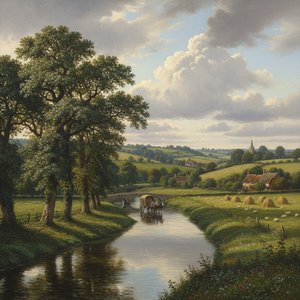
A classical landscape (William Linton)
William Linton (1791–1876) створив A classical landscape.

 Переглянути в інтер'єрі

 Картина олією ручної роботи
 Надіслати як листівку
 Поділитися
 Інформаційна картка


 Завантажити
 Схожі екземпляри
 Рентгенівське дослідження
 Слайд-шоу
 Питання та відповіді

 Статистика
A classical landscape коротко
- Назва
- A classical landscape
- Художник
- William Linton (1791–1876)
- Рік народження митця
- Liverpool, United Kingdom
- Сюжет
- landscape
Зображення високої роздільної здатності A classical landscape
Суспільне надбання: художник помер у 1876 році.
William Linton, A classical landscape. Суспільне надбання
Відповіді на запитання про A classical landscape
Що зображено на творі «A classical landscape» роботи William Linton?
Тематика, представлена у «A classical landscape» роботи William Linton, включає landscape. Разом вони підсумовують зміст твору.
Чи не захищений твір "A classical landscape" авторським правом?
«A classical landscape» роботи William Linton перебуває у є суспільним надбанням — термін дії авторського права закінчився. Цей статус визначає правила відтворення зображення твору.
Хто є автором "A classical landscape"?
«A classical landscape» було створено William Linton. Інформація на цій сторінці описує оригінальний твір William Linton.
Яким чином обґрунтовано статус авторського права на «A classical landscape» роботи William Linton?
Статус авторського права на твір "A classical landscape" — є суспільним надбанням — термін дії авторського права закінчився — визначається датою смерті митця у 1876.
Про художника William Linton

1791–1876, United Kingdom
William Linton
The Romantic Visionary of Classical Landscape William Linton, born in the maritime atmosphere of Liverpool in 1791, emerged as a pivotal figure in British landscape painting during the Victorian era—a period defined by a profound fascination with both scientific observation and idealized beauty. His artistic journey began not with the grand gestures of a master, but through the humble and disciplined practice of copying the works of legends like Claude Lorrain and Richard Wilson. These early encounters were transformative, instilling in Linton a deep-seated appreciation for the interplay of natural light and the sweeping grandeur of panoramic compositions. This foundational period shaped his distinctive style, allowing him to weave classical sensibilities into the fabric of 19th-century Romanticism.
Також за участю William Linton
 The Bathing Pool
 View Of Edinburgh; And View Of Stirling
 An Italianate Landscape, With Peasants And Livestock In The Foreground
 Bury From Blackford Bridge
Есе до твору A classical landscape
 British Landscapes: The Enduring Spirit of the Countryside in Art and Interior DesignExplore the mastery of British landscape art from Constable to Cartlidge. Discover timeless beauty for your home today.
 John Constable: Nature, Light & the Romantic Vision of Rural EnglandExplore the life & art of John Constable, the Romantic painter who revolutionized landscape with emotive scenes of rural England. Discover …
 Atmospheric Vistas: A Study of Notable Landscape CompositionsExplore a masterclass on atmospheric landscapes from Patinir to Monet. Discover the evolution of light and texture in art history.