American Realism · 1898
Salutat (Томас Ікінс, 1898)
Томас Ікінс (1844–1916) створив Salutat. Дата створення — 1898. Він належить до напряму American Realism. Виконано в Олія на полотні. Екземпляр зберігається в Addison Gallery of American Art у Массачусетс, Сполучені Штати Америки.
- 1898
- Олія на полотні
- Addison Gallery of American Art, Массачусетс

 Переглянути в інтер'єрі

 Картина олією ручної роботи
 Надіслати як листівку
 Поділитися
 Інформаційна картка


 Завантажити
 Схожі екземпляри
 Рентгенівське дослідження
 Слайд-шоу
 Питання та відповіді

 Статистика
Salutat коротко
- Назва
- Salutat
- Художник
- Томас Ікінс (1844–1916)
- Рік народження митця
- Філадельфія, Сполучені Штати Америки
- Дата
- 1898
- Матеріал
- Олія на полотні
- Де подивитися
- Addison Gallery of American Art, Массачусетс, Сполучені Штати Америки
Що зображено на Salutat?
A Portrait of Vulnerability: Exploring Thomas Eakins’ Salutat
- Subject Matter The painting “Salutat,” created in 1898 by American artist Thomas Eakins, depicts a solitary man standing amidst a crowd. Strikingly nude from the waist up, he presents his back to the audience, embodying an arresting stillness that contrasts sharply with the bustling activity surrounding him.
- Style and Technique Eakins’ masterful use of oil on canvas exemplifies realism—a hallmark of his oeuvre. The monochromatic palette—primarily shades of gray—intensifies the emotional impact, focusing attention squarely on the central figure's posture and expression. Precise brushstrokes contribute to a textured surface that conveys both physicality and psychological depth.
- Historical Context Produced during the late Victorian era, “Salutat” reflects the artistic currents of its time, prioritizing observation and anatomical accuracy over idealized representations. Eakins’ fascination with scientific illustration—evident in his meticulous rendering of musculature—mirrors a broader trend toward documenting the human form with unprecedented detail.
- Symbolism The man's posture – turned away from scrutiny – speaks to themes of introspection and vulnerability. The bucket held aloft symbolizes perhaps an act of defiance or performance, adding layers of narrative complexity to the composition. It invites contemplation on notions of exposure and self-presentation within a social context.
- Emotional Impact “Salutat” transcends mere visual depiction; it evokes feelings of quiet contemplation and subtle unease. The painting’s stark simplicity underscores the profound psychological portraiture characteristic of Eakins's work, prompting viewers to consider questions of identity and perception.
The Artist: Thomas Eakins – A Pioneer of Realism
Thomas Cowperthwait Eakins (1844-1916), born in Philadelphia, stands as a cornerstone of American art history. Unlike many artists of his era preoccupied with grand narratives or romantic ideals, Eakins relentlessly pursued the depiction of everyday life—the world of doctors, rowers, and hunters—with an unwavering commitment to anatomical precision and psychological insight.
His formative years instilled in him a profound appreciation for observation and scientific inquiry. This dedication would propel him to become one of the most influential realist painters of the late nineteenth century, challenging conventions and establishing a new standard for artistic representation. Eakins’s Philadelphia was not a city of picturesque vistas; it was a crucible of intellectual ferment—a place where he honed his skills and developed his distinctive vision.
Exploring Eakins's Method: Anatomical Precision and Monochromatic Palette
Eakins’ artistic approach stemmed from a deep understanding of human anatomy. He meticulously studied musculature, striving to capture the subtle nuances of posture and movement—a practice that would inform his paintings with remarkable accuracy. This scientific rigor extended beyond mere anatomical representation; it served as a springboard for exploring psychological states.
Furthermore, Eakins favored a monochromatic palette—primarily shades of gray—to heighten emotional resonance. By eliminating color, he focused the viewer’s gaze on form and texture, emphasizing the expressive qualities of light and shadow. This technique underscores his belief that visual art could convey profound truths about human experience.
Beyond Representation: The Psychological Depth of Salutat
"Salutat" isn't simply a portrait; it’s an invitation to delve into the complexities of human consciousness. Eakins skillfully captures the vulnerability inherent in solitude—the man’s averted gaze conveying a sense of introspection and confronting unspoken anxieties.
The painting’s deliberate simplicity amplifies its impact, prompting viewers to consider questions of identity and perception. Like Elizabeth at the Piano and Portrait of Professor Henry A. Rowland – also available on OriginalUniqueArt.com – “Salutat” exemplifies Eakins's unwavering dedication to portraying the human condition with unflinching honesty.
У якому музеї зберігається Salutat?
Addison Gallery of American Art
Массачусетс, Сполучені Штати Америки
Маяк американського бачення: дослідження Галереї Аддісон Розташована в історичному кампусі Філіпс-Академії в Ендовері, штат Массачусетс, Галерея американського мистецтва Аддісон є набагато більшим, ніж просто сховищем полотен та скульптур; це живий свідок еволюції духу та незламної сили художнього самовираження Сполучених Штатів. Заснована у 193ях роках з метою виховання критичного мислення та естетичного сприйняття, Аддісон перетворилася на динамічний центр навчання, діалогу та натхнення — простір, вільно доступний для всіх, хто прагне зв'язку з багатим творчим спадщинням Америки. Її історія — це шлях свідомого колекціонування, вдумливого розширення та непохитної відданості справі демонстрації глибини американського мистецтва: від його колоніальних коренів до пульсу сучасних рухів.


Зображення високої роздільної здатності Salutat

Суспільне надбання: художник помер у 1916 році.
Інші розміри, кадри та цитування →Томас Ікінс, Salutat (1898), Addison Gallery of American Art. Суспільне надбання
Відповіді на запитання про Salutat
Де можна побачити оригінал «Salutat» роботи Томас Ікінс?
Оригінал «Salutat» роботи Томас Ікінс зберігається в Addison Gallery of American Art, Массачусетс, Сполучені Штати Америки. Репродукція дозволяє прикрасити цим твором ваш дім.
У якому році було створено "Salutat"?
«Salutat» роботи Томас Ікінс було створено у 1898 році.
Яка техніка використана у творі "Salutat"?
Для створення «Salutat» Томас Ікінс використав(ла) техніку Олія на полотні. Саме ця техніка визначає матеріальну природу оригінального твору.
Чи є «Salutat» роботи Томас Ікінс суспільним надбанням?
Щодо авторського права, «Salutat» є є суспільним надбанням — термін дії авторського права закінчився.
Якому художнику приписують роботу "Salutat"?
«Salutat» було створено Томас Ікінс. Інформація на цій сторінці описує оригінальний твір Томас Ікінс.
До якого стилю належить "Salutat"?
«Salutat» роботи Томас Ікінс належить до течії American Realism. Цей напрям визначає стилістичний контекст твору.
Яке місце посідає «Salutat» у творчому шляху Томас Ікінс?
«Salutat» належить до Mature Period Томас Ікінс.
Скільки років було Томас Ікінс, коли було створено «Salutat»?
Томас Ікінс створив(ла) «Salutat» у віці 54 років. Митець народився(лася) у 1844, а дата створення твору — 1898.
Чому статус авторського права на "Salutat" саме такий?
«Salutat» роботи Томас Ікінс перебуває у є суспільним надбанням — термін дії авторського права закінчився. Термін дії авторського права розраховується від року смерті митця, яка відбулася у 1916.
Про художника Томас Ікінс

1844–1916, Сполучені Штати Америки
Томас Ікінс
Життя Томаса Ейкінса Народившись у Філадельфії, штат Пенсильванія, 25 липня 1844 року, Томас Ейкінс прожив життя, глибоко вкорінене в місті свого народження. Він був людиною багатьох дисциплін, працюючи як живописець, фотограф, скульптор та викладач образотворчого мистецтва. Хоча його інтереси часто змушували його вирушати за кордон задля навчання, географія його існування залишалася переважно зосередженою у Філадельфії. Він переплітався з інтелектуальними та соціальними колами міста, спостерігаючи за людьми та фізичною реальністю, що визначала місцевий ландшафт.
Також за участю Томас Ікінс
 Операційна1875
 Плавання1885
 Макс Шмётт у одиночной лодке1871
 Portrait of Samuel Murray1889

Есе до твору Salutat
 American contemporary realist paintersMasterpieces by Chuck Close and Amy Sherald define American contemporary realism. Explore the full collection online at OriginalUniqueArt.c…
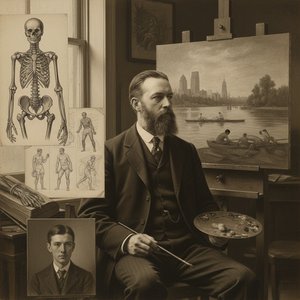 Thomas Eakins: Realism, Anatomy & the American Spirit – A Comprehensive Exploration of Life and LegacyExplore the life & legacy of Thomas Eakins, a pivotal American Realist painter. Discover his groundbreaking techniques, anatomical precisio…
 Джеймс Ебботт МакНейл Вістлер: 25 шедеврів імпресіонізму для вашого дому | OriginalUniqueArtВідкрийте 25 шедеврів Джеймса Вістлера – імпресіонізм, портрети та нічні сцени. Історія мистецтва, техніки живопису та натхнення для декору…