Раннє Відродження · 1425
Trinity (Мазаччо, 1425)
Мазаччо (1401–1428) створив Trinity. Дата створення — 1425. Він належить до напряму Раннє Відродження. Виконано в Фреска. Екземпляр зберігається в Santa Maria Novella у Флоренція, Італія. Розмір: 640 × 317 cm
- 1425
- Фреска
- 640 × 317 cm
- Santa Maria Novella, Флоренція

 Картина олією ручної роботи
 Надіслати як листівку
 Поділитися
 Інформаційна картка


 Завантажити
 Схожі екземпляри
 Слайд-шоу
 Питання та відповіді

 Статистика
Trinity коротко
- Назва
- Trinity
- Художник
- Мазаччо (1401–1428)
- Рік народження митця
- Сан-Джованні-Вальдарно, Італія
- Дата
- 1425
- Матеріал
- Фреска
- Розміри
- 640 × 317 cm
- Де подивитися
- Santa Maria Novella, Флоренція, Італія
- Період
- — Відродження
Що зображено на Trinity?
A Portal to the Divine: The Dawn of Renaissance Realism
To step before Masaccio’s Holy Trinity is to witness the exact moment when the flattened, symbolic world of the Middle Ages dissolved into the profound, breathing reality of the Renaissance. Painted between 1425 and 1427 within the hallowed walls of Santa Maria Novella in Florence, this fresco does not merely depict a religious scene; it carves a hole in the very wall of the chapel, inviting the viewer to step into a sacred, three-dimensional space. At its heart lies a revolutionary commitment to humanism—the belief that the divine can be understood through the lens of human experience and physical truth. Through his masterful command of light and form, Masaccio transformed a static icon into a living drama of salvation.
The composition is anchored by the central figure of Jesus Christ, depicted with a startling naturalism that was unprecedented for his era. He stands as the axis of the universe, flanked by the Virgin Mary and Saint John the Evangelist. Unlike the ethereal, weightless figures of the preceding Gothic period, Masaccio’s subjects possess a palpable sense of mass and gravity. Their robes fall with heavy, realistic folds, and their faces carry an emotional depth that speaks to the viewer across centuries. This is not art meant for distant adoration alone; it is art designed to resonate with the human soul, making the theological mysteries of the Trinity feel intimately present within our own physical realm.
The Architecture of Illusion: Mastery of Perspective
Perhaps the most enduring legacy of this masterpiece is Masaccio’s pioneering use of linear perspective. By employing a single vanishing point, he created an architectural illusion so convincing that contemporary viewers felt they were looking into a real, deep chapel rather than at a painted surface. The coffered barrel vault above the figures recedes with mathematical precision, guiding the eye upward and inward. This technical triumph was not merely a display of skill; it served a profound symbolic purpose. By placing the holy figures within a believable, structured environment, Masaccio bridged the gap between the earthly and the divine, suggesting that the sacred exists within the very geometry of our world.
This sense of depth is further enhanced by his sophisticated use of chiaroscuro. The subtle interplay of light and shadow—the way light seems to strike the figures from a consistent source—gives them a sculptural quality. This technique breathes life into the flesh, defining the musculature of Christ and the gentle contours of Mary’s face. For the modern collector or interior designer, this mastery of volume offers a sense of structural elegance and intellectual depth, making it a piece that commands attention through its quiet, commanding presence.
A Timeless Legacy for the Discerning Collector
Beyond the technical brilliance, the Holy Trinity remains an emotional powerhouse. It captures the tension between human mortality and eternal hope. At the base of the composition, the inclusion of the donors—the mortal figures who commissioned the work—serves as a poignant reminder of our own place in the grand tapestry of history. They stand at the threshold, looking up toward the divine, mirroring the journey of every viewer who encounters this fresco.
For those seeking to adorn a space with art that inspires contemplation and awe, a high-quality reproduction of this Masaccio masterpiece offers more than mere decoration. It brings into a home or gallery a piece of the very foundation of Western art. Whether placed in a study filled with books or as a focal point in a grand living space, the Holy Trinity provides an atmosphere of profound stability, historical richness, and enduring beauty. It is an invitation to pause, to look deeper, and to rediscover the breathtaking realism that first ignited the Renaissance.
У якому музеї зберігається Trinity?
Santa Maria Novella
Флоренція, Італія
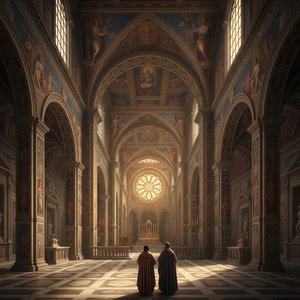
Будова та архітектура Ця базиліка вважається найважливішою романсько-готичною церквою в Тоскані. Її структура відображає тривалий період розвитку: так, нижня частина романсько-готичного фасаду була розпочата ще у 1350 році та остаточно завершена лише у 1920 році. Сам фасад має виразний вигляд завдяки геометричним візерункам з білого та зеленого мармуру.


Зображення високої роздільної здатності Trinity

Суспільне надбання: художник помер у 1428 році.
Інші розміри, кадри та цитування →Мазаччо, Trinity (1425), Santa Maria Novella. Суспільне надбання
Відповіді на запитання про Trinity
У якому музеї зберігається оригінал «Trinity»?
Оригінал твору «Trinity» можна побачити в Santa Maria Novella, Флоренція, Італія.
У якому році було створено «Trinity» роботи Мазаччо?
Яка техніка була використана для створення «Trinity» роботи Мазаччо?
Які розміри оригіналу "Trinity"?
«Trinity» має розмір 640 x 317 cm в оригіналі. Оригінальні розміри є корисним орієнтиром під час вибору розміру репродукції.
Чи можна вільно відтворювати зображення «Trinity» роботи Мазаччо?
До якого художнього напряму належить «Trinity» роботи Мазаччо?
До якого періоду творчості Мазаччо належить твір "Trinity"?
Про художника Мазаччо

1401–1428, Італія
Мазаччо
Массаччо (1401–1428): Рассвет Ренессанса Реализма Массаччо, настоящее имя Томмазо ди Сер Джованни ди Синема, был ключевой фигурой в раннем итальянском Возрождении. Родился 21 декабря 1401 года в Сан-Джованно Вальдарно, Италия, и трагически погиб в возрасте 26 лет в 1428 году. Несмотря на короткую жизнь, его влияние на последующие поколения художников было огромным, устанавливая новый стандарт для натурализма и вдохновляя ход западного искусства. Ранняя Жизнь и Обучение Массаччо родился в семье Джованни ди Синема Кассаи, нотариуса, и Якобы ди Мартинотто.
Також за участю Мазаччо
 Трійця1428
 Податок миру1425
 Вигнання з Едемського саду1426
 Відтворення грошової десятини (деталь)
Есе до твору Trinity
 Understanding Gothic and Renaissance Art: Key Differences and FeaturesMaster the differences between Gothic and Renaissance art through expert analysis of technique and style. Discover the evolution of art tod…
 25 Masterpieces by Duccio di Buoninsegna: The Dawn of Sienese ArtJourney through the Sienese School with our curated guide to Duccio di Buoninsegna’s top 25 masterpieces. From the Maesta to iconic Madonna…
 Mastering Depth: The Architectural Power of Linear Perspective in Renaissance MasterpiecesExplore the profound impact of linear perspective on Renaissance art. Discover how masters like Brunelleschi and Uccello used mathematical …