

 Переглянути в інтер'єрі
 Надіслати як листівку
 Поділитися
 Деталі витвору
 Посібник

 Завантажити
 Схожі екземпляри
 Рентгенівське дослідження
 Слайд-шоу
 Статистика
El Lissitzky, Dessau


 Розгорнути текст
Мистецький твір, представлений на цій сторінці, захищений законом про авторське право, що унеможливлює легальне створення або продаж його ідентичної репродукції. Цей захист забезпечується відповідно до міжнародних угод, таких як Бернська конвенція та національним законодавством, зокрема положеннями, що викладені в Законодавство США про авторське право — Розділ 17. Всі права захищені. Будь-яке використання без дозволу заборонено.
Цей метод повністю відповідає нормам авторського права, оскільки він не передбачає копіювання чи дублювання захищеного твору мистецтва. Натомість це творче переосмислення — створення нового малюнка під впливом оригіналу, який не є його точним відтворенням.
Гікле / Художній принт
Друк جيкле або на полотні музейної якості з оперативним виготовленням та різноманітними варіантами фінішної обробки. ( Замовити картину ручної роботи Перейти до цифрових зображень)




P118B ₴10

P118H ₴10

P118W ₴10

P438Z ₴10

P508JH ₴12

P508YH ₴12

P805H ₴10

P805Z ₴10

P919BZ ₴10

P919G ₴10

P919XJ ₴10

P959ZH ₴10

P968JZ ₴12

W106C ₴8

W218G ₴10

W218JH ₴8

W218Y ₴10

W307PJ ₴10

W316G ₴10

W316PJ ₴8

W316Y ₴10

W398PJ ₴8

W4111J ₴10

W500HY ₴15

W500JH ₴15

W692G ₴12

W849H ₴8

W940BG ₴15

W953PJ ₴8




Обирайте з наших стандартних розмірів, що відповідають оригінальним пропорціям твору мистецтва.

Введіть необхідну ширину та висоту, щоб принт ідеально підійшов до вашої рами або стіни. Принт можна лише обрізати, але не можна зробити більшим за оригінал, тому при зміні пропорцій частина зображення буде втрачена. Перед друком ми надсилаємо вам цифровий макет для затвердження. Зображення на цій сторінці не відображає реальну обрізку — її можна побачити лише на макеті.
Доставка по всьому світу () за 2 тижні замість стандартних 4/5 тижнів. (28 Жовтень)

Безкоштовна експрес-доставка по всьому світу

Високоякісне лляне полотно

Повне страхове покриття доставки

Гарантія повернення митних зборів

Гарантія точного відтворення кольорів

Політика повернення протягом 100 днів (лише у разі виявлення дефектів)

Гарантія повернення 100% коштів

Пропозиція на оптові замовлення
 Скляний варіант доступний лише для розмірів до 110 см

El Lissitzky, Dessau
Гікле / Художній принт
Розмір репродукції
-


Підсумкова вартість
₴ 3586
El Lissitzky, Dessau: A Dialogue of Form and Function
The photograph presented here – “El Lissitzky, Dessau” – isn’t merely a portrait; it's a carefully constructed distillation of the spirit of early 20th-century artistic experimentation. Captured around 1930-1932 by Josef Albers, this image offers a glimpse into the world of El Lissitzky, a pivotal figure in the Russian avant-garde who bridged the gap between Suprematism and Constructivism. It’s a document of a man grappling with the fundamental questions of form, space, and communication – concerns that resonate powerfully even today.
Lissitzky, a visionary designer and artist, was deeply influenced by Malevich's radical exploration of pure geometric abstraction. However, Lissitzky moved beyond purely formal exercises, recognizing the potential of art to serve practical purposes—designing exhibition spaces, propaganda posters, and even furniture. Albers’ photograph captures this duality: Lissitzky is both an intellectual explorer and a craftsman, his gaze suggesting a thoughtful engagement with the world around him. The composition itself – two square portraits side-by-side – immediately evokes the principles of Constructivism, emphasizing clarity, order, and geometric relationships. The stark contrast between the black and white tones further amplifies this sense of precision and intellectual rigor.
A Study in Light, Line, and Gesture
Albers’ technical mastery is evident in every detail. The photograph utilizes a classic gelatin silver print process, resulting in a rich tonal range that subtly defines Lissitzky's features. The lighting is soft and diffused, minimizing harsh shadows and allowing the textures of his clothing – a crisp white shirt and dark tie – to emerge with clarity. Notice how Albers has employed fine lines to delineate the contours of Lissitzky’s face, capturing not just his likeness but also the subtle gestures that convey his personality. The sharp edges of the portraits create a sense of immediacy, drawing the viewer into the scene.
The photograph's composition is deceptively simple. The two square images are arranged symmetrically within a rectangular frame, creating a balanced and harmonious visual experience. However, this apparent simplicity belies a deeper level of intentionality. Lissitzky’s profile view – a pose that suggests contemplation or perhaps even conversation – contrasts sharply with his frontal portrait, offering a dynamic interplay between stillness and movement. The subtle smile in the first image hints at an approachable nature, while the profile invites introspection.
Historical Context: Bauhaus and Beyond
To fully appreciate “El Lissitzky, Dessau,” it’s crucial to understand its historical context. Albers himself was a key figure at the Bauhaus school in Germany, where he developed his groundbreaking theories of color interaction and geometric abstraction. The Bauhaus sought to unify art, craft, and technology, believing that design could improve people's lives. Lissitzky, who spent time at the Bauhaus before emigrating to Russia, carried these principles with him, influencing his work as a designer and artist.
Following the Russian Revolution, Lissitzky became involved in creating propaganda for the new Soviet state. He designed posters, book layouts, and exhibition spaces—all aimed at promoting socialist ideals through innovative visual communication. His work reflected the dynamism and optimism of the era, but also the challenges of building a new society from scratch. The photograph captures a moment of quiet reflection amidst this period of intense social and political change.
Symbolism and Emotional Resonance
Beyond its technical merits, “El Lissitzky, Dessau” possesses a subtle symbolic power. The geometric composition—the squares, the lines—represents the rational order that Lissitzky sought to impose on the world. The portrait itself can be interpreted as an exploration of identity and representation – how we perceive ourselves and how others perceive us. Lissitzky’s gaze is direct and unwavering, suggesting a confidence in his own vision.
Ultimately, this photograph transcends its documentary value. It's a testament to the power of art to capture not just appearances but also ideas, emotions, and historical moments. It invites viewers to contemplate the relationship between form and function, intellect and emotion, and the enduring legacy of El Lissitzky’s artistic vision.
Питання та відповіді
До якого художнього напряму належить «El Lissitzky, Dessau» роботи Йозеф Альберс?
Мистецький напрям, до якого належить «El Lissitzky, Dessau» роботи Йозеф Альберс, — це Constructivism. Така класифікація дозволяє розмістити цей твір у контексті суміжних митців та творів мистецтва.
«El Lissitzky, Dessau» роботи Йозеф Альберс — це світлий чи темний твір мистецтва?
Загалом, показник яскравості твору «El Lissitzky, Dessau» становить brilliant. Відчутна яскравість описує, наскільки світлим або темним здається цей твір.
Хто є автором "El Lissitzky, Dessau"?
«El Lissitzky, Dessau» було створено Йозеф Альберс. Інформація на цій сторінці описує оригінальний твір Йозеф Альберс.
Біографія митця
A Life Forged in Material: The Early Years and Bauhaus Formation
Josef Albers’s artistic journey began not amidst the rarefied air of established academies, but within the pragmatic world of his father’s contracting business in Bottrop, Germany. Born in 1888, young Josef absorbed a deep respect for materials – carpentry, plumbing, house-painting – skills that would fundamentally shape his aesthetic sensibility. This wasn't merely vocational training; it was an immersion into the very essence of making, understanding how forms materialized and the inherent qualities within each medium. He learned to appreciate the subtle textures of wood, the precise angles of metal, the transformative power of color applied to surfaces. Before dedicating himself fully to art, Albers spent five years as a schoolteacher, honing patience and pedagogical skill—attributes that would later define his influential teaching career. Formal artistic training commenced at the Königliche Kunstschule in Berlin between 1913 and 1915, where he explored printmaking, painting, and, crucially, stained glass. His early commission, “Rosa Mystica Ora Pro Nobis” (1918), a stunning stained-glass window for a church in Germany, foreshadowed his lifelong fascination with the interplay of light and color, hinting at the abstract explorations to come. This initial work wasn’t simply decorative; it was an investigation into how light *transformed* material, a theme that would resonate throughout his career. The meticulous craftsmanship required for stained glass instilled in him a deep appreciation for detail and precision – qualities he would later apply to his paintings.The Bauhaus Crucible: Color as Subject
A pivotal moment arrived in 1922 when Albers joined the faculty of the Bauhaus, a revolutionary school seeking to unify all artistic disciplines under Walter Gropius’s visionary leadership. Initially tasked with teaching the preliminary course – *Werklehre* (workshop practice) – he immersed himself in its core principles: functionalism, geometric abstraction, and material exploration. This period proved transformative. Albers began a systematic investigation into color perception, moving away from representational art towards an increasingly abstract vocabulary. He wasn’t interested merely in *what* colors were, but *how* they interacted, how they influenced each other, and how our eyes perceived them. The influence of fellow Bauhaus masters like Paul Klee and Wassily Kandinsky is discernible in his early work, yet Albers charted a unique course, prioritizing empirical observation over metaphysical interpretation. He wasn’t seeking spiritual truths through color; he was meticulously documenting its physical effects – a scientific rigor that became the hallmark of his artistic method. This focus on perception, on how we *see*, rather than what is *seen*, set him apart and laid the groundwork for his future explorations. The Bauhaus environment fostered experimentation with new materials and techniques, pushing Albers to explore unconventional methods of applying color and creating visual effects.Homage to the Square: A Laboratory of Perception
Following a period teaching at Black Mountain College – where he fostered a generation of American artists including Robert Rauschenberg and Cy Twombly – Albers embarked on what would become his most iconic series in 1949: “Homage to the Square.” This ongoing project consisted of paintings featuring nested squares within squares, each iteration exploring subtle variations in color relationships. It’s a deceptively simple premise, but one that belies an incredibly complex and rigorous investigation. Albers meticulously documented his experiments, revealing how colors aren't static entities but dynamic forces governing each other through internal logic – often misleading to the eye. A seemingly brighter square might appear to recede while a darker one advances, defying intuitive understanding. The series wasn’t intended as a celebration of geometry; rather, it was a laboratory for studying color perception. Albers’s goal was not to create beautiful pictures but to reveal the underlying principles governing how we *see* color. This research culminated in his seminal book, “Interaction of Color” (1963), a foundational text still studied by artists and designers today. The book isn't a treatise on color theory; it’s a series of exercises designed to demonstrate how our perception of color is relative and contextual – a testament to Albers’ belief that seeing is not passive, but an active process of interpretation.Chromatic Interactions and Legacy
Albers continued to refine his artistic practice throughout the 1950s and 60s, exploring variations on “Homage to the Square” and creating other works based on geometric abstraction and color interaction. He developed a unique system for documenting his experiments, meticulously recording the colors used, their spatial relationships, and the resulting visual effects. This systematic approach became central to his teaching methodology, emphasizing observation, analysis, and critical thinking. Albers’s influence extended far beyond his own artistic output. As head of the design department at Yale University from 1950 until 1968, he shaped the education of countless designers and artists, instilling in them a commitment to rigorous experimentation and a deep understanding of visual perception. His legacy is one of intellectual rigor combined with profound aesthetic sensitivity – a testament to his belief that art can be both beautiful and intellectually stimulating. Josef Albers died on March 25, 1976, in New Haven, Connecticut, leaving behind a body of work that continues to challenge and inspire artists and designers around the world.Notable Works
- Gray Instrumentation I Prospectus (1975): A minimalist monochrome painting exemplifying geometric balance and subtle tonal variations.
- Study for Homage to the Square – Beaming (Date Unknown): A classic example of Albers’s exploration of color interaction within nested squares, evoking a sense of calm and spatial depth.
- Rosa Mystica Ora Pro Nobis (1918): His early stained-glass commission, foreshadowing his lifelong fascination with light and color.

Йозеф Альберс
1888 - 1976 , Німеччина
Короткі факти
- Artistic Movement Or Style: Геометрична абстракція
- Artists Or Movements Influenced By This Artist:
- Minimalism
- Color Field Painting
- Artists Who Influenced This Artist:
- Paul Klee
- Wassily Kandinsky
- Date Of Birth: 19 березня 1888
- Date Of Death: 25 березня 1976
- Full Name: Josef Albers
- Nationality: Німецько-американський
- Notable Artworks:
- Homage to the Square
- Gray Instrumentation I Prospectus
- Rosa Mystica Ora Pro Nobis
- Place Of Birth: Боттром, Німеччина
Пов'язані статті

Monochrome Visions: Exploring the Aesthetic & Historical Significance of Black & White Photography
Explore the rich history & artistic power of black and white photography. From early techniques to iconic masters like Ansel Adams, discover why monochrome continues to captivate art lovers today. Expert insights for collectors.
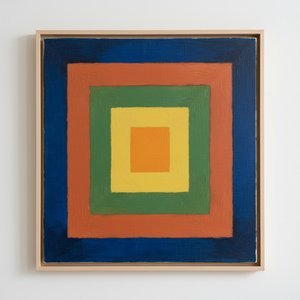
Josef Albers: A Homage to Color Interaction & the Foundations of Visual Perception
Explore Josef Albers's groundbreaking color theory & the 'Homage to the Square' series. Discover how his work revolutionized visual perception and influenced modern art movements like Minimalism & Op Art. Learn about his Bauhaus roots & lasting legacy.

Beyond the Lens: Photography's Enduring Influence on Modern & Contemporary Art
Explore photography's pivotal role in shaping modern & contemporary art. Discover key movements, influential artists like Stieglitz, and expert collecting advice from OriginalUniqueArt.

Топ-25 шедеврів Ель Греко: ікона живопису для вашого інтер'єру | OriginalUniqueArt
Відкрийте для себе 25 найзнаковіших шедеврів Ель Греко! Пориньте в світ іспанського живопису, манералізму та духовного мистецтва. Розкішні репродукції картин на OriginalUniqueArt.com – для вашого вишуканого інтер'єру. Дослідіть повну колекцію онлайн!

Pictorialism: A Search for Artistic Photography's Soul – Aesthetics, Techniques & Legacy
Explore the captivating world of Pictorialism – a pivotal movement that transformed photography into fine art. Discover key artists like Stieglitz & Käsebier, techniques, and collecting tips from experts.