Меню

() ·

A painting made for you, by hand

El Lissitzky, Dessau

Олійная репродукція ручної роботи

Написана вручну олією на полотні у вашому розмірі та рамі, виготовлена на замовлення нашими художниками. ( Перейти до друку Перейти до цифрових зображень)

Опис експоната

Explore Josef Albers's 'El Lissitzky, Dessau,' a striking black-and-white photograph capturing two portraits of the artist El Lissitzky. Discover its composition, symbolism & historical context within Bauhaus art.

Біографія митця

Йозеф Альберс – видатний американський художник та педагог, відомий своїми революційними дослідженнями теорії кольору, геометричної абстракції та впливовою діяльністю в Баухауз. Його серія «Повага до квадрата» стала символом його творчості.

from ·

Chapter 1

How large should it be?

Slide to change the size; the picture on the left shows the frame at its real width. The proportions of the original are kept.

Стандартний розмір
індивідуальний розмір
CM
INCH

Обирайте з наших стандартних розмірів, що відповідають оригінальним пропорціям твору мистецтва.

ширина
висота

Введіть необхідну ширину та висоту, щоб картина підійшла до вашої рами або стіни. Оскільки це ручний розпис, для зміни пропорцій художник може дописати трохи більше по краях або дещо обрізати композицію — вибір за вами. Перед початком роботи ми надішлемо вам цифровий макет для затвердження. Зображення, показане на цій сторінці, не є реальним результатом — лише макет відображає майбутній вигляд.

Chapter 2

How should it arrive?

Choose the edges of the stretched canvas

Choose your frame

Corner sample of the WhiteWrap canvas edge finish, stretched on масив дерева bars
White ₴1
Corner sample of the BlurSideWrap canvas edge finish, stretched on масив дерева bars
Blurside ₴1
Corner sample of the ExtendedWrap canvas edge finish, stretched on масив дерева bars
Extended ₴1
Corner sample of the P118B picture frame: формований полістирол, 5 cm wide and 3 cm thick
P118B ₴10
Corner sample of the P118H picture frame: формований полістирол, 5 cm wide and 3 cm thick
P118H ₴10
Corner sample of the P118W picture frame: формований полістирол, 5 cm wide and 3 cm thick
P118W ₴10
Corner sample of the P438Z picture frame: формований полістирол, 5.5 cm wide and 3.5 cm thick
P438Z ₴10
Corner sample of the P508JH picture frame: формований полістирол, 7 cm wide and 3.5 cm thick
P508JH ₴12
Corner sample of the P508YH picture frame: формований полістирол, 7 cm wide and 3.5 cm thick
P508YH ₴12
Corner sample of the P805H picture frame: формований полістирол, 5 cm wide and 3.5 cm thick
P805H ₴10
Corner sample of the P805Z picture frame: формований полістирол, 5 cm wide and 3.5 cm thick
P805Z ₴10
Corner sample of the P919BZ picture frame: формований полістирол, 7 cm wide and 3.5 cm thick
P919BZ ₴10
Corner sample of the P919G picture frame: формований полістирол, 7 cm wide and 3.5 cm thick
P919G ₴10
Corner sample of the P919XJ picture frame: формований полістирол, 7 cm wide and 3.5 cm thick
P919XJ ₴10
Corner sample of the P959ZH picture frame: формований полістирол, 5 cm wide and 3 cm thick
P959ZH ₴10
Corner sample of the P968JZ picture frame: формований полістирол, 6 cm wide and 4 cm thick
P968JZ ₴12
Corner sample of the W106C picture frame: масив дерева, 5 cm wide and 3 cm thick
W106C ₴8
Corner sample of the W218G picture frame: масив дерева, 5 cm wide and 3 cm thick
W218G ₴10
Corner sample of the W218JH picture frame: масив дерева, 5 cm wide and 3 cm thick
W218JH ₴8
Corner sample of the W218Y picture frame: масив дерева, 5 cm wide and 3 cm thick
W218Y ₴10
Corner sample of the W307PJ picture frame: масив дерева, 6 cm wide and 3 cm thick
W307PJ ₴10
Corner sample of the W316G picture frame: масив дерева, 6 cm wide and 3 cm thick
W316G ₴10
Corner sample of the W316PJ picture frame: масив дерева, 6 cm wide and 3 cm thick
W316PJ ₴8
Corner sample of the W316Y picture frame: масив дерева, 6 cm wide and 3 cm thick
W316Y ₴10
Corner sample of the W398PJ picture frame: масив дерева, 5 cm wide and 3 cm thick
W398PJ ₴8
Corner sample of the W4111J picture frame: масив дерева, 6.5 cm wide and 3.5 cm thick
W4111J ₴10
Corner sample of the W500HY picture frame: масив дерева, 7 cm wide and 5 cm thick
W500HY ₴15
Corner sample of the W500JH picture frame: масив дерева, 7 cm wide and 5 cm thick
W500JH ₴15
Corner sample of the W692G picture frame: масив дерева, 8 cm wide and 4 cm thick
W692G ₴12
Corner sample of the W849H picture frame: масив дерева, 5 cm wide and 3 cm thick
W849H ₴8
Corner sample of the W940BG picture frame: масив дерева, 7.5 cm wide and 4.5 cm thick
W940BG ₴15
Corner sample of the W953PJ picture frame: масив дерева, 6 cm wide and 3.5 cm thick
W953PJ ₴8
Corner sample of the H24-GOLD picture frame: різьблене дерево з левкасом, 10 cm wide and 6 cm thick
H24-GOLD ₴30
Corner sample of the H24-SILVER picture frame: різьблене дерево з левкасом, 10 cm wide and 6 cm thick
H24-SILVER ₴30
Corner sample of the H36-GOLD picture frame: різьблене дерево з левкасом, 15 cm wide and 6.5 cm thick
H36-GOLD ₴45
Corner sample of the H36-SILVER picture frame: різьблене дерево з левкасом, 15 cm wide and 6.5 cm thick
H36-SILVER ₴45

Moulding: . Overall size with the frame: .

Chapter 3

Who paints it, and should anything change?

Examples of what can be changed: Replace face with customer photo; Add pet (e.g., replace cat with dog); Include hidden message in background; Change background landscape or elements.
After order, OriginalUniqueArt.com team will email client for instructions and provide a mockup preview

Доставка по всьому світу () за 3–4 тижні замість стандартних 5 тижнів. (30 Жовтень). Без жодних компромісів у якості.

Chapter 4

The finishing touches

A nameplate, as in a museum?

Деталі гравірування на бронзовій табличці

This elegant plaque features the artist's name and the title of the artwork, finely engraved for a timeless presentation.

It is made from bronze with a refined, elegant finish. The text is precisely laser-engraved for a sharp and permanent result. Measuring 9x2 cm, the plaque is compact yet easy to read. It's built to be durable and scratch-resistant, offering a professional, museum-quality look. Mounting is simple thanks to the included adhesive backing.

Деталі прозорої акрилової таблички

The plaque includes essential engraved details such as the artist's name, the title of the artwork, the date it was created, the type of media used-like oil on canvas or watercolor-a brief description of the piece, and a QR code that links to the complete artwork information.

It is crafted from clear acrylic, offering a sleek, modern appearance. The text is UV-engraved in black to ensure strong visual contrast. With a size of 10x15 cm, it ensures optimal readability. It comes equipped with two metal hooks for secure wall mounting. The plaque is designed to be weather-resistant, making it suitable for various environments, and it includes interactive features that work seamlessly with smartphone scanning.

Деталі чорної акрилової таблички

This elegant plaque includes engraved information such as the artist's name, the title of the artwork, the date it was created, the type of media used (like oil on canvas or watercolor), a short description of the artwork, and a QR code for quick access to more information.

The plaque itself is made from refined black acrylic with a premium finish. The text is laser-engraved in white for high contrast and readability. Its size is 10x15 cm, designed to be easy to read. It comes with two metal hooks for professional mounting. The design is sleek and fits any interior style. It is also weather-resistant and durable, with built-in digital integration for mobile compatibility.

A protective varnish?

When do you need it?

Chapter 5

Your painting, as you ordered it

El Lissitzky, Dessau

Матеріал репродукції

Розмір репродукції

-

Видатний майстер-художник

Більше деталізації, витонченості та додаткового часу на створення твору

-

Рама для репродукції

-

-

Для творів мистецтва або репродукцій, розмір яких перевищує 105 см (приблизно 41 дюйм) з будь-якого боку, рама доставляється у вигляді розібраного комплекту. Такий метод гарантує безпечну доставку та запобігає пошкодженням під час транспортування.

Потребує професійного збирання — це не продукт для самостійного виготовлення (DIY).
Комплект має бути зібраний, а полотно натягнуте досвідченим майстром багетних робіт із використанням клейового дерева (не входить у комплект), щипців для натягування полотна та затискачів, щоб підрамник залишався рівним під час висихання клею. Неправильне збирання або нерівномірне натягування полотна може призвести до незворотного пошкодження твору мистецтва, що не підпадає під дію нашої гарантії.

  • У комплект входять усі бруски з цільного дерева, точно вирізані за розміром.

  • Збирається за допомогою гвинтів, що входять до комплекту, а також клейового розчину для кутових з'єднань, який не входить до комплекту і має бути підготовлений вашим майстром.

  • Потрібні професійні інструменти, які не входять до комплекту: щипці для натягування полотна (натягувач) та затискачі, щоб утримувати рейки рівно під час висихання клею.

Важливо:
Для з'єднання кутів потрібен клей для дерева, перекладини необхідно затиснути струбцинами до повного висихання клею, а для натягування полотна на зібрану раму знадобляться щипці для натягування полотна. Жоден із цих інструментів не входить до комплекту. Будь ласка, проконсультуйтеся з досвідченим майстром багетного оформлення перед замовленням рами такого розміру.

Етикетка експоната

-

-

Захисний лак

Глянцевий лак (підсилює яскравість кольорів, захищає від світла та вологи)

-

Персоналізувати мій витвір

Приклади можливих змін: заміна обличчя на фото клієнта; додавання домашньої тварини (наприклад, заміна кота на собаку); додавання прихованого повідомлення на фоні; зміна пейзажу або елементів фону.

-

Прискорено

Доставка по всьому світу () за 3–4 тижні замість стандартних 5 тижнів. (30 Жовтень). Без компромісів у якості.

-

Експрес-доставка

Доставка по всьому світу () протягом 5 тижнів. (6 Листопад).

Включено в ціну

Підсумкова вартість

₴ 14569

Загальна вартість ₴ 14569

Скляний варіант доступний лише для розмірів до 110 см

Included with every order

  • Безкоштовна експрес-доставка по всьому світу
  • Високоякісне лляне полотно
  • Повне страхове покриття доставки
  • Гарантія повернення митних зборів
  • Гарантія точного відтворення кольорів
  • Політика повернення протягом 100 днів (лише у разі виявлення дефектів)
  • Гарантія повернення 100% коштів
  • Пропозиція на оптові замовлення

El Lissitzky, Dessau: A Dialogue of Form and Function

The photograph presented here – “El Lissitzky, Dessau” – isn’t merely a portrait; it's a carefully constructed distillation of the spirit of early 20th-century artistic experimentation. Captured around 1930-1932 by Josef Albers, this image offers a glimpse into the world of El Lissitzky, a pivotal figure in the Russian avant-garde who bridged the gap between Suprematism and Constructivism. It’s a document of a man grappling with the fundamental questions of form, space, and communication – concerns that resonate powerfully even today.

Lissitzky, a visionary designer and artist, was deeply influenced by Malevich's radical exploration of pure geometric abstraction. However, Lissitzky moved beyond purely formal exercises, recognizing the potential of art to serve practical purposes—designing exhibition spaces, propaganda posters, and even furniture. Albers’ photograph captures this duality: Lissitzky is both an intellectual explorer and a craftsman, his gaze suggesting a thoughtful engagement with the world around him. The composition itself – two square portraits side-by-side – immediately evokes the principles of Constructivism, emphasizing clarity, order, and geometric relationships. The stark contrast between the black and white tones further amplifies this sense of precision and intellectual rigor.

A Study in Light, Line, and Gesture

Albers’ technical mastery is evident in every detail. The photograph utilizes a classic gelatin silver print process, resulting in a rich tonal range that subtly defines Lissitzky's features. The lighting is soft and diffused, minimizing harsh shadows and allowing the textures of his clothing – a crisp white shirt and dark tie – to emerge with clarity. Notice how Albers has employed fine lines to delineate the contours of Lissitzky’s face, capturing not just his likeness but also the subtle gestures that convey his personality. The sharp edges of the portraits create a sense of immediacy, drawing the viewer into the scene.

The photograph's composition is deceptively simple. The two square images are arranged symmetrically within a rectangular frame, creating a balanced and harmonious visual experience. However, this apparent simplicity belies a deeper level of intentionality. Lissitzky’s profile view – a pose that suggests contemplation or perhaps even conversation – contrasts sharply with his frontal portrait, offering a dynamic interplay between stillness and movement. The subtle smile in the first image hints at an approachable nature, while the profile invites introspection.

Historical Context: Bauhaus and Beyond

To fully appreciate “El Lissitzky, Dessau,” it’s crucial to understand its historical context. Albers himself was a key figure at the Bauhaus school in Germany, where he developed his groundbreaking theories of color interaction and geometric abstraction. The Bauhaus sought to unify art, craft, and technology, believing that design could improve people's lives. Lissitzky, who spent time at the Bauhaus before emigrating to Russia, carried these principles with him, influencing his work as a designer and artist.

Following the Russian Revolution, Lissitzky became involved in creating propaganda for the new Soviet state. He designed posters, book layouts, and exhibition spaces—all aimed at promoting socialist ideals through innovative visual communication. His work reflected the dynamism and optimism of the era, but also the challenges of building a new society from scratch. The photograph captures a moment of quiet reflection amidst this period of intense social and political change.

Symbolism and Emotional Resonance

Beyond its technical merits, “El Lissitzky, Dessau” possesses a subtle symbolic power. The geometric composition—the squares, the lines—represents the rational order that Lissitzky sought to impose on the world. The portrait itself can be interpreted as an exploration of identity and representation – how we perceive ourselves and how others perceive us. Lissitzky’s gaze is direct and unwavering, suggesting a confidence in his own vision.

Ultimately, this photograph transcends its documentary value. It's a testament to the power of art to capture not just appearances but also ideas, emotions, and historical moments. It invites viewers to contemplate the relationship between form and function, intellect and emotion, and the enduring legacy of El Lissitzky’s artistic vision.

Питання та відповіді

Яка яскравість твору «El Lissitzky, Dessau» роботи Йозеф Альберс?

Кольори твору "El Lissitzky, Dessau" мають рівень яскравості Bright Balance.

Які сюжети зображені у «El Lissitzky, Dessau» роботи Йозеф Альберс?

«El Lissitzky, Dessau» роботи Йозеф Альберс зображує: portrait, el lissitzky, photography, dessau, bauhaus, soviet art, 20th century.

До якого етапу кар'єри Йозеф Альберс належить твір "El Lissitzky, Dessau" (1932)?

Дата 1932 дозволяє віднести «El Lissitzky, Dessau» до Early Period творчого розвитку Йозеф Альберс.

More about this painting

Переглянути в інтер'єрі Перегляд в AR Перейти до друку Перейти до цифрових зображень Надіслати як листівку
Деталі витвору Посібник Додати до улюблених Завантажити Схожі екземпляри Рентгенівське дослідження Слайд-шоу Q&A Статистика

In numbers

  • 1932the year it was painted
  • 29frames to choose from
  • standard sizes, in its own proportions
  • 5weeks to paint and deliver it

About the original

Йозеф Альберс

Йозеф Альберс

1888 - 1976, Німеччина

Quick facts about Йозеф Альберс

  • Artistic Movement Or Style: Геометрична абстракція
  • Artists Or Movements Influenced By This Artist:
    • Minimalism
    • Color Field Painting
  • Artists Who Influenced This Artist:
    • Paul Klee
    • Wassily Kandinsky
  • Date Of Birth: 19 березня 1888
  • Date Of Death: 25 березня 1976
  • Full Name: Josef Albers
  • Nationality: Німецько-американський
  • Notable Artworks:
    • Homage to the Square
    • Gray Instrumentation I Prospectus
    • Rosa Mystica Ora Pro Nobis
  • Place Of Birth: Боттром, Німеччина

Біографія митця

A Life Forged in Material: The Early Years and Bauhaus Formation

Josef Albers’s artistic journey began not amidst the rarefied air of established academies, but within the pragmatic world of his father’s contracting business in Bottrop, Germany. Born in 1888, young Josef absorbed a deep respect for materials – carpentry, plumbing, house-painting – skills that would fundamentally shape his aesthetic sensibility. This wasn't merely vocational training; it was an immersion into the very essence of making, understanding how forms materialized and the inherent qualities within each medium. He learned to appreciate the subtle textures of wood, the precise angles of metal, the transformative power of color applied to surfaces. Before dedicating himself fully to art, Albers spent five years as a schoolteacher, honing patience and pedagogical skill—attributes that would later define his influential teaching career. Formal artistic training commenced at the Königliche Kunstschule in Berlin between 1913 and 1915, where he explored printmaking, painting, and, crucially, stained glass. His early commission, “Rosa Mystica Ora Pro Nobis” (1918), a stunning stained-glass window for a church in Germany, foreshadowed his lifelong fascination with the interplay of light and color, hinting at the abstract explorations to come. This initial work wasn’t simply decorative; it was an investigation into how light *transformed* material, a theme that would resonate throughout his career. The meticulous craftsmanship required for stained glass instilled in him a deep appreciation for detail and precision – qualities he would later apply to his paintings.

The Bauhaus Crucible: Color as Subject

A pivotal moment arrived in 1922 when Albers joined the faculty of the Bauhaus, a revolutionary school seeking to unify all artistic disciplines under Walter Gropius’s visionary leadership. Initially tasked with teaching the preliminary course – *Werklehre* (workshop practice) – he immersed himself in its core principles: functionalism, geometric abstraction, and material exploration. This period proved transformative. Albers began a systematic investigation into color perception, moving away from representational art towards an increasingly abstract vocabulary. He wasn’t interested merely in *what* colors were, but *how* they interacted, how they influenced each other, and how our eyes perceived them. The influence of fellow Bauhaus masters like Paul Klee and Wassily Kandinsky is discernible in his early work, yet Albers charted a unique course, prioritizing empirical observation over metaphysical interpretation. He wasn’t seeking spiritual truths through color; he was meticulously documenting its physical effects – a scientific rigor that became the hallmark of his artistic method. This focus on perception, on how we *see*, rather than what is *seen*, set him apart and laid the groundwork for his future explorations. The Bauhaus environment fostered experimentation with new materials and techniques, pushing Albers to explore unconventional methods of applying color and creating visual effects.

Homage to the Square: A Laboratory of Perception

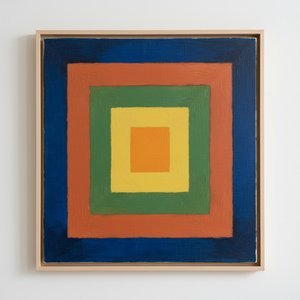
Following a period teaching at Black Mountain College – where he fostered a generation of American artists including Robert Rauschenberg and Cy Twombly – Albers embarked on what would become his most iconic series in 1949: “Homage to the Square.” This ongoing project consisted of paintings featuring nested squares within squares, each iteration exploring subtle variations in color relationships. It’s a deceptively simple premise, but one that belies an incredibly complex and rigorous investigation. Albers meticulously documented his experiments, revealing how colors aren't static entities but dynamic forces governing each other through internal logic – often misleading to the eye. A seemingly brighter square might appear to recede while a darker one advances, defying intuitive understanding. The series wasn’t intended as a celebration of geometry; rather, it was a laboratory for studying color perception. Albers’s goal was not to create beautiful pictures but to reveal the underlying principles governing how we *see* color. This research culminated in his seminal book, “Interaction of Color” (1963), a foundational text still studied by artists and designers today. The book isn't a treatise on color theory; it’s a series of exercises designed to demonstrate how our perception of color is relative and contextual – a testament to Albers’ belief that seeing is not passive, but an active process of interpretation.

Chromatic Interactions and Legacy

Albers continued to refine his artistic practice throughout the 1950s and 60s, exploring variations on “Homage to the Square” and creating other works based on geometric abstraction and color interaction. He developed a unique system for documenting his experiments, meticulously recording the colors used, their spatial relationships, and the resulting visual effects. This systematic approach became central to his teaching methodology, emphasizing observation, analysis, and critical thinking. Albers’s influence extended far beyond his own artistic output. As head of the design department at Yale University from 1950 until 1968, he shaped the education of countless designers and artists, instilling in them a commitment to rigorous experimentation and a deep understanding of visual perception. His legacy is one of intellectual rigor combined with profound aesthetic sensitivity – a testament to his belief that art can be both beautiful and intellectually stimulating. Josef Albers died on March 25, 1976, in New Haven, Connecticut, leaving behind a body of work that continues to challenge and inspire artists and designers around the world.

Notable Works

  • Gray Instrumentation I Prospectus (1975): A minimalist monochrome painting exemplifying geometric balance and subtle tonal variations.
  • Study for Homage to the Square – Beaming (Date Unknown): A classic example of Albers’s exploration of color interaction within nested squares, evoking a sense of calm and spatial depth.
  • Rosa Mystica Ora Pro Nobis (1918): His early stained-glass commission, foreshadowing his lifelong fascination with light and color.

Основна інформація

  • Notable elements: Portrait, Snapshot
  • Title: El Lissitzky, Dessau
  • Influences:
    • Bauhaus
    • Photography
  • Year: 1932
  • Location: Museum of Modern Art (MoMA)
  • Subject or theme: Forehead, Picture frame

Квіз про мистецтво

У кожному запитанні лише одна правильна відповідь.

Запитання 1:
What is the primary subject matter of ‘El Lissitzky, Dessau’?
Запитання 2:
The photograph ‘El Lissitzky, Dessau’ was created in which year?
Запитання 3:
Which artistic movement is most closely associated with El Lissitzky’s work as depicted in this photograph?
Запитання 4:
What is a key characteristic of Josef Albers’s ‘Homage to the Square’ series, which informs our understanding of this photograph?
Запитання 5:
The photographic style used in ‘El Lissitzky, Dessau’ is best described as: