Symbolism · 1903
Art (Яцек Мальчевський, 1903)
Яцек Мальчевський (1854–1929) створив Art. Дата створення — 1903. Він належить до напряму Symbolism. Виконано в Oil On Canvas. Екземпляр зберігається в National Museum in Wrocław у Wrocław, Poland. Розмір: 70 × 98 cm
- 1903
- Oil On Canvas
- 70 × 98 cm
- National Museum in Wrocław

 Переглянути в інтер'єрі

 Картина олією ручної роботи
 Надіслати як листівку
 Поділитися
 Інформаційна картка


 Завантажити
 Схожі екземпляри
 Рентгенівське дослідження
 Слайд-шоу
 Питання та відповіді

 Статистика
Art коротко
- Назва
- Art
- Художник
- Яцек Мальчевський (1854–1929)
- Рік народження митця
- Радом, Польща
- Дата
- 1903
- Матеріал
- Oil On Canvas
- Розміри
- 70 × 98 cm
- Де подивитися
- National Museum in Wrocław, Wrocław, Poland
- Рух
- Symbolism
- Період
- 19th Century
- Сюжет
- symbolism, polish art, mythology, portraiture, national identity, allegory
Що зображено на Art?
Identification of the Artwork and Artist
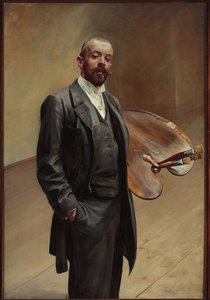
Art is an oil on canvas painting executed by Jacek Malczewski in 1903. The work belongs to the Symbolist movement, a style in which Malczewski established himself as a central figure. His practice often integrated themes of national identity and folklore into complex allegorical compositions.
Malczewski was a Polish symbolist painter. His approach frequently utilized mythological and religious motifs to explore psychological and existential states. This specific work, created at the turn of the twentieth century, reflects the artist's characteristic use of symbolic imagery to communicate ideas beyond literal representation.
Composition and Visual Elements
The composition is tightly framed, focusing the viewer's attention on the faces and upper bodies of the clustered figures. This arrangement creates a sense of intimacy and shared experience among the subjects, though the overall placement feels somewhat chaotic yet deliberate. A large, golden horse dominates the background, its head acting as a visual anchor that stabilizes the grouping of humans in the foreground.
The color palette is dominated by earthy tones, including browns, beiges, and muted greens. These base colors are contrasted by the vibrant golden hue of the horse and subtle touches of red in the hair and clothing of the figures. Lighting is diffused and soft, appearing to emanate from multiple sources without creating harsh shadows or strong contrasts. This gentle illumination contributes to the dreamlike quality of the scene.
The perspective is somewhat flattened due to the close-up framing, which limits the sense of spatial recession. Depth is achieved primarily through the layering of figures and the placement of the equine subject in the background. Organic and rounded shapes define the human forms and the natural contours of the horse, avoiding sharp angles or geometric structures.
Technique and Material Composition
Executed in oil on canvas, the work utilizes a method of blended brushstrokes to achieve its specific visual effects. The application of paint involves a visible layering process, which contributes to the depth and richness of the composition. This layering allows for a subtle transition between the earthy tones of the background and the more luminous highlights found on the figures and the equine subject.
The surface texture appears relatively smooth, a result of the extensive blending of the oil paints. This technique softens the edges of the forms, particularly in the rendering of hair and the drape of clothing. Consequently, the lines defining the facial features remain somewhat indistinct, contributing to a dreamlike quality. The interplay of light and shadow is achieved through these soft transitions rather than through harsh, high-contrast edges.
Related Works by Jacek Malczewski
The artist's exploration of symbolic and allegorical themes is evident in several other compositions. His 1901 work, Self-portrait with the Vistula in the Background, offers a different perspective on his relationship with the Polish landscape. Other significant pieces include Chimera 1 and the Thanatos series, which further investigate the psychological and spiritual dimensions central to his practice.
Malczewski also drew heavily from folklore and mythology to construct his visual language. This is particularly evident in his collection titled Bajki (Fables). These works, alongside his various symbolic studies, demonstrate the breadth of his engagement with national and universal motifs.
У якому музеї зберігається Art?
National Museum in Wrocław
Wrocław, Poland
The Architecture of the National Museum in Wrocław The National Museum in Wrocław occupies a former Silesian regency building situated on the banks of the Odra river. Constructed between 1883 and 1886, the structure reflects the architectural language of the late 19th century. Its Neo-Renaissance design provides a formal setting for the collections housed within its three floors.


Зображення високої роздільної здатності Art

Суспільне надбання: художник помер у 1929 році.
Інші розміри, кадри та цитування →Яцек Мальчевський, Art (1903), National Museum in Wrocław. Суспільне надбання
Відповіді на запитання про Art
У якому музеї зберігається оригінал «Art»?
«Art» роботи Яцек Мальчевський експонується в National Museum in Wrocław, Wrocław, Poland. У описі музею йдеться про оригінальний твір, а не про репродукції.
У якому році було створено "Art"?
«Art» роботи Яцек Мальчевський було створено у 1903 році.
Яка техніка була використана для створення «Art» роботи Яцек Мальчевський?
Техніка виконання «Art» роботи Яцек Мальчевський — Oil On Canvas. Репродукції мають на меті відтворити вигляд цієї техніки.
Які розміри оригіналу "Art"?
Розмір оригіналу «Art» роботи Яцек Мальчевський становить 70 x 98 cm.
Що зображено на творі «Art» роботи Яцек Мальчевський?
Тематика, представлена у «Art» роботи Яцек Мальчевський, включає symbolism, polish art, mythology, portraiture, national identity, allegory, artistic inspiration. Разом вони підсумовують зміст твору.
Чи є «Art» роботи Яцек Мальчевський суспільним надбанням?
Статус авторського права для «Art» роботи Яцек Мальчевський: цей твір є є суспільним надбанням — термін дії авторського права закінчився. Це визначає, чи можна вільно створювати репродукції зображення.
Якому художнику приписують роботу "Art"?
«Art» приписують Яцек Мальчевський.
До якого стилю належить "Art"?
«Art» — це твір у стилі Symbolism. Назва течії вказує на художню традицію, до якої належить цей твір.
Який етап творчого розвитку Яцек Мальчевський представляє твір "Art"?
У межах творчого шляху Яцек Мальчевський твір "Art" належить до періоду Mature Period. Ця фаза дозволяє порівняти його з іншими роботами митця.
Про художника Яцек Мальчевський
1854–1929, Польща
Яцек Мальчевський
Життя, просякнуте польською тугою Яцек Мальчевський, народжений у 1854 році в Радомі, місті, що тоді знаходилося під контролем російської Польщі, був не просто художником; він став візуальним втіленням польської національної ідентичності та глибоким голосом нації, яка прагнула самовизначення. Його життєвий шлях та творче бачення були нерозривно пов'язані з романтичними ідеалами незалежності, глибоко прищепленими його батьком, Юліаном Мальчевським – відданим патріотом, який виховав у молодому Яцеку непохитну любов до польської культури, літератури та історії. Цей ранній вплив став основою його творчого самовираження, сформувавши його як провідну фігуру польського символізму і заслуживши йому почесне звання «батька польського символізму». Його юні роки були сповнені оповідей про героїзм, жертовність та проникливе усвідомлення важкого минулого Польщі – тем, які відгукувалися протягом усього його творчого шляху.
Також за участю Яцек Мальчевський
 Self-portrait in armor with violin.1908
 Madonna and Children1897
 Portrait of artist's sister Helene with lute1906
 The Artist's death1909
Есе до твору Art
 19th century Polish painters19th-century Polish art comes alive through the masterpieces of Jan Matejko and Jacek Malczewski. View the full collection online at Origin…
 Masterpieces of the Soil: The Top 25 Jean-François Millet ArtworksImmerse yourself in the soul of French Realism with our curated list of the top 25 Jean-François Millet artworks. From iconic peasant scene…
 20th century Polish painters20th-century Polish painters like Tamara de Lempicka, Sigmar Polke, and Aleksandra Ekster define an era. Find museum-quality reproductions …