

 Förhandsvisa
 Skicka
 Dela
Dela
 Visa detaljer
 Guide
Guide

 Ladda ner
 Liknande objekt
 Röntgen
 Bildspel
 Q&A
Q&A Statistik
Beethoven komponerar Pastoralsymphonin


 Visa mer
Giclée / Konsttryck
Giclée- eller canvasprint av museumskvalitet med snabb produktion och flexibla ytbehandlingsalternativ. ( Beställ handmålad reproduktion Byt till digital bild)




P118B Skr10

P118H Skr10

P118W Skr10

P438Z Skr10

P508JH Skr12

P508YH Skr12

P805H Skr10

P805Z Skr10

P919BZ Skr10

P919G Skr10

P919XJ Skr10

P959ZH Skr10

P968JZ Skr12

W106C Skr8

W218G Skr10

W218JH Skr8

W218Y Skr10

W307PJ Skr10

W316G Skr10

W316PJ Skr8

W316Y Skr10

W398PJ Skr8

W4111J Skr10

W500HY Skr15

W500JH Skr15

W692G Skr12

W849H Skr8

W940BG Skr15

W953PJ Skr8




Välj bland våra förinställda storlekar som motsvarar konstverkets ursprungliga proportioner.

Ange den bredd och höjd du behöver för att passa din ram eller vägg. Ett tryck kan endast beskäras, aldrig göras större än originalbilden, vilket innebär att ett format med en annan proportion leder till att en del av bilden går förlorad. Vi skickar en digital mockup för godkännande innan vi påbörjar tryckningen. Bilden som visas på denna sida visar inte den faktiska beskärningen — det är endast mockuppen som gör det.
Leverans över hela världen () på 2 veckor istället för standard 4/5 veckor. (31 oktober)

Fri expressfrakt över hela världen

Högkvalitativ linnecanvas

Fullständig fraktförsäkring

Garantier för återbetalning av tullavgifter

Garantier för exakt färgåtergivning

100 dagars returrätt (endast vid fel)

100% pengarna tillbaka-garanti

Mängdrabatt erbjuds
 Glasalternativet är endast tillgängligt i storlekar under 110 cm.

Beethoven komponerar Pastoralsymphonin
Giclée / Konsttryck
Storlek på reproduktion
-


Slutgiltigt pris
Skr 804
Beethoven composing the Pastoral Symphony – A Reflection on Romantic Landscape Painting
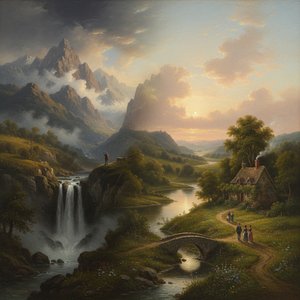
Franz Hegi’s “Beethoven composing the Pastoral Symphony,” created in 1839, transcends mere visual representation; it's a profound meditation on artistic inspiration and the sublime beauty of nature—themes central to the Romantic movement. The painting depicts a solitary man seated beside a river, his gaze fixed upon the flowing water, holding a sheet of paper bearing musical notations – an immediate connection to Ludwig van Beethoven’s groundbreaking “Pastoral Symphony,” which premiered in 1824 and revolutionized orchestral music by attempting to capture the emotional essence of rural life.- Artist & Context: Franz Hegi (1774-1850) was a prominent German Romantic landscape painter, deeply influenced by Caspar David Friedrich’s philosophical approach to art. Friedrich championed the idea that art should evoke contemplation and convey spiritual truths rather than simply documenting observable reality.
- Style & Technique: Hegi employed aquatinta etching—a technique known for its tonal subtlety and ability to reproduce nuanced shades of grey—to achieve a remarkably realistic depiction of the riverside scene. The artist meticulously rendered the textures of bark, stone, and water, creating an atmosphere of quiet solemnity.
- Composition & Symbolism: The solitary figure dominates the canvas, positioned on the edge of the river, symbolizing humanity’s yearning for connection with the natural world and its contemplation of profound questions. The flowing water represents purity and renewal, mirroring Beethoven's musical exploration of pastoral tranquility.
- Emotional Impact: “Beethoven composing the Pastoral Symphony” succeeds in capturing a feeling of serene introspection—a desire to escape the pressures of urban life and immerse oneself in the restorative power of nature. It invites viewers to consider themes of solitude, contemplation, and the sublime experience of encountering beauty.
Further Exploration: Beethoven’s Influence on Romantic Art
The “Pastoral Symphony” itself was a pivotal moment in musical history, marking a decisive break from Classical conventions. Beethoven deliberately sought to evoke emotions associated with rural landscapes—peacefulness, joy, melancholy—drawing inspiration from Friedrich's artistic vision. The symphony’s use of instrumentation and harmonic language aimed to convey the grandeur and mystery of nature, mirroring Hegi’s artistic endeavors.Reproductions & Interior Design Considerations
A high-quality reproduction of “Beethoven composing the Pastoral Symphony” can bring a sense of tranquility and intellectual stimulation into any interior space. Consider framing it in a neutral tone—perhaps grey or beige—to complement its muted palette and enhance its contemplative mood. Its understated elegance aligns perfectly with contemporary minimalist design sensibilities.Resources for Collectors
For more information about Franz Hegi and his artistic legacy, visit the Beethoven-Haus Bonn’s Digital Archive: Find more information about this object in the Beethoven-Haus' Digital Archive. Explore related artworks by Friedrich and other Romantic landscape painters to deepen your understanding of the movement’s aesthetic principles.Frågor och svar
Är "Beethoven komponerar Pastoralsymphonin" ett berömt verk inom German Romanticism?
Inom German Romanticism-rörelsen har "Beethoven komponerar Pastoralsymphonin" en Ikonisk popularitetsnivå.
Hur laddar jag ner bilden av "Beethoven komponerar Pastoralsymphonin" av Franz Hegi?
"Beethoven komponerar Pastoralsymphonin" av Franz Hegi kan laddas ner som en högupplöst digital bildnedladdning via verkets sida för Ladda ner digital bild.
Vad föreställer "Beethoven komponerar Pastoralsymphonin" av Franz Hegi?
"Beethoven komponerar Pastoralsymphonin" av Franz Hegi föreställer: landscape, beethoven, composition, solitude, mountain, atmosphere, painting.
Konstnärsbiografi
A Master of Line and Light
The artistry of Franz Hegi resides in the delicate intersection of precision and atmosphere, a realm where the etched line breathes life into the landscapes of Switzerland. Born in Lausanne, Switzerland, Hegi’s journey was one of movement and apprenticeship, shaped by the rich traditions of European printmaking. His early years were marked by a profound connection to the craft, beginning with an apprenticeship under the etcher Matthias Pfenninger. It was here that he mastered the nuanced technique of aquatint, a method capable of producing tonal gradations that mimic the soft washes of watercolor, allowing him to capture the ephemeral qualities of light and shadow across the Swiss terrain.
As his talent matured, Hegi’s work became an essential visual chronicle of his era. His movements through Basel and eventually back to Zürich allowed him to immerse himself in the cultural fabric of these regions. Working alongside figures such as the painter and publisher Peter Birmann, Hegi developed a keen eye for the architectural soul of Swiss towns and the intricate details of local costume. His prints were not merely aesthetic objects but historical documents, capturing the essence of Swiss architecture and the dignity of traditional dress with an almost ethnographic devotion.
The Chronicles of Zürich and Beyond
Hegi’s creative output reached a particular zenith through his dedication to documenting the cultural and historical substance of Zürich. His work often transcended simple landscape depiction, venturing into the realm of historical subjects and the preservation of memory. Through his etchings and aquatints, he brought to life the stories embedded in the city's monuments and its very streets. This passion for detail extended to his collaborations, such as his studies of the Codex Manesse, where he sought to honor the deep historical roots of the region.
The breadth of his technical skill is evident in the variety of his subjects:
- Landscape Views: Capturing the serene and rugged beauty of the Swiss countryside through masterful tonal control.
- Architectural Studies: Providing a detailed visual record of Swiss buildings and urban structures, particularly within Zürich.
- Costume Depictions: Documenting the intricate textures and cultural significance of traditional attire.
- Historical Illustrations: Contributing to almanacs, literary works, and publications like the Helvetischer Almanach, ensuring that history remained visually accessible to the public.
Beyond his individual prints, Hegi’s legacy is woven into the very fabric of Swiss visual heritage. His ability to blend the technical rigor of engraving with a romantic sensibility for nature ensured that his works would find a permanent home in prestigious institutions, including the Swiss National Library and the Kunsthaus Zürich. Through his meticulous hand, the landscapes and histories of his homeland were preserved, rendered in a timeless language of ink and light that continues to resonate with those who seek the true spirit of Switzerland.

Franz Hegi
1774 - 1850 , Switzerland
Kortfakta
- Artistic Movement Or Style: Aquatint, engraving, and etching
- Artists Who Influenced This Artist: ['Matthias Pfenninger']
- Full Name: Franz Hegi
- Nationality: Swiss
- Notable Artworks:
- Views of Swiss landscapes
- Swiss architecture and costume studies
- Place Of Birth: Lausanne, Switzerland
- Date Of Birth: 1774
- Date Of Death: 1850
Relaterade artiklar

Romantiska landskap: Topp 10 mästerverk som definierade en epok – OriginalUniqueArt.se
Utforska de 10 mest ikoniska mästerverken inom romantisk landskapsmålning! Lär känna Caspar David Friedrich, Turner & andra. Hitta inspiration och köp museumkvalitativa konsttryck på OriginalUniqueArt.com.

John Constables 25 Mästerverk: En Konstnärlig Resa i Det Engelska Landskapet | OriginalUniqueArt
Utforska John Constables 25 mest ikoniska målningar – romantikens mästare av det engelska landskapet. Upptäck historien, tekniken & skönheten i verk som 'Hay Wain'. Köp exklusiva konsttryck på OriginalUniqueArt.com.

The Sublime and the Picturesque: Exploring Emotion & Nature in Romantic Landscape Painting
Explore the emotional power of Romantic landscape painting! Discover the sublime & picturesque traditions, key artists like Friedrich & Cole, and find your perfect artwork at OriginalUniqueArt.

Evocations of Place: A Historical Journey Through Landscape Art
Explore the rich history of landscape art with OriginalUniqueArt. Discover renowned artists, movements like Impressionism & Romanticism, and expert guidance for collecting timeless pieces. Find your perfect serene escape today!
The Sublime and the Picturesque: Exploring Emotion & Nature in Romantic Landscape Painting
Explore the emotional power of Romantic landscape painting! Discover the sublime & picturesque aesthetics, key artists like Friedrich & Cole, and lasting influence on art history. Find your perfect piece at OriginalUniqueArt.
