

 Förhandsvisa
 Skicka
 Dela
Dela
 Visa detaljer

 Ladda ner
 Liknande objekt
 Röntgen
 Bildspel
 Statistik
Beethoven komponerar Pastoralsymphonin


 Visa mer
Handgjord oljereproduktion
Handmålad olja på duk i din valda storlek och ram, tillverkad efter beställning av våra konstnärer. ( Byt till tryck Byt till digital bild)




P118B $10

P118H $10

P118W $10

P438Z $10

P508JH $12

P508YH $12

P805H $10

P805Z $10

P919BZ $10

P919G $10

P919XJ $10

P959ZH $10

P968JZ $12

W106C $8

W218G $10

W218JH $8

W218Y $10

W307PJ $10

W316G $10

W316PJ $8

W316Y $10

W398PJ $8

W4111J $10

W500HY $15

W500JH $15

W692G $12

W849H $8

W940BG $15

W953PJ $8




Välj bland våra förinställda storlekar som motsvarar konstverkets ursprungliga proportioner.

Du kan ange egna mått för att passa en specifik ram eller yta. Om den valda storleken inte matchar originalbildens proportioner kommer vi antingen att beskära konstverket eller utöka målningen med ytterligare handmålade element. En digital skiss skickas till dig för godkännande innan produktionen påbörjas.
Observera att förhandsvisningen på skärmen inte återspeglar den faktiska beskärningen eller utökningen. Endast skissen visar den slutgiltiga kompositionen korrekt.
Även om anpassade storlekar är möjliga, rekommenderar vi att du väljer en dimension från den fördefinierade listan för att bevara originalproportionerna.
Efter beställning kommer OriginalUniqueArt.com team att mejla kunden för instruktioner och tillhandahålla en skissförhandsvisning
Leverans över hela världen () på 3–4 veckor istället för standard 5 veckor. (18 september). Inga kompromisser med kvaliteten.

Fri expressfrakt över hela världen

Högkvalitativ linnecanvas

Fullständig fraktförsäkring

Garantier för återbetalning av tullavgifter

Garantier för exakt färgåtergivning

100 dagars returrätt (endast vid defekter)

100% pengarna tillbaka-garanti

Mängdrabatt erbjuds
 Glasalternativet är endast tillgängligt i storlekar under 110 cm.

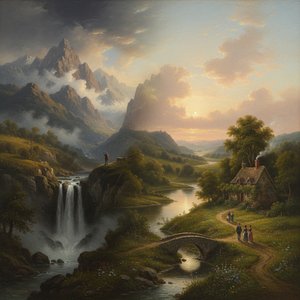
Beethoven komponerar Pastoralsymphonin
Reproduktionsmedium
Storlek på reproduktion
-


Slutgiltigt pris
$ 300
Beethoven composing the Pastoral Symphony – A Reflection on Romantic Landscape Painting
Franz Hegi’s “Beethoven composing the Pastoral Symphony,” created in 1839, transcends mere visual representation; it's a profound meditation on artistic inspiration and the sublime beauty of nature—themes central to the Romantic movement. The painting depicts a solitary man seated beside a river, his gaze fixed upon the flowing water, holding a sheet of paper bearing musical notations – an immediate connection to Ludwig van Beethoven’s groundbreaking “Pastoral Symphony,” which premiered in 1824 and revolutionized orchestral music by attempting to capture the emotional essence of rural life.- Artist & Context: Franz Hegi (1774-1850) was a prominent German Romantic landscape painter, deeply influenced by Caspar David Friedrich’s philosophical approach to art. Friedrich championed the idea that art should evoke contemplation and convey spiritual truths rather than simply documenting observable reality.
- Style & Technique: Hegi employed aquatinta etching—a technique known for its tonal subtlety and ability to reproduce nuanced shades of grey—to achieve a remarkably realistic depiction of the riverside scene. The artist meticulously rendered the textures of bark, stone, and water, creating an atmosphere of quiet solemnity.
- Composition & Symbolism: The solitary figure dominates the canvas, positioned on the edge of the river, symbolizing humanity’s yearning for connection with the natural world and its contemplation of profound questions. The flowing water represents purity and renewal, mirroring Beethoven's musical exploration of pastoral tranquility.
- Emotional Impact: “Beethoven composing the Pastoral Symphony” succeeds in capturing a feeling of serene introspection—a desire to escape the pressures of urban life and immerse oneself in the restorative power of nature. It invites viewers to consider themes of solitude, contemplation, and the sublime experience of encountering beauty.
Further Exploration: Beethoven’s Influence on Romantic Art
The “Pastoral Symphony” itself was a pivotal moment in musical history, marking a decisive break from Classical conventions. Beethoven deliberately sought to evoke emotions associated with rural landscapes—peacefulness, joy, melancholy—drawing inspiration from Friedrich's artistic vision. The symphony’s use of instrumentation and harmonic language aimed to convey the grandeur and mystery of nature, mirroring Hegi’s artistic endeavors.Reproductions & Interior Design Considerations
A high-quality reproduction of “Beethoven composing the Pastoral Symphony” can bring a sense of tranquility and intellectual stimulation into any interior space. Consider framing it in a neutral tone—perhaps grey or beige—to complement its muted palette and enhance its contemplative mood. Its understated elegance aligns perfectly with contemporary minimalist design sensibilities.Resources for Collectors
For more information about Franz Hegi and his artistic legacy, visit the Beethoven-Haus Bonn’s Digital Archive: Find more information about this object in the Beethoven-Haus' Digital Archive. Explore related artworks by Friedrich and other Romantic landscape painters to deepen your understanding of the movement’s aesthetic principles.Konstnärsbiografi
Caspar David Friedrich: The Soul of the German Landscape
Caspar David Friedrich, born in 1774 in the windswept Baltic town of Greifswald, wasn’t merely a painter; he was a translator of experience. His life, marked by profound personal loss and an intense connection to nature, became inextricably woven into the fabric of his art – a body of work that continues to resonate with viewers today as a poignant exploration of spirituality, solitude, and the sublime. Often considered the most important German artist of his generation, Friedrich’s landscapes aren't simply depictions of scenery; they are carefully constructed invitations to contemplate the mysteries of existence, rendered in a style both intensely personal and profoundly influential.
Early Life and Influences: A World Shaped by Loss
Friedrich’s childhood was shadowed by tragedy. The early deaths of his mother and brother instilled within him a deep sense of melancholy and an acute awareness of mortality – themes that would repeatedly surface in his art. This personal sorrow, coupled with the strict religious upbringing he received within a devout Lutheran family, profoundly shaped his worldview. He initially pursued studies at the University of Greifswald, focusing on architecture before ultimately dedicating himself to painting. Crucially, during this period, he encountered and was deeply moved by the works of Dutch masters like Jacob van Ruisdael and Jan Vermeer – artists who had mastered the subtle nuances of light and atmosphere, capturing a sense of quiet contemplation within their landscapes. These early influences instilled in him a meticulous attention to detail and a desire to evoke a specific mood or feeling through his art.
The Development of a Distinctive Style: Romanticism Takes Root
Friedrich’s artistic journey truly began after he moved to Copenhagen, where he studied at the Royal Danish Academy. However, it was in Dresden, the capital of Saxony, that he established himself as an artist and developed his unique style – a cornerstone of the burgeoning German Romantic movement. Unlike the Neoclassical emphasis on reason and order, Friedrich sought to capture the emotional power of nature, prioritizing subjective experience over objective representation. His paintings are characterized by a dramatic use of light and shadow, often employing a muted palette dominated by blues, greys, and browns, creating an atmosphere of mystery and introspection. He frequently incorporated solitary figures – often dwarfed by the vastness of the landscape – into his compositions, suggesting humanity’s place within the grand scheme of nature. These figures aren't heroic or triumphant; they are vulnerable, contemplative, and deeply connected to their surroundings.
Key Works and Symbolic Language
Several paintings stand as particularly potent examples of Friedrich’s artistic vision. “Wanderer above the Sea of Fog” (1818), perhaps his most iconic work, depicts a solitary figure gazing out over a misty landscape, embodying both human ambition and the humbling power of nature. "The Abbey in the Oak Forest" (1809) explores themes of spirituality and decay, juxtaposing the grandeur of the ruined abbey with the dense, brooding forest. “Chalk Cliffs on Rügen” (1826), showcases his mastery of atmospheric perspective and the evocative use of light to create a sense of depth and distance. Beyond their visual beauty, these works are laden with symbolic meaning. Friedrich frequently employed motifs such as ruins, mountains, forests, and bodies of water – each carrying layers of historical, religious, and philosophical significance. He deliberately blurred the boundaries between reality and imagination, inviting viewers to engage in a dialogue with the artwork and project their own emotions and experiences onto it.
Legacy and Historical Significance
Despite enjoying early success and patronage, Friedrich’s fortunes declined significantly during his later years. The waning of Romanticism and the rise of industrialization contributed to a shift in artistic tastes, leaving him largely forgotten until the late 19th century when Symbolist artists rediscovered his work and recognized its profound emotional depth. Today, Caspar David Friedrich is celebrated as one of the most important figures in German art history – a pioneer of Romantic landscape painting who profoundly influenced generations of artists. His paintings continue to captivate viewers with their evocative atmosphere, symbolic richness, and enduring exploration of the human condition’s relationship with nature. His work remains a powerful reminder of the importance of introspection, solitude, and the sublime beauty that can be found in the natural world.

franz hegi
1774 - 1850 , Switzerland
Kortfakta
- Artistic Movement Or Style: Romanticism
- Artists Or Movements Influenced By This Artist:
- Expressionism
- Symbolism
- Artists Who Influenced This Artist:
- J.M.W. Turner
- Joshua Reynolds
- Date Of Birth: September 5, 1774
- Date Of Death: May 7, 1840
- Full Name: Caspar David Friedrich
- Nationality: German
- Notable Artworks:
- Wanderer above the Sea of Fog
- Monk by the Sea
- The Abbey in the Oak Forest
- Place Of Birth: Greifswald, Germany
Relaterade artiklar

Romantiska landskap: Topp 10 mästerverk som definierade en epok – OriginalUniqueArt.se
Utforska de 10 mest ikoniska mästerverken inom romantisk landskapsmålning! Lär känna Caspar David Friedrich, Turner & andra. Hitta inspiration och köp museumkvalitativa konsttryck på OriginalUniqueArt.com.

Evocations of Place: A Historical Journey Through Landscape Art
Explore the rich history of landscape art with OriginalUniqueArt. Discover renowned artists, movements like Impressionism & Romanticism, and expert guidance for collecting timeless pieces. Find your perfect serene escape today!

The Sublime and the Picturesque: Exploring Emotion & Nature in Romantic Landscape Painting
Explore the emotional power of Romantic landscape painting! Discover the sublime & picturesque traditions, key artists like Friedrich & Cole, and find your perfect artwork at OriginalUniqueArt.
The Sublime and the Picturesque: Exploring Emotion & Nature in Romantic Landscape Painting
Explore the emotional power of Romantic landscape painting! Discover the sublime & picturesque aesthetics, key artists like Friedrich & Cole, and lasting influence on art history. Find your perfect piece at OriginalUniqueArt.

John Constables 25 Mästerverk: En Konstnärlig Resa i Det Engelska Landskapet | OriginalUniqueArt
Utforska John Constables 25 mest ikoniska målningar – romantikens mästare av det engelska landskapet. Upptäck historien, tekniken & skönheten i verk som 'Hay Wain'. Köp exklusiva konsttryck på OriginalUniqueArt.com.
