Portrait of Vilijam Moris

The 26 Most Famous Vilijam Moris Paintings, a Gallery Selection

Updated октобар 2026 · ranked by our popularity score (searches, visits and orders for each work) · 37 works by Vilijam Moris in our catalogue

In short

Of all the originals Vilijam Moris left, the most famous is Strawberry Thief (1936), in the collection of the Cleveland Museum of Art, Klivlend. Close behind it come The Little Tree (Hammersmith Rug) (1895) and Snakeshead (1900). Our catalog holds 37 works by Vilijam Moris; the gallery has kept the 26 the world admires most, each shown with its date, its museum and its story.

1834 – 1896, Volthamstov Romantic revival Most works: William Morris Gallery

Vilijam Moris's top 10 paintings: the gallery's choice

1
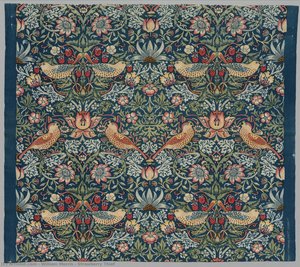
Strawberry Thief (1936) by Vilijam Moris

Strawberry Thief

1936 · Textile · Cleveland Museum of Art, Klivlend

William Morris's "Strawberry Thief," completed in 1936, isn’t merely a decorative textile; it’s a vibrant distillation of the Arts and Crafts movement’s core tenets – a celebration of nature, a rejection of industrialization, and a subtle yet potent expression of social critique. This iconic design, now instantly recognizable, draws its inspiration from Morris's own garden at Kelmscott Manor in Oxfordshire, specifically the mischievous thrushes that frequented his fruit beds. The…

2
The Little Tree (Hammersmith Rug) (1895) by Vilijam Moris

The Little Tree (Hammersmith Rug)

1895 · Textile · Museum of Applied Arts, Budimpešta

William Morris’s “The Little Tree” (Hammersmith Rug), completed in 1895, isn't merely a decorative textile; it’s a meticulously crafted portal to a world steeped in medieval romance, folklore, and the enduring beauty of nature. Born from the fertile imagination of one of England’s most influential artists and designers, this rug embodies the core tenets of the Arts and Crafts movement – a rejection of mass-produced industrialism in favour of handcrafted…

3
Snakeshead (1900) by Vilijam Moris

Snakeshead

1900 · Textile · Cleveland Museum of Art, Klivlend

The fabric breathes with a heavy, rhythmic energy, pulling the eye into a dense thicket of color. Deep reds and stark blacks collide in a pattern that feels both grounded and strikingly bold. Small, delicate motifs move across the surface, creating a sense of movement that mimics the swaying of wildflowers in a summer breeze. There is a certain tension here, found in the way the dark tones press against…

4
Design for (1881) by Vilijam Moris

Design for

1881 · Textile · William Morris Gallery, Walthamstow

Before he was a revolutionary socialist, a poet of immense talent, or simply one of the most celebrated textile designers in history, William Morris was a young man captivated by the remnants of a lost world. Born in Walthamstow, Essex, in 1834, his childhood was steeped in the romanticism of medieval chivalry and the beauty of the English countryside—a landscape he would relentlessly strive to capture within his designs. This…

5
Design for (1876) by Vilijam Moris

Design for

1876 · William Morris Gallery, Walthamstow

In the delicate interplay of flora and geometry, Design for stands as a profound testament to the visionary genius of William Morris. Created in 1876, this exquisite piece is far more than a mere decorative pattern; it is a bridge between the artisanal traditions of the past and the burgeoning aesthetic movements of the nineteenth century. The work captures a moment where nature and craftsmanship converge, offering a rhythmic dance…

8
Design for (1862) by Vilijam Moris

Design for

1862 · Acrylic · William Morris Gallery, Walthamstow

A Celebration of Pastoral Harmony: Exploring William Morris’s Watercolor Design The watercolor painting titled “Design for” by William Morris stands as a testament to the Arts and Crafts movement's unwavering belief in the restorative power of nature and its rejection of mass production. Executed in 1862, this artwork isn’t merely a depiction of flora; it’s an embodiment of Morris’s artistic ethos—a deliberate attempt to recapture the idealized beauty of the…

9
Design for woven fabric with birds and palms (1870) by Vilijam Moris

Design for woven fabric with birds and palms

1870 · William Morris Gallery, Walthamstow

This sketch by William Morris was likely intended for a woven textile repeat pattern, but was never realised. It bears a resemblance to a number of bird designs Morris & Co. produced in the late 1870s, including ‘Bird’ and ‘Bird and Dragon’, both designed by Morris in 1878. The fabrics were manufactured at the Morris & Co. premises at Queen Square, London, before subsequently being woven on hand-activated jacquard looms…

10
Qui Bien Aime Tard Oublie (1860) by Vilijam Moris

Qui Bien Aime Tard Oublie

1860 · Embroidery · William Morris Gallery, Walthamstow

In the delicate interplay of thread and color, "Qui Bien Aime Tard Oublie" emerges as a breathtaking testament to the Pre-Raphaelite spirit and the profound connection between art and the natural world. Created in 1860 by the legendary William Morris, this extraordinary embroidery is far more than a mere decorative hanging; it is a window into a romanticized era where craftsmanship served as a vessel for deep emotion. The work…

The Vilijam Moris selection continues, 11 to 26

The subjects that held Vilijam Moris's eye

The four subjects that come back most often in these originals, each with its finest example.

The museums that keep Vilijam Moris's originals

The 6 museums that hold the most of the paintings on this page.

Museum City Works by Vilijam Moris Paintings from this list
William Morris Gallery, WalthamstowWilliam Morris Gallery Walthamstow 13 Design for, Design for, Design for
Cleveland Museum of Art, KlivlendCleveland Museum of Art Klivlend 2 Strawberry Thief, Snakeshead
Museum of Applied Arts, BudimpeštaMuseum of Applied Arts Budimpešta 1 The Little Tree (Hammersmith Rug)
Boca Raton Museum of Art, Boca RatonBoca Raton Museum of Art Boca Raton 1 Petroglianska Česma
The Baltimore Museum of Art, BaltimoreThe Baltimore Museum of Art Baltimore 1 Rose
Tate Britain, LondonTate Britain London 1 La Belle Iseult

Vilijam Moris decade by decade: the original that defines each

Works per decade

Pick a decade to see the original that defines it.

Collectors' questions about Vilijam Moris's paintings

Which work is Vilijam Moris most famous for?Reveal the answer

Strawberry Thief (1936), Cleveland Museum of Art, Klivlend. The Little Tree (Hammersmith Rug) (1895) and Snakeshead (1900) come next.

What are the ten most famous Vilijam Moris paintings?Reveal the answer

Strawberry Thief, The Little Tree (Hammersmith Rug), Snakeshead, Design for, Design for, Fruit, Honeycomb, Design for, Design for woven fabric with birds and palms and Qui Bien Aime Tard Oublie. The ranking above gives each one's year and museum.

How many paintings did Vilijam Moris leave?Reveal the answer

Our catalog holds 37 works by Vilijam Moris, dated from 1857 to 1895.

In which museums do Vilijam Moris's masterpieces hang?Reveal the answer

Mostly in William Morris Gallery (Walthamstow), Cleveland Museum of Art (Klivlend) and Museum of Applied Arts (Budimpešta). The museum table above lists them all.

In which years did Vilijam Moris paint the most famous works?Reveal the answer

In 1870s: 5 of the 26 works on this page were made then, Design for among them.

What are the first and the last famous originals of Vilijam Moris?Reveal the answer

On this page, the earliest is Sword (1857) and the latest The Little Tree (Hammersmith Rug) (1895).

Which subjects did Vilijam Moris choose most often?Reveal the answer

Floral pattern (5), Pattern (4) and Textile design (4), across the 26 works on this page.

Which technique did Vilijam Moris use most?Reveal the answer

Textile, for 5 of the 26 works on this page.

To which art movement does Vilijam Moris belong?Reveal the answer

Romantic revival, judging by the originals on this page.

Which Vilijam Moris works hang at the William Morris Gallery?Reveal the answer

Design for, Design for and Design for: the William Morris Gallery, Walthamstow holds 10 of the works on this page.

Can I commission a reproduction of a Vilijam Moris painting?Reveal the answer

Yes, as a reproduction: the original stays in its museum, but any painting on this page can be painted by hand for you, made to order one at a time, from the painting's own page.

Vilijam Moris: life and work

Život ukorenjen u prirodi i romantizmu

Viljam Moris, rođen 24. marta 1834. godine u Voltemstou u Eseksu, poticao je iz komforno imućnog srednjeg sloja—okolnost koji mu je omogućio slobodu da prati svoje strasti umesto samo profesije. Uspeh njegovog oca kao finansijera doneo je ne samo sigurnost, već i okruženje u kojem su estetska osećanja mogla da cvetaju. Morisovo detinjstvo duboko je oblikovalo englesko seosko prizorje koje je okruživalo njegov dom i fascinacija pričama o srednjovekovnom viteštvu, postavljajući temelje za doživotnu posvećenost prirodnoj lepoti i romantičnim narativima. Ovi rani uticaji nisu bili samo sentimentalni; oni su činili jezgro njegove umetničke filozofije. On nije bio samo inspirisan prirodom ili prošlošću—verovao je u njihovu urođenu moralnu i estetsku superiornost nad ubrzano industrializovanim presentom. Njegovo formalno obrazovanje na Univerzitetu u Oksfordu prvobitno ga je usmerilo ka administrativnoj karijeri, ali upravo su unutar živopisnih intelektualnih krugova univerziteta počeli da se oblikuju njegovi pravi pozivi. Pridružio se „The Set“, grupi studenata koji su delili intenzivno interesovanje za umetnost, književnost i srednjovekovnu istoriju, uspostavljajući prijateljstva—najpre sa Edvardom Bern-Džonsom—koja će duboko uticati na njegov umetnički put. Upravo je u tom periodu susreo dela Džona Raskina, čija je kritika industrijskog društva i zagovaranje zanatstva snažno odjeknulo sa Morisovim rastućim uverenjima.

Revolucija pokreta Arts & Crafts

Nakon Oksforda, kratka avantura u arhitekturi brzo je ustupila mesto slikarstvu, dok je Moris sarađivao sa Danteom Gabrielom Rosetijem na projektima zidnih slika. Međutim, upravo je osnivanje firme Morris, Marshall, Faulkner & Co. 1861. godine—kasnije poznate jednostavno kao Morris & Co.—označilo prekretnicu, ne samo u njegovoj karijeri, već i u istoriji dizajna. Ovo nije bio samo poslovni poduhvat; bio je to pokušaj stvaranja novog načina života, onog u kojem umetnost prožima svaki aspekt svakodnevnog postojanja, a zanatstvo se vrednuje iznad svega. Zajedno sa Bern-Džonsom, Rosetijem, Filipom Vejbom i drugima, Moris je težio oživljavanju tradicionalnih tehnika i proizvodnji prelepih, kvalitetno izrađenih predmeta za dom. Rani rad firme bio je duboko pod uticajem „Crvene kuće“ (Red House), doma koji je Moris naručio od Vejba—strukture koja je otelotvorila ideal Arts & Crafts pokreta o stvaranju jedinstvenog estetskog okruženja kroz ručno izrađen nameštaj i dekoraciju. Moris je postao vodeći glas u uspensujućem pokretu Arts & Crafts, zastupajući ručni rad kao protivotrazu perceptivnim dehumanizujućim efektima masovne proizvodnje. Strastveno je verovao da umetnost treba da bude dostupna svima, a ne samo bogatoj eliti, i da treba da bude integrisana u svakodnevni život—što je bila radikalna ideja u vreme kada se dizajn često posmatrao odvojeno od funkcije. Ova filozofija prevazilazila je puke estetike; bila je ukorenjena u duboko društvenom savesti i želji da se poboljšaju životi radničkog naroda.

Nasleđe utkano u tekstil, poeziju i štampu

Iako je Morris & Co. obuhvatala širok spektar dekorativnih umetnosti—nameštaj, vitraž, tepihe—on je možda najpoznatiji po svojim dizajnu tekstila. To nisu bili samo obrasci; bili su to zamršeni narativi utkani u protokaju cvetnih motiva, bujne vegetacije i bogatih, evocirajućih boja. Njegine tapete su, naročito, revolucionisale dizajn enterijera, udaljavajući se od sterilnih imitacija prevalentnih u viktorijanskoj eri ka kreacijama inspirisanim prirodom koje su bile istovremeno lepe i funkcionalne. On nije samo projektovao ove šare; uronio je u sam proces njihove kreacije, razumev nijanse tehnika bojenja i metoda tkanja. Pored tekstila, Moris je oživio umetnost izrade tapiserija, proizvodeći velike narativne tapiserije zasnovane na srednjovekovnim romanima i arturskim legendama—radove koji su pokazivali njegovu veštinu pripovedača i njegovu duboku vezu sa prošlošću. Njegova kreativna energija nije bila ograničena na vizuelne umetnosti; bio je i plodni pisac, komponujući poeziju, romane i prevode. „Zemljanski raj“ (1868-1870) i „Vesti iz ničega“ (1890) svedočanstva su njegovog književnog talenta i njegove utopijske vizije društva utemeljenog na zanatstvu i socijalnoj pravdi. Godine 1890. osnovao je Kelskot Pres (Kelmscott Press), privatnu štampariju posvećenu proizvodnji visokokvalitetnih knjiga sa prelepom tipografijom i ilustracijama—poduhvat koji je duboko uticao na moderni dizajn knjige.

Socijalizam, očuvanje prirode i trajni uticaj

Morisova posvećenost protezala se izvan estetike u sferu društvenog aktivizma. Postajao je sve više uključen u socijalističku politiku, zastupajući prava radnika i društvene reforme. Verovao je da istinski lepo društvo ne može postojati bez ekonomske jednakosti i pravde—ubedjenje koje je oblikovalo i njegovu umetnost i njegove političke spise. Ovo nije bilo apstraktno teoretsiranje; aktivno je podržavao različite socijalističke ciljeve i koristio svoju platformu da podigne svest o sudbini radničkog naroda. Štaviše, Moris je bio pionir u očuvanju prirode, prepoznajući važnost očuvanja istorijskih zgrada i pejzaža za buduće generacije. Razumeo je da ove strukture nisu samo relikte prošlosti, već vitalne veze sa kulturnim identitetom i umetničkom inspiracijom. Galerija Vilijama Morisa u Voltemstou stoji kao svedočanstvo njegovog trajnog nasleđa, prikazujući njegove radove i pružajući uvid u njegov život i ideje. Danas njegovi dizajni nastavljaju da inspirišu umetnike i dizajnere svih disciplina. Njegov naglasak na zanatstvu, prirodnim oblicima i integrisanom dizajnu ostavio je trajan trag na dekoraciju enterijera, umetnost tekstila i grafički dizajn. Njegova vizija sveta u kojem su lepota i korisnost isprepletani—i gde je umetnost dostupna svima—ostaje podjednako relevantna danas kao i u 19. veku. Vilijam Moris nije bio samo umetnik; bio je vizionar koji je težio da transformiše društvo kroz moć dizajna, zanatstva i socijalne pravde.

All 37 works by Vilijam Moris →