Arts and Crafts · 1881
Design for (Vilijam Moris, 1881)
Vilijam Moris (1834–1896) je napravio Design for . Datirano je iz 1881. Pripada pokretu Arts and Crafts. Izrađeno je u Textile. Čuva se u muzeju William Morris Gallery u mestu Walthamstow, Ujedinjeno Kraljevstvo. Dimenzije su 66 × 69 cm.
- 1881
- Textile
- 66 × 69 cm
- William Morris Gallery, Walthamstow

 Ručno oslikano uljanim bojama
 Pošalji
 Podeli
 Informativni list za štampu


 Preuzmi
 Slični predmeti
 Automatska prezentacija
 Pitanja i odgovori

 Statistika
Design for , ukratko
- Naslov
- Design for
- Umetnik
- Vilijam Moris (1834–1896)
- Mesto rođenja umetnika
- Volthamstov, Ujedinjeno Kraljevstvo
- Datum
- 1881
- Tehnika
- Textile
- Dimenzije
- 66 × 69 cm
- Gde se može videti
- William Morris Gallery, Walthamstow, Ujedinjeno Kraljevstvo
- Pokret
- Arts and Crafts
- Period
- 19th Century
- Tema
- floral design, william morris, textile art, medieval motifs, nature, pattern
Šta prikazuje Design for ?
The Genesis of a Vision: William Morris and the Dawn of Arts & Crafts
Before he was a revolutionary socialist, a poet of immense talent, or simply one of the most celebrated textile designers in history, William Morris was a young man captivated by the remnants of a lost world. Born in Walthamstow, Essex, in 1834, his childhood was steeped in the romanticism of medieval chivalry and the beauty of the English countryside—a landscape he would relentlessly strive to capture within his designs. This early fascination wasn’t merely nostalgic; it represented a profound belief that nature and its traditions held an inherent moral and aesthetic superiority over the burgeoning industrial age. Morris, alongside figures like Dante Gabriel Rossetti and Edward Burne-Jones, rejected the mass production and soullessness of Victorian society, seeking instead to revive traditional craftsmanship and imbue everyday objects with beauty and meaning. “Design for,” a pencil sketch from 1881, stands as a potent embodiment of this ethos – a quiet declaration of rebellion against the prevailing trends and a fervent yearning for a more harmonious relationship between humanity and nature.
- Historical Context: The late Victorian era was marked by rapid industrialization, social unrest, and a growing critique of mass-produced goods. Morris’s work emerged as a direct response to this environment, advocating for a return to handcraftsmanship and celebrating the beauty of natural materials.
- The Arts & Crafts Movement: “Design for” is inextricably linked to the Arts & Crafts movement, which championed quality, individuality, and the rejection of factory production.
A Symphony of Flora and Form: Deconstructing the Design
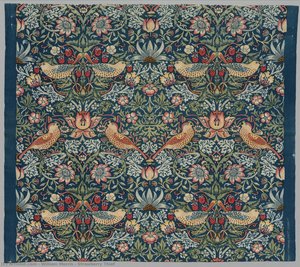
This particular pencil design, destined for a carpet (as evidenced by its reference to the William Morris Gallery N17), is remarkably detailed, revealing a meticulous approach to composition. The central focus is undeniably a bird – likely a robin or thrush – rendered with delicate precision and imbued with an air of quiet dignity. Surrounding this focal point are intricate arrangements of other birds, creating a complex tapestry of avian life that suggests both abundance and careful observation. Scattered amongst the feathered subjects are smaller, more stylized elements: blossoms, leaves, and vines intertwine in a swirling pattern, echoing the organic forms of the natural world. The lines are fluid and graceful, avoiding sharp angles or rigid symmetry – a hallmark of Morris’s aesthetic philosophy. The use of shading and hatching creates a sense of depth and texture, bringing the design to life on paper.
Technique Note: Pencil Sketch: The work is executed entirely in pencil, showcasing Morris's exceptional skill in rendering detail and capturing subtle tonal variations. This technique lends a raw, immediate quality to the design, emphasizing its conceptual origins as a preliminary study.Decoding the Symbolism: Nature’s Language
Beyond its purely decorative qualities, “Design for” is rich with symbolic meaning. The prevalence of birds – often associated with freedom, hope, and spirituality – suggests a longing for transcendence and escape from the constraints of industrial society. The abundant flora speaks to Morris's deep connection with nature and his belief in its restorative power. The intertwining vines and blossoms can be interpreted as symbols of interconnectedness and harmony—a visual representation of his ideal world. The careful arrangement of the birds, rather than a chaotic jumble, suggests an underlying order and balance, reflecting Morris’s desire for a more harmonious society.
- The Bird: Represents freedom, hope, and connection to the spiritual realm.
- Floral Motifs: Symbolize nature's beauty, abundance, and restorative qualities.
- Intertwined Forms: Suggest interconnectedness, harmony, and a rejection of rigid social structures.
A Legacy Enduring: The Spirit of “Design for” Today
“Design for” is more than just a pencil sketch; it’s a window into the mind of a visionary artist and activist. It encapsulates Morris's belief that art should not merely be beautiful but also morally uplifting, promoting a return to traditional values and celebrating the inherent dignity of human labor. Reproductions of this design continue to resonate today, offering a glimpse into a world where craftsmanship, nature, and social responsibility are valued above all else. Its intricate detail and evocative symbolism make it a timeless masterpiece—a testament to William Morris’s enduring legacy as one of the most influential figures in the history of art and design.
U kom muzeju se nalazi Design for ?
William Morris Gallery
Walthamstow, Ujedinjeno Kraljevstvo
Svadilište zanata i misli: Istraživanje Galerije Vilijama Morisa Smeštena u živopisnoj londonskoj opštini Volstov, Galerija Vilijama Morisa predstavlja mnogo više od običnog čuvara lepih predmeta; ona je prožimajuće putovanje kroz život i nasleđe jedne od najsloženijih figura Britanije – Vilijama Morisa. Ovaj izuzetan prostor poziva posetioce da zakorače u prošlost, ne samo da bi *videli* umetnost, već da istinski *osete* duh čoveka koji je strastveno verovao u dostojanstvo rada, lepotu svakodnevnog života i transformativnu moć dizajna. Od svojih skromnih početaka kao kuća motora za lokalne vodovode do svog sadašnjeg oblika slavljenja Morisove umetničke vizije, galerija nudi jedinstveno intimno iskustvo, otkrivajući dubinu i širinu njegovog uticaja na viktorijansko društvo i šire.


Slike visoke rezolucije za Design for

Vilijam Moris, Design for (1881), William Morris Gallery. Javno dobro.
Odgovori na pitanja o Design for
U kom muzeju se čuva originalni "Design for"?
Delo „Design for”, autor Vilijam Moris je izloženo u muzeju William Morris Gallery, Walthamstow, Ujedinjeno Kraljevstvo. Navod o muzeju odnosi se na originalno delo, a ne na reprodukcije.
Kada je nastalo delo „Design for”, autor Vilijam Moris?
Delo „Design for”, autor Vilijam Moris datira iz 1881. godine.
U kojoj je tehnici izvedeno delo „Design for”, autor Vilijam Moris?
Vilijam Moris je koristio/la tehniku Textile za delo "Design for". Ova tehnika definiše materijalnu prirodu originalnog dela.
Kolikih je dimenzija originalnog dela "Design for"?
Dimenzije dela „Design for”, autor Vilijam Moris su 66 x 69 cm. Reprodukcije se mogu naručiti u drugim dimenzijama uz zadržavanje istih proporcija.
Šta prikazuje „Design for”, autor Vilijam Moris?
Teme prisutne u delu „Design for”, autor Vilijam Moris obuhvataju floral design, william morris, textile art, medieval motifs, nature, pattern, craftsmanship, victorian, što zajedno sažima suštinu ovog umetničkog dela.
Da li je "Design for" slobodan od autorskih prava?
Status autorskih prava za „Design for”, autor Vilijam Moris: delo je u javnom vlasništvu – autorska prava su istekla. Ovo određuje da li se reprodukcije slike mogu slobodno izrađivati.
Kome se pripisuje delo "Design for"?
Delo "Design for" je kreirao/la Vilijam Moris. Informacije na ovoj stranici opisuju originalno delo umetnika Vilijam Moris.
Koji umetnički pravac obuhvata „Design for”, autor Vilijam Moris?
„Design for“ je delo Arts and Crafts pokreta. Ovaj pokret označava umetničku tradiciju kojoj je delo pripada.
U kojoj fazi stvaralaštva umetnika Vilijam Moris se nalazi delo "Design for"?
"Design for" predstavlja Late Period umetnika Vilijam Moris.
O umetniku, Vilijam Moris

1834–1896, Ujedinjeno Kraljevstvo
Vilijam Moris
Život ukorenjen u prirodi i romantizmu Viljam Moris, rođen 24. marta 1834. godine u Voltemstou u Eseksu, poticao je iz komforno imućnog srednjeg sloja—okolnost koji mu je omogućio slobodu da prati svoje strasti umesto samo profesije. Uspeh njegovog oca kao finansijera doneo je ne samo sigurnost, već i okruženje u kojem su estetska osećanja mogla da cvetaju.
O umetniku Vilijam Moris Istaknuta dela umetnika Vilijam Moris
Takođe i Vilijam Moris
 Strawberry Thief1936
 The Little Tree (Hammersmith Rug)1895
 Snakeshead1900
 Fruit1862

Eseji o delu Design for
 Wings of Art: Tracing Avian Beauty from Ornithological Precision to Impressionist LightExplore the evolution of avian art from scientific plates to Impressionist light. Trace this feathered history with our expert guide.
 10 Iconic Textile Masterpieces That Redefined the World of ArtJourney through history with 10 legendary textile masterpieces that redefined art. Explore the stories, intricate techniques, and timeless …
 Wings of Meaning: Decoding the Powerful Symbolism of Birds in Art HistoryExplore the profound history of avian symbolism from Renaissance icons to Winslow Homer. Decode the secrets behind every wing today.