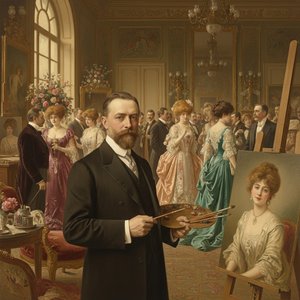
The Formative Years of a Flemish Painter
In the quiet corners of Grammont, a young boy named Pieter Van Huffel first learned to see the world through the eyes of a craftsman. His early education began not in a grand academy, but under the watchful guidance of his uncle and godfather, Pierre Canivé, who spent his days preserving the integrity of paintings. This intimate introduction to the chemistry of pigments and the care of canvas laid a foundation of technical discipline that would define his later years.
As his ambitions grew beyond the borders of his birthplace, he sought the structured rigor of the Royal Academy of Fine Arts in Ghent, where his talent was recognized with prizes in 1786 and 1788. His path then led him through the artistic hubs of Antwerp and Mechelen, eventually drawing him to the heart of Paris. It was in the French capital that he encountered the influential studio of Jacques-Louis David. There, amidst the shadows of the old masters he sought to copy, he absorbed the gravity and precision of the era's most significant stylistic shifts.
A Life of Dual Pursuits
The life of Van Huffel was marked by a curious intersection of fine art and industry. While his hands were often stained with oil and pigment, his mind was equally engaged with the burgeoning mechanical age. He became a cotton manufacturer, owning a spinning mill in Oudevest, Ghent, where he embraced the future by installing a steam machine in 1823. This duality—the scholar of the brush and the owner of the mill—shaped a man who understood both the delicate stroke of a pencil and the heavy gears of progress.
His social standing in Ghent was substantial, as he moved through the highest circles of civic and religious life. He held positions that demanded both aesthetic judgment and administrative care, serving as:
- Director-artist and professor at the Royal Academy of Fine Arts in Ghent
- Curator of the Museum of Fine Arts in Ghent
- Founder of the Société royale des beaux-arts et de littérature de Gand
- Member of the regency of Ghent and deputy provincial States
The Faces of an Era
Though he composed religious works, such as his series on the Mysteries of the Rosary and depictions of Saint Paul and Saint Peter, it was in the realm of portraiture that Van Huffel truly captured the spirit of his time. He possessed a particular talent for immortalizing the faces of the politicians, clergy, and notables who governed the Low Countries. His brush recorded the likenesses of powerful figures, including Napoleon Bonaparte, whom he is attributed to have painted during the era of the First Consul.
His portraits were more than mere likenesses; they were records of status and character. From the solemnity of his religious commissions to the dignified presence of his subjects like Anna Van Damme or the Bishop of Mechelen, his work reflects a period of profound transition. Through his oil on canvas, the faces of the nineteenth century remain fixed, caught in the steady, observant gaze of a man who lived through the shifting tides of empires.
Pitanja i odgovori
Gde mogu da vidim dela umetnika Pieter Van Huffel u 3D galeriji?
Moguća je i virtuelna poseta: stranica 3D galerija umetnika Pieter Van Huffel predstavlja njegova dela u trodimenzionalnoj galeriji.
Gde mogu da vidim koloristički profil radova umetnika Pieter Van Huffel?
Upotrebu boje kod umetnika Pieter Van Huffel u delima navedenim na ovaj sajt možete proučiti na umetnikovoj stranici Genom palete.
Gde se mogu pronaći dela umetnika Pieter Van Huffel grupisanja po paleti boja?
Radove umetnika Pieter Van Huffel možete pregledati prema paleti boja na Preko palete boja stranici umetnika.