Early Life, Family and Training
Lui Shou-Kwan was born in 1919 in Guangzhou, China. His path toward art was shaped early by the presence of his father, Lui Can Ming, who was also a painter. From his childhood, Lui Shou-Kwan received formal training in the art of painting under his father's guidance. This early immersion in the technical and creative aspects of the craft provided a foundation that would stay with him throughout his life.
While his artistic roots were firmly planted in his family's traditions, his formal education took a different direction. He pursued studies in economics at Guangzhou University. He remained dedicated to his academic pursuits there until 1946, when he graduated with a degree in economics. This period of study offered a structured intellectual background alongside his lifelong engagement with the brush and ink.
Life and Activity in Hong Kong
After moving to Hong Kong in 1948, Lui Shou-Kwan lived a life that balanced steady employment with a deep commitment to the local art scene. For many years, he worked as an inspector for the Hongkong and Yaumati Ferry Company, a role he held until 1966. This period of his life provided a sense of stability while he navigated the changing landscape of the city.
His involvement in the community grew through his dedication to organizing and building artistic spaces. In 1956, he became a founding member of the Hong Kong Chung Kok Chinese Art Club. He was also active in organizing various art societies alongside his peers. His influence on the local culture was recognized by the British Government when he was awarded an MBE in 1971 for his contributions to the arts.
Technique and Artistic Style
Lui Shou-Kwan sought a way to bridge the gap between the traditions of his past and the modern movements emerging from the West. He looked toward the works of Huang Banruo for inspiration, finding a connection in the traditional styles that had long defined Chinese ink painting. At the same time, he was deeply interested in the possibilities of Western modernism. He explored how the energy of calligraphy could meet the abstract forms of contemporary art, attempting to bring these new ideas into the local landscape of Chinese painting.
This search for a new language led him to his most recognized period: the "Zen" series. From the 1960s until his death, he moved away from literal representation toward a more abstract approach. These paintings were not merely visual exercises but were deeply rooted in spiritual and philosophical symbolism. He used motifs from Taoist and Buddhist traditions, such as the lotus and flames, to express ideas that went beyond the surface of the paper. His work often focused on how a painting might capture a sense of light or the infinite through the deliberate arrangement of ink and space.
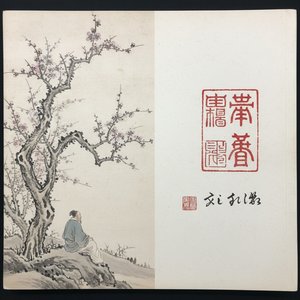
- Zen (1968)
- Purity (1970)
Teaching and Artistic Circles
Lui Shou-Kwan’s influence extended far beyond his own brushes, reaching into the classrooms where the next generation of artists gathered. He shared his knowledge of ink painting at the University of Hong Kong within the Department of Architecture. His reach continued in 1966, when he taught at the Chinese University of Hong Kong's Department of Extra-Mural Studies. Through these roles, he helped shape the technical and philosophical foundations of many who would go on to define the local art scene.
His commitment to his students was deeply personal, often leading to collective action. In 1968, he worked alongside his students to form the Tao Art Association, creating a space for shared exploration. His mentorship helped guide prominent artists such as Wucius Wong and Gu Mei. These connections helped foster a community of practice that moved away from traditional naturalism toward more experimental forms of expression.
Key Works and Major Exhibitions
Lui Shou-Kwan’s presence in the Hong Kong art scene grew steadily through the mid-twentieth century. In 1962, his work was featured in the Hong Kong Art Today exhibition at the Hong Kong City Hall Museum and Art Gallery. This was a significant moment, as it was the first exhibition to focus specifically on art from Hong Kong. By 1964, his paintings were being displayed in the Hong Kong Museum of Art, marking his growing recognition within the local community.
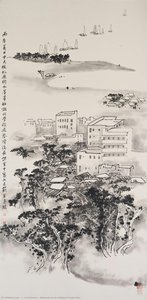
Throughout the 1950s and 1960s, he spent much of his time producing experimental ink paintings. These works often focused on the landscapes of Hong Kong, capturing the local scenery through a modern lens. His later years saw the development of his "Zen" series, which utilized abstract forms and spiritual symbols like the lotus and flames. These pieces, created from the 1960s until his death, moved away from traditional naturalism toward a more philosophical style of abstraction.
His paintings have since found their way into major international auction houses, including Christie's. His output includes various studies of nature and urban life, such as:
- Zen (1968)
- Purity (1970)
- Landscape (about 1971)
- Yacht (about 1959)
- The worship of Tin Hau in Joss House Bay (about 1961)
Legacy and Artistic Influence
Lui Shou-Kwan left a mark on the landscape of modern art that continued to grow long after his death in 1975. As a founder of the Hong Kong New Ink Movement, he helped shift the direction of local art, moving it toward a new way of seeing. He was a pioneer of the Modern Ink Painting Movement in Hong Kong, bridging the gap between traditional ink methods and the changing currents of the twentieth century. His work helped ensure that the language of Chinese ink could speak to a modern era.
The reach of his influence extends far beyond the borders of Hong Kong. In 2018, Oxford's Ashmolean Museum recognized his importance, calling him one of the most significant artists in Hong Kong during the mid-twentieth century. His presence is felt in the collections of major institutions, where his experiments with form and spirit continue to be studied. He remains a central figure for those looking to understand how traditional roots can meet modern expression.
Pitanja i odgovori
Mogu li da pregledam dela umetnika Lui Shou-Kwan prema medijumu?
Da biste pronašli sva dela umetnika Lui Shou-Kwan u određenoj tehnici, posetite stranicu Svi mediji na profilu umetnika.
Koliko su popularna dela umetnika Lui Shou-Kwan?
Statistika o delima umetnika Lui Shou-Kwan dostupna je na njegovoj stranici Statistika.
Na koje periode je podeljena karijera umetnika Lui Shou-Kwan?
Hronika umetnika Lui Shou-Kwan predstavlja hronološku vremensku liniju koja se pomera uz skrolovanje i prikazuje dela umetnika po hronološkom redu, grupisana u poglavlja prema periodima stvaralaštva.
Mogu li da pregledam dela umetnika Lui Shou-Kwan prema umetničkom pravcu?
Stranica Svi umetnički pravci grupiše dela umetnika Lui Shou-Kwan prema umetničkom pravcu.