Pređi na štampu
 Pročitaj više







































 Za umetnička dela ili reprodukcije čija je bilo koja strana veća od 105 cm (približno 41 inč), okvir će biti isporučen u obliku rastavljenog seta za sklapanje. Ovaj metod osigurava bezbednu dostavu i sprečava oštećenja tokom transporta.


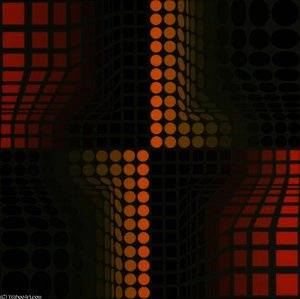
Vega-Wa-3: A Geometric Dance of Perception
Victor Vasarely’s “Vega-Wa-3” isn't merely a painting; it’s an invitation into a realm where visual reality bends to the will of mathematical precision. Created in 1968, this striking artwork embodies the very essence of Op Art – Optical Art – a movement that revolutionized artistic expression during the mid-20th century and continues to fascinate audiences today. The piece immediately captivates with its bold juxtaposition of red and white circles, arranged in an intricate checkerboard pattern that seems to shimmer and pulsate before your eyes. This isn’t accidental; Vasarely meticulously crafted this illusion through a deliberate manipulation of color and repetition, techniques central to Op Art's groundbreaking approach.The Genesis of Geometric Abstraction
Born Károly Vaszary in Pécs, Croatia (then Austria-Hungary), Victor Vasarely’s artistic journey began with an unexpected detour into medicine at Eötvös Loránd University in Budapest. However, his passion for visual art swiftly overruled academic pursuits, propelling him toward a transformative encounter with the Bauhaus movement and Sándor Bortnyik's influential workshop – Műhely. It was here that Vasarely absorbed the principles of functional design and geometric abstraction—concepts that would become the bedrock of his distinctive style. This formative period instilled in him a profound belief in the power of mathematics to unlock the secrets of perception, shaping his artistic vision for decades to come.Decoding the Visual Illusion
“Vega-Wa-3” achieves its mesmerizing effect through a deceptively simple method: repetition and color modulation. Vasarely employed a systematic approach—a “geometric system”—to generate countless variations on basic geometric forms – circles, squares, triangles – transforming them into dynamic patterns that defy conventional representation. The overlapping circles create an illusion of depth, suggesting movement and instability without any discernible source of motion. This technique brilliantly exploits the human eye’s tendency to perceive patterns as continuous rather than discrete, resulting in a captivating sensory experience.Symbolism Beyond Geometry
While seemingly devoid of recognizable imagery, “Vega-Wa-3” carries subtle symbolic resonance rooted in Vasarely's philosophical convictions. He viewed art not merely as decoration but as a tool for exploring fundamental questions about consciousness and reality. The geometric forms themselves represent order and rationality—values championed by the Bauhaus movement—yet their dynamic arrangement conveys an inherent tension, mirroring the complexities of human experience. Vasarely sought to liberate art from traditional constraints, presenting it as an independent entity capable of communicating ideas beyond linguistic expression.A Legacy of Innovation
“Vega-Wa-3” stands as a testament to Victor Vasarely’s unwavering commitment to artistic experimentation and his pioneering role in shaping the landscape of modern art. Its enduring appeal lies not only in its visual beauty but also in its intellectual depth—a reflection of Vasarely's profound engagement with scientific principles and his desire to challenge viewers' perceptions. Reproductions of this iconic Op Art masterpiece offer a chance to bring this captivating geometric dance into your home, celebrating the brilliance of a visionary artist who dared to redefine what art could be.Pitanja i odgovori
Šta predstavlja delo "Вега-ВА-3"?
Teme prisutne u delu „Вега-ВА-3”, autor Viktor Vasereli obuhvataju geometric abstraction, circular patterns, optical illusion, color vibration, dynamic composition, minimalist design, retro futurism, što zajedno sažima suštinu ovog umetničkog dela.
Gde se "Вега-ВА-3" nalazi među uobičajenim motivima umetnika Viktor Vasereli?
"Вега-ВА-3" prikazuje geometric abstraction, circular patterns, optical illusion, color vibration, dynamic composition, minimalist design, retro futurism, dok su dokumentovane teme umetnika Viktor Vasereli zapravo bauhaus influence, geometric minimalism, visual perception, futuristic aesthetic, iconic op art piece. Poređenje ova dva elementa pokazuje kako se ovo delo povezuje sa uobičajenim motivima ovog umetnika.
Koliko je godina imao/la Viktor Vasereli kada je stvorio/la "Вега-ВА-3"?
Viktor Vasereli je imao/la 62 godina kada je kreirao/la "Вега-ВА-3" u 1968. Godina je izračunata na osnovu godine rođenja umetnika, 1906.
 Pregledaj u prostoru
 Pošalji
 Podeli
 Detalji o delu
 Vodič
Vodič

 Preuzmi
 Slični predmeti
 Rendgenski snimak
 Automatska prezentacija
 Q&A
Q&A Statistika