Cubism
Interior (Стјуарт Дејвис)
Стјуарт Дејвис (1892–1964) je napravio Interior. Pripada pokretu Cubism.

 Pregledaj u prostoru

 Ručno oslikano uljanim bojama
 Pošalji
 Podeli
 Vodič


 Preuzmi
 Slični predmeti
 Rendgenski snimak
 Automatska prezentacija
 Pitanja i odgovori

 Statistika
Interior: osnove
- Naslov
- Interior
- Umetnik
- Стјуарт Дејвис (1892–1964)
- Rođen/a u
- Филаделфија, Сједињене Америчке Државе
- Pokret
- Cubism
- Tema
- abstract, geometric, modernism, composition, lines, forms
Šta prikazuje Interior?
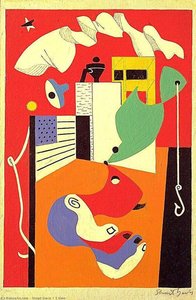
A Dynamic Vision of Modernity: Exploring Stuart Davis’s “Interior”
Stuart Davis's “Interior” is a captivating example of American Modernism, pulsating with energy and reflecting the artist’s unique response to the burgeoning urban landscape and the rhythms of jazz. Created sometime during his prolific career (1892-1964), this work embodies Davis’s commitment to developing a distinctly American visual language, moving beyond European influences towards a bold, independent style.
Deconstructing Space: Style & Technique
- The artwork is immediately striking for its geometric abstraction. Davis employs fragmented forms and flattened perspectives – hallmarks of both Cubism and Constructivism – but infuses them with a uniquely American sensibility.
- A vibrant palette dominates, anchored by the stark contrast between the white background, bold reds, blues, and greys, and punctuated by energetic black lines. The orange border further intensifies this visual impact.
- Davis’s technique is evident in the visible brushstrokes and layering of paint, creating a subtle texture that adds depth despite the overall flattened composition. This suggests an active process of building up form and color on the canvas, likely using oil paints as his primary medium.
- The arrangement isn't simply random; it’s carefully orchestrated into distinct zones – a tower-like structure in blue-grey, a dynamic red section with a vertical ‘sail’ or flag element, and a central area of interwoven geometric shapes. This zoning creates a sense of controlled chaos.
Echoes of Jazz & the Machine Age: Context & Symbolism
Davis was deeply influenced by jazz music, which he saw as embodying the spirit of modern America – improvisational, energetic, and uniquely its own. While “Interior” isn’t a direct representation of musical notes, the dynamic interplay of shapes and colors evokes the same sense of rhythm and syncopation found in jazz compositions.
- The architectural elements, particularly the stylized tower, could be interpreted as representing aspiration or the burgeoning skyscrapers of American cities. Davis frequently engaged with urban themes throughout his career.
- The ‘sail’ or flag-like form introduces a sense of movement and direction, perhaps symbolizing progress or the forward momentum of modern life.
- His early exposure to the Armory Show in 1913 was pivotal. While his initial works reflected the Ashcan School style, he quickly absorbed and transformed European avant-garde ideas into something distinctly American.
Emotional Resonance & Lasting Impact
“Interior” is not a tranquil scene; it’s charged with energy and tension. The fragmented forms and bold colors create a sense of dynamism, while the lack of traditional perspective can be slightly unsettling. This emotional complexity reflects the anxieties and excitements of a rapidly changing world.
- The artwork invites viewers to actively engage with its abstract language, prompting individual interpretations and fostering a personal connection.
- As a pioneering figure in American Modernism, Stuart Davis paved the way for subsequent generations of artists. His work continues to inspire those seeking to break free from convention and explore new forms of visual expression.
Interior u visokoj rezoluciji
Zaštićeno autorskim pravima: slika je prikazana samo u informativne svrhe.
Više dimenzija, kadriranih prikaza i citata →Стјуарт Дејвис, Interior.
Pitanja o Interior
Koja paleta i dominantna boja definišu "Interior"?
„Interior”, autor Стјуарт Дејвис koristi Metallics paletu, pri čemu je Steel Blue (#5c7ba9) dominantna boja.
Mogu li da gledam "Interior" kao prezentaciju preko celog ekrana?
Dijaporama dela "Interior" dostupna je na stranici Galerija slika tog umetničkog dela.
Šta objašnjava status autorskih prava za „Interior”, autor Стјуарт Дејвис?
„Interior”, autor Стјуарт Дејвис je u i dalje je zaštićeno autorskim pravima. Autorska prava traju od smrti umetnika, koja se dogodila 1964.
Koja je paleta boja u delu "Interior"?
„Interior”, autor Стјуарт Дејвис koristi Metallics paletu boja. Ova paleta sažima opšti koloristički karakter dela.
Postoje li dela slična delu "Interior"?
Radovi slični delu „Interior“ možete pronaći na stranici Slična dela ovog umetničkog dela.
Koja boja dominira kompozicijom dela „Interior”, autor Стјуарт Дејвис?
Dominantna boja dela „Interior”, autor Стјуарт Дејвис je Steel Blue (#5c7ba9).
Ko je umetnik koji stoji iza dela "Interior"?
Delo "Interior" pripisuje se umetniku Стјуарт Дејвис.
Koji umetnički pravac obuhvata „Interior”, autor Стјуарт Дејвис?
Umetnički pravac koji se povezuje sa delom „Interior”, autor Стјуарт Дејвис je Cubism. Ova klasifikacija smešta rad među srodne umetnike i umetnička dela.
Kako je izgrađena koloristička kompozicija dela „Interior”, autor Стјуарт Дејвис?
U delu "Interior", Statement kontrast je uparen sa Strong Color Unity harmonijom.
O umetniku, Стјуарт Дејвис

1892–1964, Сједињене Америчке Државе
Стјуарт Дејвис
Стюарт Дејвис: Пионир америчког модернизма Рођен 7. децембра 1892. године у Филаделфији, Стјуарт Дејвис је од раног узраста био уроњен у уметничку атмосферу. Његов отац, Едвард Вајат Дејвис, служио је као уредник за уметност у Philadelphia Press, док је његова мајка, Хелен Стјуарт Дејвис, била вајарка.
Takođe i Стјуарт Дејвис
 Odol
 Lucky Strike1924
 T View1951
 Blue Café1928
Eseji o delu Interior
 Stuart Davis: Modernist Abstraction & the Vibrant Spirit of the Jazz AgeExplore the vibrant world of Stuart Davis, a pioneer of American Modernism. Discover his jazz-inspired paintings, signature style & investm…
 The Geometry of Elegance: Elevating Modern Villa Interiors with Cubist-Inspired ArtDiscover how Cubist-inspired art elevates modern villa interiors. Explore the intersection of geometric precision and luxury design through…
 Steel & Soul: The Rhythmic Geometry and Industrial Resonance of the Machine AgeExplore the rhythmic geometry of Fernand Leger and the Machine Age. Discover the power of industrial art today.