
 Pređi na štampu
 Pročitaj više







































 Za umetnička dela ili reprodukcije čija je bilo koja strana veća od 105 cm (približno 41 inč), okvir će biti isporučen u obliku rastavljenog seta za sklapanje. Ovaj metod osigurava bezbednu dostavu i sprečava oštećenja tokom transporta.


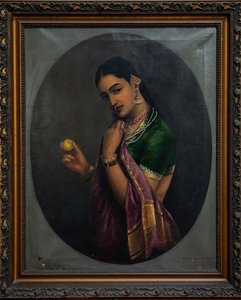
A Vision of Grace: The Allure of Raja Ravi Varma’s The Coquette
In the golden era of Indian academic realism, few names command as much reverence as Raja Ravi Varma. His masterpiece, The Coquette, painted in 1893, serves as a breathtaking window into a world where Eastern soul meets Western technique. The painting presents us with an intimate encounter with a woman of profound elegance; her long, flowing tresses and the delicate shimmer of her jewelry suggest a life of refined splendor. As she gazes toward the viewer, there is a captivating play of modesty and confidence in her eyes, a subtle invitation into her private moment. In her hand, she cradels an apple—a symbol that transcends borders, evoking themes of temptation, fertility, and the fleeting nature of beauty. This single piece of fruit acts as a focal point, anchoring the composition and adding a layer of classical allegory to the portrait.
The technical mastery displayed in this work is nothing short of extraordinary, making it a premier choice for collectors who value precision and depth. Varma’s ability to manipulate light and shadow—a hallmark of his training in European academic styles—gives the subject a three-dimensional presence that feels almost tactile. The rich, vibrant palette breathes life into the scene, with deep tones that contrast beautifully against the decorative, intricate background. This careful balance of color and texture creates an atmospheric depth that draws the eye inward, ensuring that the painting remains a captivating centerpiece in any setting.
The Intersection of Tradition and Modernity
Born from the royal lineage of Kilimanoor, Varma was uniquely positioned to bridge the gap between the aristocratic traditions of India and the burgeoning modernism of his time. He was not merely a painter but a cultural pioneer who skillfully blended European academic techniques with the rich tapestry of Indian mythology and aesthetics. This duality is palpable in The Coquette, where the subject's poise reflects the courtly grace of the Travancore era, while the oil-on-canvas execution speaks to the global artistic movements of the late 19th century. For the discerning interior designer, the work offers a sophisticated interplay of light that can transform a room from a mere space into a curated gallery.
Beyond its aesthetic brilliance, the painting carries a heavy emotional resonance and historical significance. It represents a moment in history when Indian art began to find a new, accessible voice through the fusion of realism and local iconography. For those seeking to adorn their homes with a piece that tells a story of heritage and innovation, this reproduction offers more than just visual beauty; it provides a connection to the dawn of modern Indian painting. Whether placed in a sunlit study or a grand dining hall, The Coquette serves as an enduring testament to the power of a single, masterful gaze.
Pitanja i odgovori
Da li je "The Coquette" dobra ideja za poklon?
Kao poklon za Anniversary, predlaže se „The Coquette”, autor Раја Рави Варма. Odličan izbor može biti i za druge prilike.
U kojoj fazi karijere Раја Рави Варма se nalazi delo "The Coquette", s obzirom na datum njegovog nastanka?
S obzirom na datum nastanka iz 1893. godine, delo "The Coquette" pripada Mature Period periodu umetnika Раја Рави Варма.
Ko je autor dela "The Coquette" i iz koje godine je?
Раја Рави Варма je napravio/la "The Coquette" u 1893. godini.





 Pregledaj u prostoru
 Pošalji
 Podeli
 Detalji o delu
 Vodič
Vodič

 Preuzmi
 Slični predmeti
 Rendgenski snimak
 Automatska prezentacija
 Q&A
Q&A Statistika