Pređi na štampu
 Pročitaj više







































 Za umetnička dela ili reprodukcije čija je bilo koja strana veća od 105 cm (približno 41 inč), okvir će biti isporučen u obliku rastavljenog seta za sklapanje. Ovaj metod osigurava bezbednu dostavu i sprečava oštećenja tokom transporta.


A Symphony of Abstraction: Exploring Mondrian’s ‘Diagonal Composition’
‘Diagonal Composition’, by Piet Mondrian, is a seminal work embodying the core principles of De Stijl – a Dutch artistic movement that radically reshaped 20th-century art and design. This piece isn't merely an arrangement of colors and lines; it’s a visual manifesto for universal harmony achieved through reductive abstraction. It represents a pivotal moment in the history of modern art, marking a decisive break from representational painting and establishing geometric abstraction as a dominant aesthetic force.Deconstructing Form: Style & Technique
Mondrian meticulously constructed this composition using a limited palette – primary red, blue, and yellow, alongside the neutrality of white and black. The canvas is divided by a dynamic grid of bold, black lines, some vertical, others horizontal, but notably presented on a diagonal orientation - hence the title. This deliberate arrangement eschews representational imagery entirely. The technique itself is characterized by precise brushwork; Mondrian employed oil paint with meticulous care, applying it in thin layers to achieve flat planes of color with minimal texture. He prioritized clarity and order above all else, striving for a visual equilibrium that reflected his belief in underlying universal harmony. The resulting surface possesses an almost ethereal quality – remarkably smooth and devoid of perceptible brushstrokes—a testament to Mondrian’s mastery of material science and artistic vision.Historical Context: The Birth of Neoplasticism
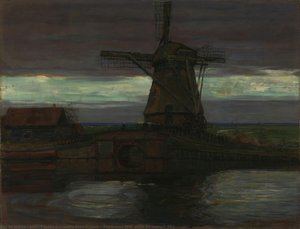
Born from a period of intense artistic experimentation, ‘Diagonal Composition’ reflects Mondrian's evolving philosophy. His early works were rooted in naturalistic landscapes – as seen in pieces like *The Red Mill* and *Trees in Moonrise*. However, influenced by Theosophy and a desire to express spiritual truths through art, he progressively abstracted his forms. By 1917, Mondrian co-founded De Stijl with Theo van Doesburg, advocating for *Neoplasticism* – a style focused on the essential elements of form and color. This artwork stands as a powerful example of that philosophy in action. The movement sought to liberate art from the constraints of illusionism, embracing instead pure abstraction as a path toward spiritual enlightenment—a reaction against the perceived chaos and emotional turbulence of the era. Its creation coincided with significant social transformations, prompting artists like Mondrian to grapple with questions of identity and purpose amidst rapid industrialization and urbanization.Symbolism & Meaning: A Quest for Harmony
The seemingly simple arrangement within ‘Diagonal Composition’ is laden with symbolic meaning. Mondrian believed that by reducing art to its fundamental components – straight lines, primary colors, and geometric shapes – he could reveal the underlying structure of reality and express a universal harmony. The orthogonal lines represent opposing forces in equilibrium—a visual metaphor for cosmic order—while the primary colors symbolize essential energies. White spaces are not merely voids but active elements contributing to the overall balance and clarity; they illuminate the colored rectangles, creating a luminous effect that underscores Mondrian’s aesthetic ideals. The diagonal composition introduces dynamism and tension, subtly disrupting symmetry—a deliberate gesture intended to convey movement and vitality without sacrificing visual stability.Emotional Impact & Interior Design
Despite its abstract nature, ‘Diagonal Composition’ evokes a sense of calm, order, and intellectual stimulation. It's a work that invites contemplation and encourages viewers to find their own meaning within its carefully constructed framework. Its clean lines and bold colors make it exceptionally versatile for interior design—a striking focal point in modern living spaces, complementing minimalist aesthetics or adding a sophisticated touch to more eclectic environments. A high-quality reproduction of this piece would bring a sense of timeless elegance and intellectual depth to any room—transforming ordinary interiors into spaces imbued with artistic inspiration. Consider pairing it with neutral fabrics and textures to maximize its visual impact and create an atmosphere of serene sophistication.Pitanja i odgovori
Kako mogu da pronađem dela koja su slična delu „Дијагонална Композиција”, autor Пит Мондријан?
Stranica Slična dela za delo „Дијагонална Композиција”, autor Пит Мондријан prikazuje srodna umetnička dela.
Kako se „Дијагонална Композиција”, autor Пит Мондријан može iskoristiti u uređenju doma?
„Дијагонална Композиција”, autor Пит Мондријан se preporučuje za Fokalna tačka, idealno u Dnevna soba. Upotreba i prostor zajedno ukazuju na to gde reprodukcija najbolje pristaje.
Na koji način je najbolje postaviti delo „Дијагонална Композиција”, autor Пит Мондријан s obzirom na njegov format?
Format Kvadratni format dela „Дијагонална Композиција”, autor Пит Мондријан preporučuje se za Dnevna soba. Format i prostor zajedno služe kao smernica za postavljanje reprodukcije.
 Pregledaj u prostoru
 Pošalji
 Podeli
 Detalji o delu
 Vodič
Vodič

 Preuzmi
 Slični predmeti
 Rendgenski snimak
 Automatska prezentacija
 Pitanja i odgovori
 Statistika