

 Pregledaj u prostoru
 Pošalji
 Podeli
 Detalji o delu
 Vodič
Vodič

 Preuzmi
 Slični predmeti
 Rendgenski snimak
 Automatska prezentacija
 Q&A
Q&A Statistika
Burning Desire Four
 Acrylic On Canvas
- WallArt
- Contemporary Symbolism
 2000
2000- Modern
 10.0 x 25.0 cm
 Nacionalni muzej u Singapuru
 Pročitaj više
Umetničko delo prikazano na ovoj stranici zaštićeno je autorskim pravima, što znači da zakonski nismo u mogućnosti da kreiramo niti prodajemo identičnu reprodukciju. Ova zaštita se sprovodi u skladu sa međunarodnim sporazumima kao što su Bernska konvencija i nacionalnim zakonima, uključujući i one koji su definisani u Američki zakon o autorskom pravu – Naslov 17.
Ovaj metod je u potpunosti usklađen sa regulativama o autorskim pravima jer ne podrazumeva kopiranje ili dupliranje zaštićenih umetničkih dela. Umesto toga, reč je o kreativnoj reinterpretaciji – novom slikarskom delu koje je inspirisano originalom, ali nije identično njemu.
Giclee štampa / Umetnički otisak
Giclée štampa ili print na platnu muzejskog kvaliteta uz brzu izradu i raznovrsne opcije završne obrade. ( Kupite ručno oslikano delo Pređi na digitalnu sliku)




P118B дин10

P118H дин10

P118W дин10

P438Z дин10

P508JH дин12

P508YH дин12

P805H дин10

P805Z дин10

P919BZ дин10

P919G дин10

P919XJ дин10

P959ZH дин10

P968JZ дин12

W106C дин8

W218G дин10

W218JH дин8

W218Y дин10

W307PJ дин10

W316G дин10

W316PJ дин8

W316Y дин10

W398PJ дин8

W4111J дин10

W500HY дин15

W500JH дин15

W692G дин12

W849H дин8

W940BG дин15

W953PJ дин8




Izaberite jednu od naših unapred definisanih veličina koje odgovaraju originalnim proporcijama umetničkog dela.

Unesite željenu širinu i visinu kako bi se štampa uklopila u vaš ram ili zid. Štampu je moguće samo iseći, ali nikada povećati iznad dimenzija originalne slike, stoga format sa drugačijim proporcijama uzrokuje gubitak dela slike. Pre početka štampe, poslaćemo vam digitalni prikaz radi potvrde. Slika prikazana na ovoj stranici ne predstavlja stvarni isrez — to pokazuje samo digitalni prikaz.
Dostava širom sveta () za 2 nedelje umesto uobičajenih 4/5 nedelja. (29 октобар)

Besplatna ekspresna dostava širom sveta

Visokokvalitetno laneno platno

Potpuno osiguranje transporta

Garancija povraćaja carine i uvoznih dažbina

Garancija vernosti boja

Politika povraćaja u roku od 100 dana (samo u slučaju nedostataka)

Garancija povrata 100% novca

Popust na više proizvoda
 Opcija sa staklom dostupna je samo za dimenzije manje od 110 cm

Burning Desire Four
Giclee štampa / Umetnički otisak
Dimenzije reprodukcije
-


Ukupna cena
дин 8282
Mohammad Din Mohammad’s ‘Burning Desire Four’: A Symphony of Color and Sufi Mysticism
This captivating artwork, titled ‘Burning Desire Four,’ offers a profound glimpse into the artistic vision of Mohammad Din Mohammad (1955-2007), a pivotal figure in Malaysian art who seamlessly blended Western influences with his deeply rooted cultural heritage and spiritual beliefs. Born in Kampung Gangsa, Malaysia, Mohammad’s journey began in Malacca before he relocated to Singapore, shaping his perspective on the world and informing his artistic explorations. The painting, created in 2000, is a testament to his mastery of color and composition, presenting a vibrant tableau that resonates with both natural beauty and profound symbolic meaning.
A Riot of Color and Floral Symbolism
The immediate impact of ‘Burning Desire Four’ is undeniably its explosive palette. Dominated by rich reds and punctuated by striking yellows, the artwork immediately draws the eye into a dynamic arrangement of flowers. At least four distinct floral forms are discernible – each rendered with meticulous attention to detail and varying shades and sizes – creating a visually arresting composition. This bold use of color isn’t merely decorative; it's deeply connected to Mohammad’s exploration of Sufi mysticism, where vibrant hues often represent spiritual enlightenment and the divine. Flowers themselves have long been potent symbols in art and religion, representing beauty, love, fertility, and ultimately, transcendence.
- Red: Represents passion, energy, and the heart – core tenets within Sufi philosophy.
- Yellow: Symbolizes enlightenment, wisdom, and divine grace.
- Floral Arrangement: Evokes a sense of abundance, growth, and the cyclical nature of life and death, themes frequently explored in Islamic art.
Birds as Messengers of the Soul
Adding another layer of complexity to this evocative scene are the two birds depicted within the artwork. One positioned towards the top left corner and another near the center, they appear to be either flying or hovering above the flowers. This detail is particularly significant given Mohammad’s engagement with Islamic symbolism. Birds frequently serve as messengers of the soul in Islamic tradition, representing spiritual aspiration and the desire for union with God. Their presence elevates the floral arrangement beyond a simple still life, transforming it into a meditation on faith and the human yearning for something greater.
Technique and Historical Context
‘Burning Desire Four’ exemplifies Mohammad Din Mohammad's unique artistic style – a fusion of Western painting techniques with his Malaysian cultural background. The meticulous rendering of the flowers, combined with the dynamic composition, demonstrates a sophisticated understanding of both formal and expressive elements. Created during a period of significant artistic experimentation in Southeast Asia, this work reflects a broader movement towards embracing local traditions while engaging with global art trends. The artwork’s creation aligns with Mohammad's exploration of themes related to spirituality and cultural identity, reflecting the growing interest in Sufism within Malaysia at the time.
Dimensions and Acquisition
This hand-painted reproduction is presented in a generous 10 x 25 cm format, making it suitable for a wide range of interior design applications. Whether adorning a gallery wall, adding a touch of vibrant color to a study, or serving as a thoughtful gift, ‘Burning Desire Four’ offers an exceptional opportunity to own a piece of significant artistic heritage.
Pitanja i odgovori
Da li je "Burning Desire Four" tipično za ono što je Mohammad Din Mohammad obično stvarao?
"Burning Desire Four" prikazuje flowers, birds, sufi mysticism, islamic art, red flowers, symbolism, malaysia, dok su dokumentovane teme umetnika Mohammad Din Mohammad zapravo sufi mysticism, islamic art, cultural symbolism, malaysian heritage, red flowers, spiritual themes, provocative, challenging western norms. Poređenje ova dva elementa pokazuje kako se ovo delo povezuje sa uobičajenim motivima ovog umetnika.
Mogu li da vidim rendgenski prikaz dela „Burning Desire Four”, autor Mohammad Din Mohammad?
Delo "Burning Desire Four" možete istraživati sloj po sloj na stranici Rentgensko posmatranje, koja predstavlja interaktivni pregledač inspirisan konzervatorskim svetlosnim stolom, sa jedanaest optičkih prikaza slike.
Koje boje dominiraju u delu „Burning Desire Four”, autor Mohammad Din Mohammad?
Koloristički identitet dela „Burning Desire Four”, autor Mohammad Din Mohammad: paleta u nijansama Earthy, sa dominacijom boje Espresso (#585257).
Biografija umetnika
A Tapestry of Spirit and Tradition
The life of Mohammad Din Mohammad was a profound journey through the intersections of the physical and the metaphysical. Born in Kampung Gangsa, Malaysia, his early years were marked by a migration to Singapore at the age of two, a transition that would eventually shape a perspective uniquely poised between different worlds. His artistic soul began to stir in childhood, manifesting in simple experiments with ceramics and the molding of clay cups. This innate curiosity for form and texture laid the foundation for a career that would later transcend mere visual representation, becoming a vessel for deep spiritual exploration.
His formal training at the Nanyang Academy of Fine Arts provided him with a rigorous command of Western techniques. Majoring in Western painting from 1973 to 1976, he initially embraced the disciplined approach of Realist portraiture. This period of his life was characterized by a direct engagement with the human form, even spending years at old Bugis Street capturing the likenesses of travelers and tourists. However, as his practice matured, the literal became secondary to the symbolic, and his work began to evolve into a complex synthesis of Western abstract expressionism and the profound depths of his Malay heritage.
The Synthesis of Mysticism and Movement
What truly distinguishes the work of Mohammad Din Mohammad is the seamless integration of Sufi mysticism with the rhythmic energy of silat, the traditional Malay martial art. He was not merely a painter but a practitioner of many ancient disciplines; he was a writer, a collector of Southeast Asian objects, and a bomoh, or traditional healer. This multifaceted identity breathed life into his canvases, allowing him to use Islamic calligraphy and symbolic icons to convey complex philosophical truths. His art became a spiritual practice in itself, where the act of painting mirrored the search for inner enlightenment.
In masterpieces such as Kaa, one can witness this extraordinary fusion. Utilizing a wet-on-wet technique and thick impasto, he created textures that felt alive with movement and instability. His compositions often utilized skewed perspectives to evoke emotional responses, drawing the viewer into a fragmented vision of reality. The influence of his devotion to silat is palpable in the gestural, energetic brushwork that suggests the controlled power and fluid motion of martial combat. Through his use of color—often blending earthy tones with vibrant yellows and greens—he captured the very essence of spiritual energy.
A Legacy of Cultural Convergence
The historical significance of Mohammad Din Mohammad lies in his ability to act as a bridge between disparate traditions. He refused to see a conflict between the Western academic training he received and the deeply rooted cultural and spiritual beliefs he practiced. His work stands as a testament to the possibility of a modern art form that remains authentically connected to its ancestral roots. By weaving together elements of assemblage, painting, and calligraphy, he created a visual language that spoke of both the local and the universal.
His life was marked by resilience and an unwavering commitment to his path. Even after facing severe physical hardship following a motorcycle accident, he turned to traditional healing and his silat master to find recovery, further deepening his connection to Malay medicinal traditions. This lived experience of healing and spiritual endurance is etched into the very fabric of his art, leaving behind a legacy that continues to invite contemplation on the nature of identity, faith, and the enduring power of cultural heritage.

Mohammad Din Mohammad
1955 - 2007 , Malaysia
Osnovne informacije
- Artistic Movement Or Style: Abstract expressionism, Sufi mysticism
- Full Name: Mohammad Din Mohammad
- Nationality: Singaporean Malay
- Notable Artworks:
- Kaa
- Burning Desire Four
- Spiritual Energy
- Place Of Birth: Kampung Gangsa, Malaysia
- Date Of Birth: 1955
- Date Of Death: 2007
Povezani članci
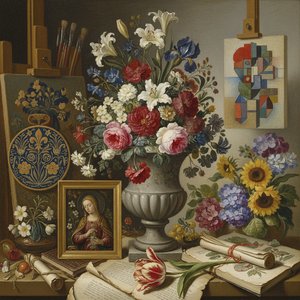
Blossoming Symbolism: A Historical Journey Through Flowers in Western Painting
Explore the rich history of flower symbolism in Western painting! Discover how artists from the Renaissance to Modernism used blossoms to convey meaning, emotion & beauty. Learn about iconic artworks and movements.

Blossoms of Time: A Historical & Aesthetic Exploration of Floral Painting Across Cultures
Explore the rich history of floral painting! Discover symbolism, techniques & masterpieces from Van Huysum to O'Keeffe. Expert insights for art lovers & collectors at OriginalUniqueArt.

Crimson Threads of Narrative: Exploring Symbolism & Representation in Artworks Featuring the Red Dress
Explore the rich symbolism of the red dress in art history! From ancient power displays to iconic portraits like Cézanne’s 'Madame Cezanne', discover the cultural and artistic significance behind this captivating color. Expert analysis & insights.

Blossoms of Time: A Historical Journey Through Flower Painting
Explore the captivating history of flower painting! Discover Dutch masters, symbolic meanings, & botanical art. Expert insights & high-quality reproductions at OriginalUniqueArt.

Mark Rothko: 25 Remek-dela Apstraktne Ekspresije za Vaš Dom | OriginalUniqueArt
Istražite 25 remek-dela Marka Rothka – ikona apstraktne ekspresije. Otkrijte priče, tehnike i emocije iza ovih veličanstvenih slika. Reprodukcije vrhunskog kvaliteta za vaš dom na OriginalUniqueArt.com!