Abstract Expressionism · 1953
Untitled (Марк Ротко, 1953)
Марк Ротко (1903–1970) je napravio Untitled. Datirano je iz 1953. Pripada pokretu Abstract Expressionism. Izrađeno je u Oil On Canvas. Čuva se u muzeju Guggenheim Museum Bilbao u mestu Bilbao, Španija. Dimenzije su 299 × 442 cm.
- 1953
- Oil On Canvas
- 299 × 442 cm
- Guggenheim Museum Bilbao

 Pregledaj u prostoru

 Ručno oslikano uljanim bojama
 Pošalji
 Podeli
 Informativni list


 Preuzmi
 Slični predmeti
 Rendgenski snimak
 Automatska prezentacija
 Pitanja i odgovori

 Statistika
Untitled, ukratko
- Naslov
- Untitled
- Umetnik
- Марк Ротко (1903–1970)
- Rođen/a u
- Даугавпилс, Letonija
- Datum
- 1953
- Tehnika
- Oil On Canvas
- Dimenzije
- 299 × 442 cm
- Gde se može videti
- Guggenheim Museum Bilbao, Bilbao, Španija
- Pokret
- Abstract Expressionism
- Period
- Modern
- Tema
- color field painting, emotional resonance, chromatic harmony, minimalism, atmospheric depth, geometric forms
Šta prikazuje Untitled?
The Creation of Untitled by Mark Rothko
To understand Untitled, one must look toward the origins of Mark Rothko. He was born in 1903 in a place now known as Daugavpils, Latvia. His early years were shaped by the atmosphere of the Pale of Settlement, a region marked by political unrest and the constant shadow of pogroms. This sense of instability followed his family when they emigrated to the United States in 1913, eventually settling in Portland, Oregon. These formative experiences of displacement and loss became a quiet foundation for the man he would become.
By 1953, Rothko had moved into a period of profound abstraction. He painted Untitled during this time, a year that sits within his prolific New York period. The work emerged from a long transition away from the structured realism of his youth. He had moved past the depiction of urban scenes and portraits, seeking instead a way to express the weight of human experience without relying on the literal shapes of the physical world. This shift allowed him to focus on the internal landscape of emotion.
The artist continued to refine this language of color until his death in 1970. In Untitled, we see the result of this lifelong search for a direct encounter with the viewer. He stripped away titles that might suggest a specific narrative, leaving us to face the pigment itself. The canvas becomes a space for quiet, heavy presence, inviting a confrontation with the fundamental mysteries of existence.
Visual Composition and Color Fields
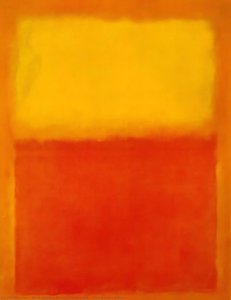
The canvas presents a large-scale encounter with two primary chromatic zones. A yellow background dominates the majority of the space, providing a luminous foundation for the composition. Overlaid upon this expanse is a section of red paint, which occupies a smaller area and is positioned toward the right side of the work. This arrangement creates a deliberate imbalance, drawing the eye across the field of color.
The interaction between these two sections is marked by a sense of quiet movement. In certain areas, the red pigment appears to be fading, which lends the surface a weathered quality. This subtle degradation suggests the passage of time, as if the colors are slowly receding into the canvas itself. The relationship between the expansive yellow and the concentrated red creates a tension that defines the visual structure of the piece.
Technique and Material Application
To understand this work, one must consider the patient, layered process Rothko employed. He utilized a method known as color field painting, moving away from the heavy, textured brushstrokes of traditional realism. Before any color was applied, he meticulously prepared the canvas with gesso, creating a smooth, receptive surface. This preparation allowed him to work with thin washes of oil paint, building the composition through a slow accumulation of pigment. Each layer was applied with a sense of lightness, allowing the colors to interact within the fibers of the cloth.
As the paint dried, it developed a characteristic matte sheen. This finish avoids the aggressive glare of high-gloss oils, instead offering a soft, diffused light that seems to emanate from within the canvas itself. The edges of the rectangular forms are never sharp or defined; they are intentionally blurred and soft. This technique allows the cadmium yellow and crimson to bleed into one another, creating a sense of depth and a breathing, permeable boundary between the hues.
Interpretations of Color and Form
The interaction between the two primary hues suggests a dialogue between opposing human states. The yellow field acts as a beacon, representing enlightenment and optimism. In contrast, the crimson section embodies passion, sacrifice, and primal emotion. These colors do not merely sit side by side; they meet in a way that suggests the tension inherent in the human condition.
The composition relies on the presence of these rectangular blocks to guide the viewer's internal experience. One might see these forms as the boundaries between consciousness and the unconscious. The scale of the canvas is intentional, designed to envelop the person standing before it. This immersion encourages a meditative state, where the viewer is no longer an observer but a participant in the space created by the pigment.
Related Works by Mark Rothko
To understand the evolution of this period, one might look toward his later explorations of color and scale. In 1956, he produced Orange and yellow, a work that continues his investigation into how luminous hues interact within a defined space. His practice also moved toward more specific, numbered compositions, such as No. 5 No. 22, which demonstrate his commitment to the language of abstraction through the use of large, breathing rectangular forms.
The artist also engaged deeply with the architecture of specific environments. He developed the Seagram murals, a series of paintings intended for a New York restaurant, though he eventually chose to donate them to the Tate Gallery in London. Similarly, his interest in how color occupies a room led to the creation of the Harvard Mural series, designed for a dining room at the Holyoke Center. These large-scale projects show his desire to create an immersive atmosphere where the viewer is enveloped by the presence of the paint.
Where to See This Artwork Today
This specific canvas, created around 1953, resides within the permanent collection of the Guggenheim Museum Bilbao. Located in Bilbao, Spain, the museum provides a space where this work can be experienced in its intended scale. The institution is part of the Solomon R. Guggenheim Foundation and maintains a collection that spans the 20th and 21st centuries.
Visiting the museum allows for a direct encounter with the subtle shifts in color that define this piece. The architecture of the building provides a contemporary setting for such a significant work of the mid-twentieth century. It remains a central part of the museum's holdings, offering a quiet moment of reflection within the broader context of modern and contemporary art.
U kom muzeju se nalazi Untitled?
Guggenheim Museum Bilbao
Bilbao, Španija
Istorija Guggenheim Museum Bilbao Koreni Guggenheim Museum Bilbao sežu još iz 1991. godine, kada je Vlada Baskije predložila osnivanje nove kulturne institucije. Ova inicijativa imala je za cilj da transformiše industrijski pejzaž Bilba, u provinciji Vizaja, u Španiji.


Slike visoke rezolucije za Untitled

Protected by copyright: these files are for personal reference, not a licence to republish.
Марк Ротко, Untitled (1953), Guggenheim Museum Bilbao.
Odgovori na pitanja o Untitled
Gde se danas može videti delo „Untitled”, autor Марк Ротко?
Delo „Untitled”, autor Марк Ротко je izloženo u muzeju Guggenheim Museum Bilbao, Bilbao, Španija. Navod o muzeju odnosi se na originalno delo, a ne na reprodukcije.
U kojoj godini je nastalo "Untitled"?
„Untitled“ potiče iz 1953. Ovaj datum smešta delo u okviru karijere umetnika Марк Ротко i same ere.
U kojoj je tehnici izvedeno delo „Untitled”, autor Марк Ротко?
Tehnika dela „Untitled”, autor Марк Ротко je Oil On Canvas. Reprodukcije imaju za cilj da dočaraju izgled ove tehnike.
Koje su dimenzije originalnog dela „Untitled”, autor Марк Ротко?
Dimenzije originalnog dela „Untitled”, autor Марк Ротко su 442 x 299 cm.
Šta predstavlja delo "Untitled"?
Teme prisutne u delu „Untitled”, autor Марк Ротко obuhvataju color field painting, emotional resonance, chromatic harmony, minimalism, atmospheric depth, geometric forms, texture, što zajedno sažima suštinu ovog umetničkog dela.
Da li je "Untitled" slobodan od autorskih prava?
„Untitled”, autor Марк Ротко pripada i dalje je zaštićeno autorskim pravima. Ovaj status određuje način na koji se slika dela može reprodukovati.
Ko je autor dela "Untitled"?
Delo "Untitled" je kreirao/la Марк Ротко. Informacije na ovoj stranici opisuju originalno delo umetnika Марк Ротко.
Koji umetnički pravac obuhvata „Untitled”, autor Марк Ротко?
„Untitled“ je delo Abstract Expressionism pokreta. Ovaj pokret označava umetničku tradiciju kojoj je delo pripada.
U kom periodu karijere Марк Ротко pripada delo "Untitled"?
"Untitled" predstavlja Mature Period umetnika Марк Ротко.
O umetniku, Марк Ротко

1903–1970, Letonija
Марк Ротко
Mark Rothko: Boja, Tragika i Besmrtna Emocija Markus Jakovljevič Rotkovic, poznatiji kao Mark Rotko, rođen je 1903. godine u Daugavpilsu, Letoniji, u vreme kada je ta oblast bila deo Ruske imperije. Njegovo porečlo, obeleženo strepnjama i nemirima Jevrejske porodice koja je živela na rubovima društva, ostavilo je dubok utisak na njegov život i umetničko stvaralaštvo. Godine 1913, emigracija njegove porodice u Portland, Oregon, predstavljala je ne samo geografski, već i kulturni prelazak za mladog Rotka.
Takođe i Марк Ротко
 Бело Центар1950
 No.1 (Црвени и Плави)
 Br. 61 (Rđa i plava)1953
 Narandžasta i žuta1956
Eseji o delu Untitled
 Mastering Emotion: The Top 25 Most Iconic Mark Rothko ArtworksImmerse yourself in the profound emotion of Abstract Expressionism. Explore our curated guide to the top 25 Mark Rothko masterpieces, from …
 Action Painting vs. Color Field Painting: A Guide to Two Abstract StylesMaster the differences between Action and Color Field painting through expert analysis. Explore these abstract styles now.
 The Architecture of Emotion: A Connoisseur’s Guide to the Chromatic Sublimity of Mark RothkoExplore the profound emotional landscapes of Mark Rothko. An expert editorial on Color Field painting, decoding the spiritual depth, techni…