

 Pregledaj u prostoru
 Pošalji
 Podeli
 Detalji o delu

 Преузми
 Slični predmeti
 Rendgenski snimak
 Slajdovi
 Statistika
Afternoon in Ostend

 Pročitaj više
Ručno rađena uljana reprodukcija
Ručno oslikano uljanim bojama na platnu u dimenzijama i okviru po vašem izboru, izrađeno po porudžbini od strane naših umetnika. ( Pređi na štampu Pređi na digitalnu sliku)




































Izaberite jednu od naših unapred definisanih veličina koje odgovaraju originalnim proporcijama umetničkog dela.

Можете унети сопствене димензије како бисте прилагодили дело одређеном оквиру или простору. Ако одабрана величина не одговара пропорцијама оригинала, слика ће бити исечена или проширена додатним елементима који се ручно насликавају. Дигитални prikaz ће вам бити послат на одобрење пре почетка производње.
Имајте на уму да преглед на екрану не одражава стварно исецање или проширење. Само приказ (mockup) ће тачно приказати коначну композицију.
Иако су доступне прилагођене величине, препоручујемо да одаберете димензију из дефинисане листе како бисте сачували оригиналне пропорције.
Nakon narudžbine, tim OriginalUniqueArt.com će klijentu putem e-pošte poslati uputstva i dostaviti prikaz predloženog rešenja
Isporuka širom sveta () za 3/4 nedelje umesto uobičajenih 5 nedelja. (12 септембар). Bez kompromisa po pitanju kvaliteta.

Besplatna ekspresna dostava širom sveta

Visokokvalitetno laneno platno

Kompletno osiguranje transporta

Garancija povraćaja carine i uvoznih dažbina

Garancija vernosti boja

Politika povraćaja u roku od 100 dana (isključivo u slučaju nedostataka)

Garancija povrata novca od 100%

Popust pri grupnoj kupovini
 Opcija sa staklom dostupna je samo za dimenzije manje od 110 cm

Afternoon in Ostend
Tehnika reprodukcije
Dimenzije reprodukcije
-


Konačna cena
$ 300
A Window into Expressionist Emotion: James Ensor’s Afternoon in Ostend
James Ensor's “Afternoon in Ostend” stands as a cornerstone of Belgian Expressionism, capturing not merely a scene but an atmosphere thick with unease and psychological complexity. More than just a depiction of two women seated at a table—though that tableau is undeniably arresting—the painting delves into the anxieties inherent within domestic tranquility, offering viewers a glimpse into Ensor’s profoundly personal vision.
- Composition & Elements: The scene unfolds with deliberate precision. Two figures occupy the central space, positioned at a table adorned with a fireplace and surrounded by objects – a clock, vases brimming with flowers, delicate cups, and a bowl—each contributing to the overall sense of contained stillness. Ensor’s masterful use of perspective draws the eye inwards, emphasizing intimacy while simultaneously hinting at hidden tensions.
- Style & Influences: Ensor's stylistic choices resonate deeply with the broader Expressionist movement, particularly mirroring the unsettling explorations championed by Edvard Munch in “The Scream.” Like Munch, Ensor employs distorted forms and vibrant hues—primarily reds and yellows—to convey emotion rather than objective representation. This technique underscores the artist’s commitment to portraying inner turmoil through visual language.
- Historical Context: Painted in 1881, “Afternoon in Ostend” emerged during a period of significant artistic ferment in Belgium. The burgeoning Symbolist movement was challenging academic conventions, prioritizing subjective experience and delving into psychological themes—a trend that Ensor wholeheartedly embraced. Furthermore, the painting reflects the broader societal anxieties surrounding modernity and social change prevalent at the time.
- Symbolism & Emotional Impact: Beyond its formal elements, “Afternoon in Ostend” is laden with symbolic significance. The muted palette contrasts sharply with the fiery glow of the fireplace, representing both warmth and impending doom—a motif frequently employed by Ensor to convey feelings of dread and disillusionment. The figures themselves are rendered with a disconcerting lack of detail, emphasizing their psychological vulnerability and hinting at unspoken anxieties.
- Ostend & Beyond: To appreciate “Afternoon in Ostend” fully, consider its connection to the cultural landscape of Ostend, Belgium—a seaside resort town that served as inspiration for numerous artists, including Vincent Van Gogh. The Mu.ZEE museum houses a remarkable collection of Belgian art from 1830 onwards, providing invaluable context for understanding Ensor’s artistic trajectory and his contribution to the Expressionist canon.
A reproduction at OriginalUniqueArt allows you to experience the profound emotional resonance of Ensor's masterpiece firsthand—a testament to his enduring legacy as one of Belgium’s most influential artists.
Biografija umetnika
James Ensor: A Pioneer of Expressionism and Surrealism
James Sidney Edouard, Baron Ensor (Ostend, 13 April 1860 – 19 November 1949) was a Belgian painter and printmaker who stands as one of the most influential figures in the development of Expressionism and Surrealism. Born into an English father and Belgian mother amidst the vibrant atmosphere of Ostend’s seaside resort town, Ensor’s upbringing instilled within him a profound fascination with observation and detail—a foundation upon which he would construct his distinctive artistic vision.
Early Influences and Artistic Training
From a young age, Ensor demonstrated an exceptional talent for drawing and painting. Encouraged by his parents' operation of a souvenir shop brimming with curiosities and carnival masks – a veritable cabinet of wonders that ignited his imagination – he pursued formal artistic training at the Académie Royale des Beaux-Arts in Brussels. Despite encountering resistance from the rigid academic conventions of the time, Ensor quickly recognized the necessity of forging his own path, prioritizing experimentation and personal expression above all else.
The Emergence of Grotesque Vision
Around 1886–87, Ensor embarked on a transformative artistic journey, rejecting Impressionistic ideals in favor of a bold embrace of grotesque imagery. Influenced by Rembrandt’s masterful use of chiaroscuro, the unsettling visions of Francisco Goya, and the evocative symbolism of Japanese woodcuts, he developed a highly personal iconography characterized by jarring juxtapositions of color and form.
Major Works and Recurring Themes
Ensor's oeuvre is marked by an unparalleled exploration of psychological complexity and social critique. Paintings like *The Oyster-eater* (1882) exemplify his meticulous attention to detail and his ability to convey profound emotional resonance, while *Christ’s Entry into Brussels* (1888–89), arguably his magnum opus, remains a monumental satire of religious hypocrisy—a painting initially met with vehement disapproval but now universally recognized as a cornerstone of Expressionist art.
Legacy and Influence
James Ensor's uncompromising artistic vision profoundly impacted subsequent generations of artists. His rejection of academic formalism, coupled with his fearless confrontation of taboo subjects and his masterful manipulation of visual language—particularly the use of bold brushstrokes and vibrant hues—established him as a pivotal figure in the genesis of Expressionism and Surrealism. Today, Ensor’s work continues to inspire awe and provoke contemplation, serving as a timeless reminder that art possesses the capacity to unsettle conventions and illuminate the darkest recesses of human consciousness.

Јемас Енсор
1860 - 1949 , Бележија
Osnovne informacije
- Artistic Movement Or Style: Expressionism, Surrealism
- Artists Who Influenced This Artist:
- Bruegel the Elder
- Francisco Goya
- Whistler
- Date Of Birth: April 13, 1860
- Date Of Death: November 19, 1949
- Full Name: James Sidney Edouard Ensor
- Nationality: Belgian
- Notable Artworks:
- The Scandalized Masks
- Skeletons Fighting...
- Christ's Entry into Brussels
- Place Of Birth: Ostend, Belgium
Povezani članci

Oil on Canvas: A Historical & Technical Exploration of a Timeless Artistic Medium
Explore the rich history & enduring techniques of oil painting on canvas. Discover the science behind its longevity, conservation practices, and contemporary relevance. Expert insights for art enthusiasts.
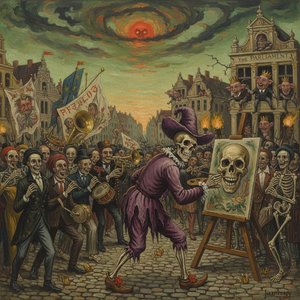
James Ensor's Grotesque Visions: Social Commentary & Artistic Innovation
Explore the unsettling yet captivating world of James Ensor, a pioneer of Expressionism. Discover his satirical masterpieces, symbolic imagery & lasting influence on modern art. High-quality reproductions available at OriginalUniqueArt.

The Enduring Legacy of Oil on Canvas: Technique, History & Aesthetic Impact
Explore the rich history & techniques of oil painting – from Renaissance masters to Impressionism. Discover pigments, layering methods, and why this timeless medium endures. Expert insights for artists & art enthusiasts.

Sir Alfred Munnings' Masterpieces: 25 Paintings That Define Equine Art | OriginalUniqueArt
Explore 25 iconic Sir Alfred Munnings paintings! Discover the beauty of British Impressionism, equine art & rural England. Find museum-quality reproductions and elevate your home decor with OriginalUniqueArt. Explore the full collection online.

Džems Abbot MekNil Whistler: 25 Remek-dela Majstora Tonalizma | OriginalUniqueArt
Istražite 25 remek-dela Džemsa Abota MekNila Whistler-a! Uronite u svet Tonalizma, portreta i prelepog pejzaža. Kupite vrhunske reprodukcije slika na OriginalUniqueArt.com i obogatite svoj enterijer luksuznom umetnošću.


